. Scientific Frontline

Tuesday, October 12, 2021

42 Asteroids in our Solar System

This poster shows 42 of the largest objects in the asteroid belt, located between Mars and Jupiter (orbits not to scale). The images in the outermost circle of this infographic have been captured with the Spectro-Polarimetric High-contrast Exoplanet REsearch (SPHERE) instrument on ESO’s Very Large Telescope. The asteroid sample features 39 objects larger than 100 kilometers in diameter, including 20 larger than 200 kilometers. The poster highlights a few of the objects, including Ceres (the largest asteroid in the belt), Urania (the smallest one imaged), Kalliope (the densest imaged) and Lutetia, which was visited by the European Space Agency’s Rosetta mission. 
Credit: ESO/M. Kornmesser/Vernazza et al./MISTRAL algorithm (ONERA/CNRS)
Click Here For Hi-Res Zoomable Image

Using the European Southern Observatory’s Very Large Telescope (ESO’s VLT) in Chile, astronomers have imaged 42 of the largest objects in the asteroid belt, located between Mars and Jupiter. Never before had such a large group of asteroids been imaged so sharply. The observations reveal a wide range of peculiar shapes, from spherical to dog-bone, and are helping astronomers trace the origins of the asteroids in our Solar System.

The detailed images of these 42 objects are a leap forward in exploring asteroids, made possible thanks to ground-based telescopes, and contribute to answering the ultimate question of life, the Universe, and everything.

“Only three large main belt asteroids, Ceres, Vesta and Lutetia, have been imaged with a high level of detail so far, as they were visited by the space missions Dawn and Rosetta of NASA and the European Space Agency, respectively,” explains Pierre Vernazza, from the Laboratoire d’Astrophysique de Marseille in France, who led the asteroid study published today in Astronomy & Astrophysics. "Our ESO observations have provided sharp images for many more targets, 42 in total."

The previously small number of detailed observations of asteroids meant that, until now, key characteristics such as their 3D shape or density had remained largely unknown. Between 2017 and 2019, Vernazza and his team set out to fill this gap by conducting a thorough survey of the major bodies in the asteroid belt.

Most of the 42 objects in their sample are larger than 100 km in size; in particular, the team imaged nearly all of the belt asteroids larger than 200 kilometers, 20 out of 23. The two biggest objects the team probed were Ceres and Vesta, which are around 940 and 520 kilometers in diameter, whereas the two smallest asteroids are Urania and Ausonia, each only about 90 kilometers.

By reconstructing the objects’ shapes, the team realized that the observed asteroids are mainly divided into two families. Some are almost perfectly spherical, such as Hygiea and Ceres, while others have a more peculiar, “elongated” shape, their undisputed queen being the “dog-bone” asteroid Kleopatra.

By combining the asteroids’ shapes with information on their masses, the team found that the densities change significantly across the sample. The four least dense asteroids studied, including Lamberta and Sylvia, have densities of about 1.3 grams per cubic centimeter, approximately the density of coal. The highest, Psyche and Kalliope, have densities of 3.9 and 4.4 grams per cubic centimeter, respectively, which is higher than the density of diamond (3.5 grams per cubic centimeter).

This large difference in density suggests the asteroids’ composition varies significantly, giving astronomers important clues about their origin. “Our observations provide strong support for substantial migration of these bodies since their formation. In short, such tremendous variety in their composition can only be understood if the bodies originated across distinct regions in the Solar System,” explains Josef Hanuš of the Charles University, Prague, Czech Republic, one of the authors of the study. In particular, the results support the theory that the least dense asteroids formed in the remote regions beyond the orbit of Neptune and migrated to their current location.

These findings were made possible thanks to the sensitivity of the Spectro-Polarimetric High-contrast Exoplanet REsearch (SPHERE) instrument mounted on ESO’s VLT. “With the improved capabilities of SPHERE, along with the fact that little was known regarding the shape of the largest main belt asteroids, we were able to make substantial progress in this field,” says co-author Laurent Jorda, also of the Laboratoire d'Astrophysique de Marseille.

Astronomers will be able to image even more asteroids in fine detail with ESO’s upcoming Extremely Large Telescope (ELT), currently under construction in Chile and set to start operations later this decade. “ELT observations of main-belt asteroids will allow us to study objects with diameters down to 35 to 80 kilometers, depending on their location in the belt, and craters down to approximately 10 to 25 kilometers in size,” says Vernazza. “Having a SPHERE-like instrument at the ELT would even allow us to image a similar sample of objects in the distant Kuiper Belt. This means we’ll be able to characterize the geological history of a much larger sample of small bodies from the ground.”

Source/Credit: ESO (European Southern Observatory)

sn101221_01
Monday, October 11, 2021

Resurrecting Quasicrystals

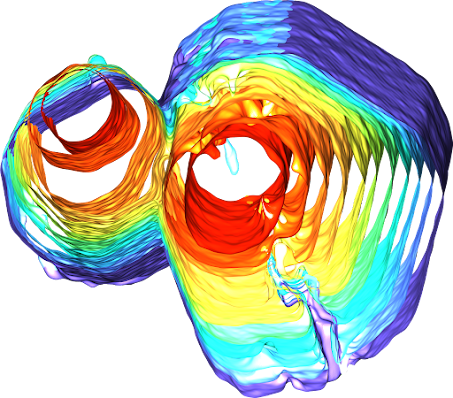
An X-ray tomography visualization shows a top-down view of two quasicrystals as they start to meld together during cooling. Image credit: Shahani Group, University of Michigan

A class of materials that once looked as if it might revolutionize everything from solar cells to frying pans—but fell out of favor in the early 2000s—could be poised for commercial resurrection, findings from a University of Michigan-led research team suggest.

Published in Nature Communications, the study demonstrates a way to make much larger quasicrystals than were possible before, without the defects that plagued past manufacturers and led quasicrystals to be dismissed as an intellectual curiosity.

“One reason why industry gave up on quasicrystals is because they’re full of defects,” said Ashwin Shahani, U-M assistant professor of materials science and engineering and chemical engineering and a corresponding author on the paper. “But we’re hoping to bring quasicrystals back into the mainstream. And this work hints that it can be done.”

Radio signals from distant stars suggest hidden planets

Using the world’s most powerful radio antenna, scientists have discovered stars unexpectedly blasting out radio waves, possibly indicating the existence of hidden planets.

The University of Queensland’s Dr Benjamin Pope and colleagues at the Dutch national observatory ASTRON have been searching for planets using the world’s most powerful radio telescope Low Frequency Array (LOFAR) situated in the Netherlands.

“We’ve discovered signals from 19 distant red dwarf stars, four of which are best explained by the existence of planets orbiting them,” Dr Pope said.

“We’ve long known that the planets of our own solar system emit powerful radio waves as their magnetic fields interact with the solar wind, but radio signals from planets outside our solar system had yet to be picked up.

“This discovery is an important step for radio astronomy and could potentially lead to the discovery of planets throughout the galaxy.”

Previously, astronomers were only able to detect the very nearest stars in steady radio emission, and everything else in the radio sky was interstellar gas, or exotica such as black holes.

Ocean life helps produce clouds, but existing clouds keep new ones at bay

The view from the DC-8 research aircraft as it flies through the marine boundary layer, the portion of the atmosphere close to the ocean’s surface where the ocean affects processes like cloud formation. Credit: Sam Hall
Stand on the ocean’s shore and take a big whiff of the salt spray and you’ll smell the unmistakably pungent scent of the sea. That ripe, almost rotting smell? That’s sulfur.

Marine plankton breathe more than 20 million tons of sulfur into the air every year, mostly in the form of dimethyl sulfide (DMS). In the air, this chemical can transform into sulfuric acid, which helps produce clouds by giving a site for water droplets to form. Over the scale of the world’s oceans, this process affects the entire climate.

But new research from the University of Wisconsin–Madison, the National Oceanic and Atmospheric Administration and others reveals that more than one-third of the DMS emitted from the sea can never help new clouds form because it is lost to the clouds themselves. The new findings significantly alter the prevailing understanding of how marine life influences clouds and may change the way scientists predict how cloud formation responds to changes in the oceans.

In plant stress response, one protein lures, binds its own killer

Postdoctoral researcher Hye Lin Park works in Gyeong Mee Yoon’s lab. Yoon,
Postdoctoral researcher Hye Lin Park works in Gyeong Mee Yoon’s lab. Yoon, an associate professor of botany and plant pathology studies the plant stress response. (Photo by Gyeong Mee Yoon)Postdoctoral researcher Hye Lin Park works in Gyeong Mee Yoon’s lab. Yoon, an associate professor of botany and plant pathology studies the plant stress response. (Photo by Gyeong Mee Yoon)an associate professor of botany and plant pathology studies the plant stress response.
(Photo by Gyeong Mee Yoon)
Like the plot of a mystery novel, research has found a twist in the way plants cannibalize their own cells to survive under stress.

In response to drought, cold, lack of sunlight and other stress, cellular proteins interact in different ways to help a plant survive. A primary protective act is the destruction and recycling of some of the plant’s own cellular materials into what is needed for others.

A Purdue University-led research team has identified proteins involved in this protective process and discovered how they act upon each other. A better understanding of these mechanisms could lead to ways to help plants withstand severe conditions.

Method recycles batteries faster, with less environmental impact

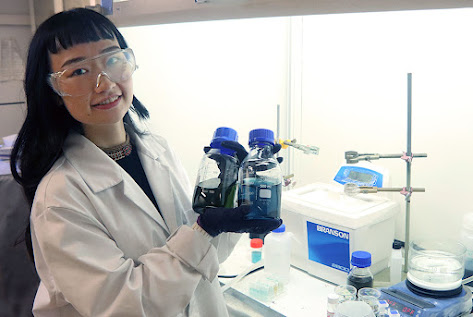
KTH scientist Xiong Xiao uses ultrasound in combination with acetic acid and citric acid, instead of sulfuric acid, to extract the metals from the batteries.
Photo: Peter Ardell
As the electrification of society increases, so does the amount of used batteries that need to be recycled. Scientists at KTH have developed a new method to recycle valuable metals from used lithium batteries.

Is it possible to extract metals from a lithium battery in half the time it normally takes? Is it possible to use acids that are common in most homes worldwide for the extraction process? The answer is yes. Scientists at KTH have discovered a way.

In a scientific article published by the journal Green Chemistry scientist Xiong Xiao, a postdoc at the Division of Polymeric Materials at KTH, explains how it works using ultrasound.

“We perform the metal extraction in half the time it normally takes and we take out more metal ion than normally reported in scientific literature. In the extraction process we use mild acids such as acetic acid and citric acid instead of sulfuric acid, which is very beneficial from a work environment and sustainable development point of view,” says Xiong Xiao.

Primates’ ancestors may have left trees to survive asteroid

Photo by Francesco Ungaro from Pexels

 When an asteroid struck 66 million years ago and wiped out dinosaurs not related to birds and three-quarters of life on Earth, early ancestors of primates and marsupials were among the only tree-dwelling (arboreal) mammals that survived, according to a new study.

Arboreal species were especially at risk of extinction due to global deforestation caused by wildfires from the asteroid’s impact.

In the study, computer models, fossil records and information from living mammals revealed that most of the surviving mammals did not rely on trees, though the few arboreal mammals that lived on – including human ancestors – may have been versatile enough to adapt to the loss of trees.

The study points to the influence of this extinction event, known as the Cretaceous-Paleogene (K-Pg) boundary, on shaping the early evolution and diversification of mammals.

“One possible explanation for how primates survived across the K-Pg boundary, in spite of being arboreal, might be due to some behavioral flexibility, which may have been a critical factor that let them survive,” said Jonathan Hughes, the paper’s co-first author and a doctoral student in the lab of Jeremy Searle, professor of ecology and evolutionary biology in the College of Agriculture and Life Sciences. Co-first author Jacob Berv, Ph.D. ’19, is currently a Life Sciences Fellow at the University of Michigan.

Mushroom consumption may lower risk of depression

Image: Pexel
Mushrooms have been making headlines due to their many health advantages. Not only do they lower one’s risk of cancer and premature death, but new research led by Penn State College of Medicine also reveals that these superfoods may benefit a person’s mental health.

Penn State researchers used data on diet and mental health collected from more than 24,000 U.S. adults between 2005 and 2016. They found that people who ate mushrooms had lower odds of having depression.

According to the researchers, mushrooms contain ergothioneine, an antioxidant that may protect against cell and tissue damage in the body. Studies have shown that antioxidants help prevent several mental illnesses, such as schizophrenia, bipolar disorder and depression.

“Mushrooms are the highest dietary source of the amino acid ergothioneine — an anti-inflammatory which cannot be synthesized by humans,” said lead researcher Djibril Ba, who recently graduated from the epidemiology doctoral program at the College of Medicine. “Having high levels of this may lower the risk of oxidative stress, which could also reduce the symptoms of depression.”

Serotonin stabilizes social memories

Who wouldn’t like to be better at remembering people you meet, even after a brief introduction?

New research by scientists affiliated with the Wu Tsai Neurosciences Institute at Stanford has shown this could be achieved through targeted stimulation of the brain’s serotonin system.

In a study published in Nature, the Stanford team was able to observe for the first time how the mouse brain forms a memory of a new acquaintance and demonstrated the ability to selectively dampen or enhance these social memories with targeted drugs.

Rob Malenka, MD.
Image credit: Stanford Medicine
“We identified neurons that appear to tell a mouse that it's interacting with a new animal with a different smell, a different looking face, distinct posture, etc, and generate a new memory trace for that individual,” said Robert Malenka, MD, the Nancy Friend Pritzker Professor of Psychiatry and Behavioral Sciences at Stanford Medicine. “By tuning that neural activity up and down, we were able to change how well animals remembered this new individual later on.”

“Like us, mice live in social groups, and need to be able to quickly remember if another animal is a family member, a former aggressor, a potential mate, and so on,” added Xiaoting Wu, PhD, a postdoctoral researcher in Malenka’s laboratory and the lead author of the new study. “This finding is really exciting because it represents the very earliest stage of social memory — an ability to remember new individuals that can then be built upon by future experiences.”

The research adds to a growing body of work by the Malenka lab showing how serotonin and other neuromodulatory chemicals control social cognition in the brain, and represents a promising step towards targeted treatments that could one day improve impaired social function in disorders such as autism, depression, and post-traumatic stress disorder (PTSD).

Saturday, October 9, 2021

Pandemic linked to rising rates of depressive and anxiety disorders

Cases of major depressive disorder and anxiety disorders have increased by more than 25 per cent worldwide, according to a world-first study of the impact of COVID-19 on mental health.

The research, led by researchers from The University of Queensland’s School of Public Health, Queensland Centre for Mental Health Research and Institute for Health Metrics and Evaluation (University of Washington) estimated people living in countries severely impacted by the COVID-19 pandemic have been most affected, especially women and younger people.

The study is the first to assess global impacts of the pandemic on major depressive and anxiety disorders, quantifying the prevalence and burden of the disorders by age, sex, and location in 204 countries and territories in 2020.

Study leader Dr Damian Santomauro said countries hit hardest by the pandemic in 2020 had the greatest rise in prevalence of the disorders.

“We estimated that cases of major depressive disorder and anxiety disorders increased by 28 per cent and 26 per cent, respectively in 2020, with women affected more than men, and younger people affected more than older age groups,” Dr Santomauro said.

“Countries with high COVID-19 infection rates and major reductions in the movement of people – a consequence of measures such as lockdowns and school closures – were found to have the greatest increases in prevalence of major depressive disorder and anxiety disorders.”

Featured Article

What Is: Theory of Mind

Scientific Frontline: Extended "At a Glance" Summary : Theory of Mind The Core Concept : Theory of Mind is the advanced neurocompu...

Top Viewed Articles