
 |
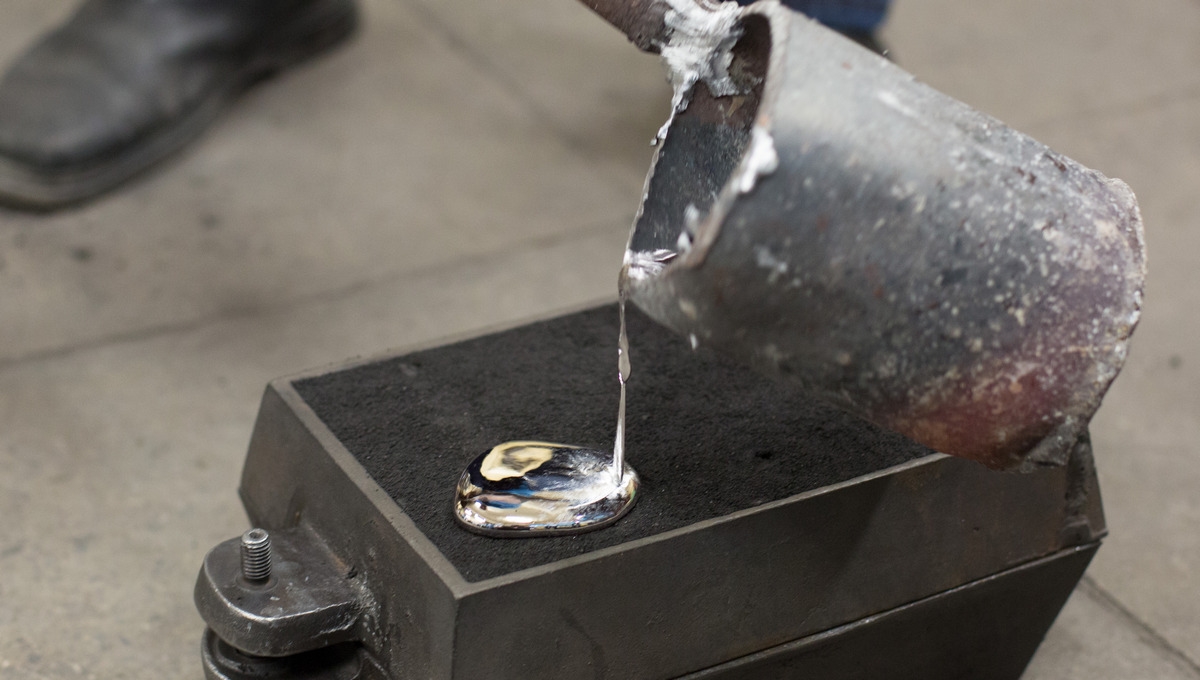
| The melt viscosity determines the choice of casting mode, ingot formation conditions and other parameters. Photo Credit: Ilya Safarov |
Scientists at the Institute of Metallurgy, Ural Branch of the Russian Academy of Sciences, and Ural Federal University have developed a method for theoretically high-precision determination of the viscosity of liquid metals using a trained artificial neural network. The method was successfully tested in the process of building the deep learning potential of the neural network on the example of liquid gallium. Scientists were able to significantly increase the spatiotemporal scale of the simulation. The results of molecular dynamics modeling of liquid gallium are particularly accurate. Previous calculations were notoriously inaccurate, especially in the low temperature range. An article describing the research was published in the journal Computational Materials Science.
"First, liquids are in principle difficult to be described theoretically. The reason, in our opinion, lies in the absence of a simple initial approximation for this class of systems (for example, the initial approximation for gases is the ideal gas model). Secondly, the atomistic calculation of viscosity requires processing of a large volume of statistical data and, at the same time, a large accuracy of description of the potential energy surface and forces acting on atoms. Direct calculations cannot achieve such an effect. Thirdly, gallium in the liquid state is difficult to describe theoretically, because, due to certain features, its structure differs from that of most other metals," explains Vladimir Filippov, Senior Researcher at the Department of Rare Metals and Nanomaterials at UrFU, research participant and co-author of the article.


.jpg)

.jpg)

.jpg)
.jpg)
.jpg)
.png)


.jpg)