. Scientific Frontline

Friday, January 20, 2023

Malformed seashells, ancient sediment provide clues about Earth’s past

A drone photo of the JOIDES Resolution in the Mentelle Basin, where Northwestern scientists drilled for ancient sediment.
Photo Credit: Gabriele Tagliaro, University Sao Paulo

Nearly 100 million years ago, the Earth experienced an extreme environmental disruption that choked oxygen from the oceans and led to elevated marine extinction levels that affected the entire globe. 

Now, in a pair of complementary new studies, two Northwestern University-led teams of geoscientists report new findings on the chronology and character of events that led to this occurrence, known as Ocean Anoxic Event 2 (OAE2), which was co-discovered more than 40 years ago by late Northwestern professor Seymour Schlanger. 

By studying preserved planktonic microfossils and bulk sediment extracted from three sites around the world, the team collected direct evidence indicating that ocean acidification occurred during the earliest stages of the event, due to carbon dioxide (CO2) emissions from the eruption of massive volcanic complexes on the sea floor.

In one of the new studies, the researchers also propose a new hypothesis to explain why ocean acidification led to a strange blip of cooler temperatures (dubbed the “Plenus Cold Event”), which briefly interrupted the otherwise intensely hot greenhouse period.

Algae Can Help Dispose of Hazardous Substances and Produce Bioethanol

Algae can absorb zinc, magnesium, iron, aluminum, silicon and lead.
Photo Credit: Rodion Narudinov

Scientists of the Ural Federal University have developed a technology for the production of environmentally friendly bioethanol fuel using waste heat from thermal power plants (TPP) and combined heat and power plants (CHPP) and freshwater algae produced in large quantities in cooling ponds. The use of this technology leads to a reduction in harmful emissions and makes energy production more efficient. The developers emphasize that the technology signifies a transition from hydrocarbon to green energy. An article describing the technology has been published in the International Journal of Hydrogen Energy.

TPPs and CHPPs are the main suppliers of heat, light, and hot water; at the same time, they are sources of greenhouse gas emissions generated during fuel combustion and saturated with carbon dioxide, soot, unburned particles, and various chemical substances. Another byproduct is the so-called waste heat - water heated during the cooling of superheated steam, rotating turbines of TPPs and CHPPs. The waste heat, in the form of steam, evaporates into the atmosphere in large quantities and is discharged together with industrial effluents into storage ponds. Process water containing solutions of hydrochloric acid, caustic soda, ammonia, ammonium salts, iron and other substances is discharged after flushing the flue gases and boiler units.

Researchers unravel the complex reaction pathways in zero carbon fuel synthesis

Chemical plant
Photo Credit: Robert Jones

When the eCO2EP: A chemical energy storage technology project started in 2018, the objective was to develop ways of converting carbon dioxide emitted as part of industrial processes into useful compounds, a process known as electrochemical CO2 reduction (eCO2R)

While eCO2R is not a new technique, the challenge has always been the inability to control the end products. Now, researchers from the University of Cambridge have outlined how carbon isotopes can be used to trace intermediates during the process, which will allow scientists to create more selective catalysts, control product selectivity, and promote eCO2R as a more promising production method for chemicals and fuels in the low-carbon economy. Their results are reported in the journal Nature Catalysis.

The project was led by Professor Alexei Lapkin, from Cambridge’s Centre for Advanced Research and Education in Singapore (CARES Ltd) and Professor Joel Ager, from the Berkeley Education Alliance for Research in Singapore (BEARS Ltd). Both organizations are part of the Campus for Research Excellence and Technological Enterprise (CREATE) funded by Singapore’s National Research Foundation.

Tracing the flow of water with DNA

Oliver Schilling analyzing spring water at Mount Fuji.
Photo Credit: T. Schilling

Scientific Frontline: "At a Glance" Summary

  • Main Discovery: Environmental DNA (eDNA) analysis of microbial communities serves as a reliable tracer for determining the origins and flow paths of deep groundwater systems.
  • Methodology: Researchers combined the analysis of microbial eDNA with natural inorganic tracers, including noble gases like helium and trace elements such as vanadium, to examine spring water sources on Mount Fuji.
  • Key Data: The study identified specific microbial signatures in the spring water that only survive at depths of 500 to 1,000 meters, confirming the presence of systematic deep groundwater circulation.
  • Significance: This technique provides a novel method for mapping complex hydrological cycles where standard methods fail, offering critical insights for pollution tracking and sustainable water resource management.
  • Future Application: The approach allows for the calibration of global hydrological models to predict water availability and quality, specifically aiding regions like Switzerland in assessing glacial meltwater contributions in response to climate change.
  • Branch of Science: Hydrogeology
  • Additional Detail: The study site was selected because Mount Fuji sits at the unique convergence of three tectonic plates, creating a complex geological setting that rendered traditional investigation methods ineffective.

Coating bubbles with protein results in a highly stable contrast agent for medical use

Bacteria produce gas vesicles
Image Credit: Aalto University

Inspired by the bubbles bacteria create inside their cells, researchers developed a similar system by coating tiny gas vesicles with protein. The resulting bubbles are safe, highly stable, and function as contrast agent in medical applications. They could be used to diagnose, for example, cardiological issues, blood flow, and liver lesions.

Bacteria produce gas vesicles, tiny thin-walled sacs filled with air or fluid, to help them float. This phenomenon has captured the attention of scientists who see potential for similar bubble-based designs in fields like medicine. A team of researchers at Aalto University’s Department of Applied Physics, led by Professor Robin Ras, have now used the same idea to create a new kind of contrast agent for use in medical applications such as ultrasound imaging. The research was recently published in the Proceedings of the National Academy of Sciences.

Magnetic method to clean PFAS contaminated water


Researchers at The University of Queensland have pioneered a simple, fast and effective technique to remove PFAS chemicals from water.  

Using a magnet and a reusable absorption aid that they developed, polymer chemist Dr Cheng Zhang and PhD candidate Xiao Tan at the Australian Institute for Bioengineering and Nanotechnology have cleared 95 per cent of per- and polyfluoroalkyl substances (PFAS) from a small amount of contaminated water in under a minute.

“Removing PFAS chemicals from contaminated waters is urgently needed to safeguard public and environmental health,” Dr Zhang said.

“But existing methods require machinery like pumps, take a lot of time and need their own power source.

“Our method shows it is possible to remove more of these chemicals in a way that is faster, cheaper, cleaner, and very simple.

How Huntington’s disease affects different neurons

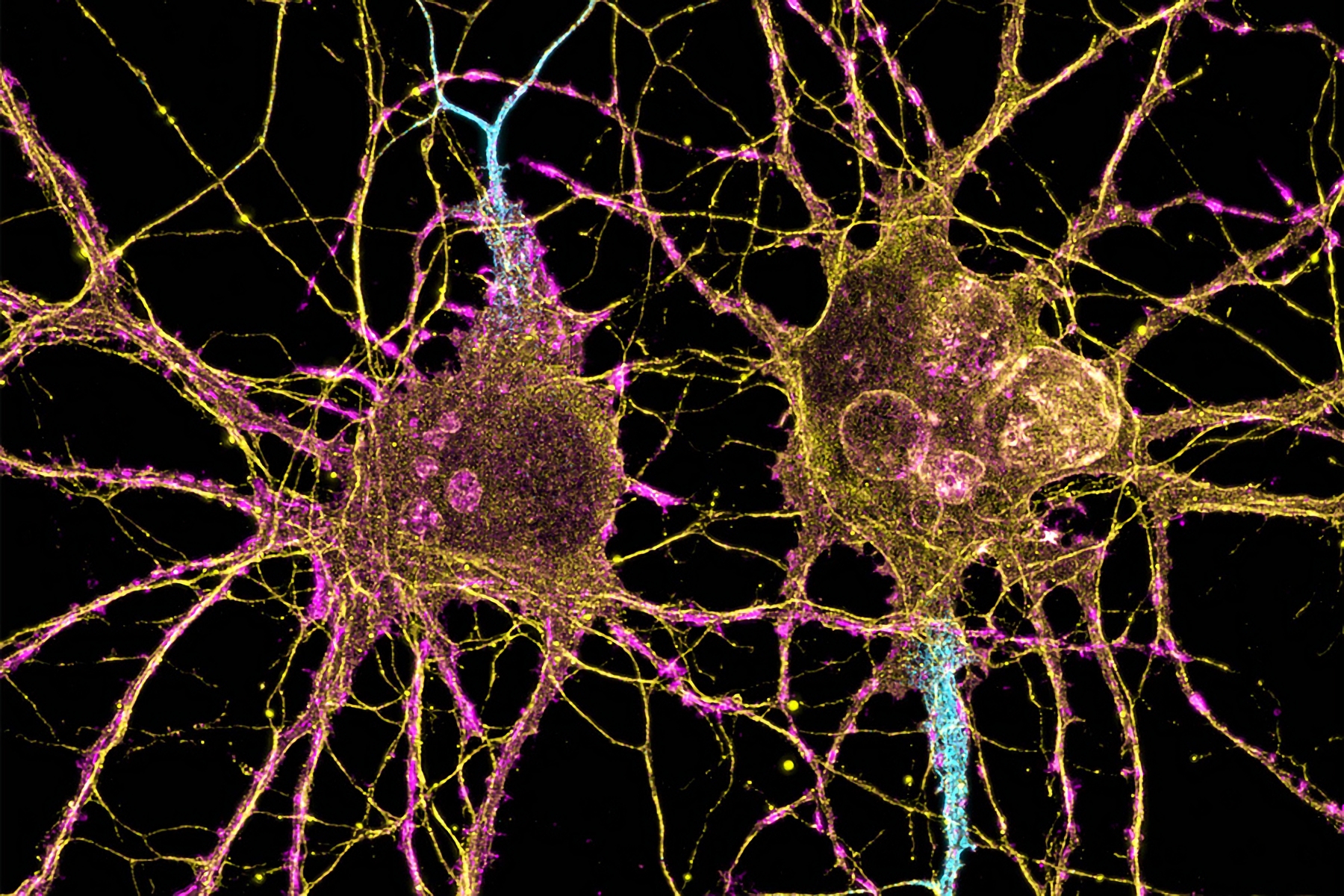
Neuroscientists at MIT have shown that two distinct cell populations in the striatum are affected differently by Huntington’s disease.
Image Credit: Leterrier, NeuroCyto Lab, INP, Marseille, France

In patients with Huntington’s disease, neurons in a part of the brain called the striatum are among the hardest-hit. Degeneration of these neurons contributes to patients’ loss of motor control, which is one of the major hallmarks of the disease.

Neuroscientists at MIT have now shown that two distinct cell populations in the striatum are affected differently by Huntington’s disease. They believe that neurodegeneration of one of these populations leads to motor impairments, while damage to the other population, located in structures called striosomes, may account for the mood disorders that are often see in the early stages of the disease.

“As many as 10 years ahead of the motor diagnosis, Huntington’s patients can experience mood disorders, and one possibility is that the striosomes might be involved in these,” says Ann Graybiel, an MIT Institute Professor, a member of MIT’s McGovern Institute for Brain Research, and one of the senior authors of the study.

Using single-cell RNA sequencing to analyze the genes expressed in mouse models of Huntington’s disease and postmortem brain samples from Huntington’s patients, the researchers found that cells of the striosomes and another structure, the matrix, begin to lose their distinguishing features as the disease progresses. The researchers hope that their mapping of the striatum and how it is affected by Huntington’s could help lead to new treatments that target specific cells within the brain.

The visibility of stars in the night sky quickly decreases

These astronaut photos of parts of Calgary (Canada) show examples of how lighting changed between 2010 and 2021. Here is a picture from 2010.
 Image Credit: Courtesy of the Earth Science and Remote Sensing Unit, NASA Johnson Space Center, georeferencing by GFZ Potsdam

This is shown by a science study based on a worldwide Citizen Science project on light pollution, which has collected data in the past eleven years.

People see fewer and fewer stars in the night sky worldwide. The cause is probably light pollution in the evening and night hours, which increases by seven to ten percent per year. This rate of change is greater than satellite measurements of artificial light missions on Earth suggested. This is the finding of a study in the science magazine, carried out by a research group led by Dr. Christopher Kyba from the German GeoForschungsZentrum GFZ and the Ruhr University Bochum with researchers from the GFZ and the NOIRLab of the US National Science Foundation. As part of the Citizen Science project "Globe at Night", they evaluated more than 50,000 observations with the naked eye of civil scientists around the world from 2011 to 2022. The study also shows that the Citizen Science data are an important addition to previous measurement methods.

Thursday, January 19, 2023

Low-impact human recreation changes wildlife behavior

Camera trap images revealed how animals changed their use of areas around hiking trails in Glacier National Park during and after a COVID-19 closure.
Photo Credit: courtesy of Mammal Spatial Ecology and Conservation Lab at Washington State University.

Even without hunting rifles, humans appear to have a strong negative influence on the movement of wildlife. A study of Glacier National Park hiking trails during and after a COVID-19 closure adds evidence to the theory that humans can create a “landscape of fear” like other apex predators, changing how species use an area simply with their presence.

Washington State University and National Park Service researchers found that when human hikers were present, 16 out of 22 mammal species, including predators and prey alike, changed where and when they accessed areas. Some completely abandoned places they previously used, others used them less frequently, and some shifted to more nocturnal activities to avoid humans.

“When the park was open to the public, and there were a lot of hikers and recreators using the area, we saw a bunch of changes in how animals were using that same area,” said Daniel Thornton, WSU wildlife ecologist and senior author on the study published in the journal Scientific Reports. “The surprising thing is that there’s no other real human disturbance out there because Glacier is such a highly protected national park, so these responses really are being driven by human presence and human noise.”

Knowledge is Flowing: Connecting the Dots and Chipping Away at Modeling Uncertainty

UConn researchers are working to improve the modeling for understanding how water moves through the ecosystem
Photo Credit: SFLORG stock image

When working to find solutions for complex problems, it can be easy to focus either too broadly or too narrowly. Oftentimes the answers lie somewhere in the middle.

UConn Department of Natural Resources and the Environment researcher James Knighton and his group are working to connect two fields of research – one with a global focus, the other with a local focus — to overcome a disconnect and improve models used for studying how water moves through the earth’s systems. The study is published in the Journal of Advances in Modeling Earth Systems.

Knighton explains that projections for climate change over the next 50 to 100 years rely on complex models called general circulation models or earth systems models.

“In those models, people try to simulate the flow of the atmosphere, the flow of the ocean, water exchanges with the continents, how that water moves as freshwater out to the ocean, and how a significant portion of it moves back to the atmosphere. About half of all rain that falls on land goes back to the atmosphere directly and most of that through plants.”

Featured Article

What Is: Quorum Sensing

Scientific Frontline: Extended "At a Glance" Summary : Quorum Sensing The Core Concept : Quorum sensing is a sophisticated, popula...

Top Viewed Articles