
 |
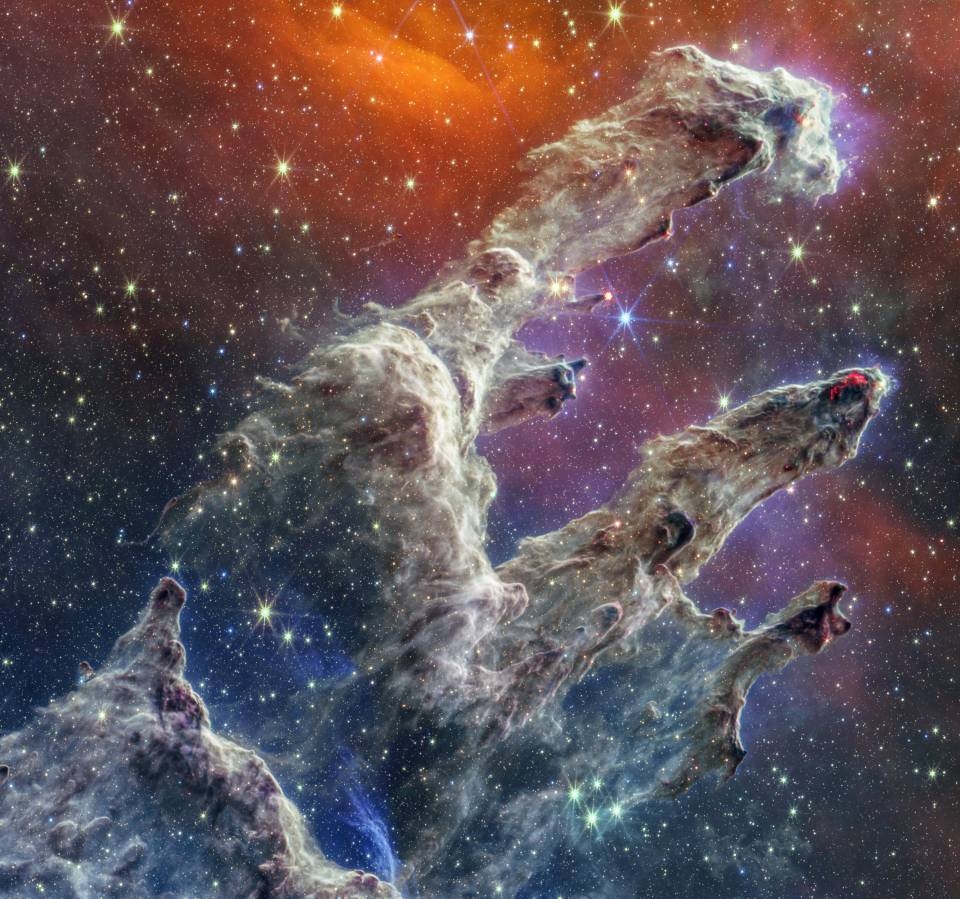
| Pillars of Creation: By combining images of the iconic Pillars of Creation from two cameras aboard NASA’s James Webb Space Telescope, the universe has been framed in its glory. The pillars are the vast clouds of dust and gas in the foreground that swirl around and form celestial bodies. Hi-Res Zoomable Image Photo Credit: JWST/NASA |
The first laboratory realization of the longstanding but never-before confirmed theory of the puzzling formation of planets, stars and supermassive black holes by swirling surrounding matter has been produced at the Princeton Plasma Physics Laboratory (PPPL). This breakthrough confirmation caps more than 20 years of experiments at PPPL, which is based at Princeton University.
The puzzle arises because matter orbiting around a central object does not simply fall into it, due to what is called the conservation of angular momentum that keeps planets and the rings of Saturn from tumbling from their orbits. That’s because the outward centrifugal force balances out the inward pull of gravity on the orbiting matter. However, the clouds of dust and plasma called accretion disks that swirl around and collapse into celestial bodies do so in defiance of the conservation of angular momentum.
The solution to this puzzle, a theory known as the Standard Magnetorotational Instability (SMRI), was first proposed in 1991 by University of Virginia theorists Steven Balbus and John Hawley. They built on the fact that in a fluid that conducts electricity, whether the fluid be plasma or liquid metal, magnetic fields behave like springs connecting different sections of the fluid. This allows ubiquitous Alfvén waves, named after Nobel Prize winner Hannes Alfvén, to create a turbulent back-and-forth force between the inertia of the swirling fluid and the springiness of the magnetic field, causing angular momentum to be transferred between different sections of the disk.


.jpg)

.jpg)


.jpg)