
 |
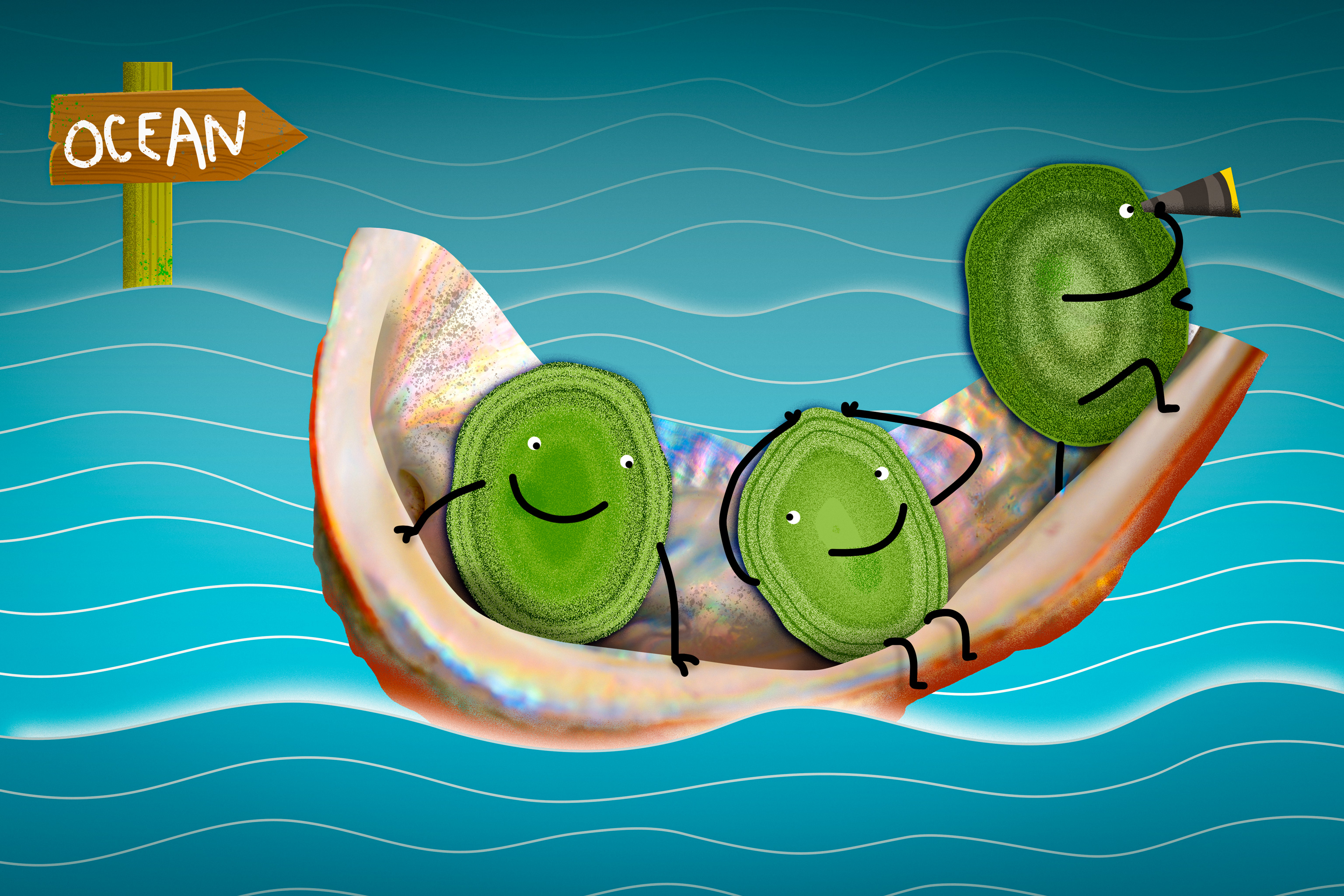
| New research suggests the Prochlorococcus microbe’s ancient coastal ancestors colonized the ocean by rafting out on chitin particles. Illustration Credit: Jose-Luis Olivares/MIT (CC BY-NC-ND 3.0) |
Throughout the ocean, billions upon billions of plant-like microbes make up an invisible floating forest. As they drift, the tiny organisms use sunlight to suck up carbon dioxide from the atmosphere. Collectively, these photosynthesizing plankton, or phytoplankton, absorb almost as much CO2 as the world’s terrestrial forests. A measurable fraction of their carbon-capturing muscle comes from Prochlorococcus — an emerald-tinged free-floater that is the most abundant phytoplankton in the oceans today.
But Prochlorococcus didn’t always inhabit open waters. Ancestors of the microbe likely stuck closer to the coasts, where nutrients were plentiful and organisms survived in communal microbial mats on the seafloor. How then did descendants of these coastal dwellers end up as the photosynthesizing powerhouses of the open oceans today?
MIT scientists believe that rafting was the key. In a new study they propose that ancestors of Prochlorococcus acquired an ability to latch onto chitin — the degraded particles of ancient exoskeletons. The microbes hitched a ride on passing flakes, using the particles as rafts to venture further out to sea. These chitin rafts may have also provided essential nutrients, fueling and sustaining the microbes along their journey.

.jpg)

.jpg)
.jpg)


.jpg)


.jpg)