 |
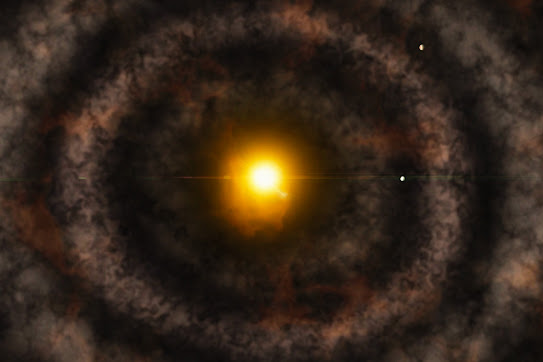
| An artist's impression of the colliding bubbles that can produce extremely low frequency gravitational waves during a cosmological phase transition in the early Universe. Image credit: Riccardo Buscicchio. |
New methods of detecting ultra-low frequency gravitational waves can be combined with other, less sensitive measurements to deliver fresh insights into the early development of our universe, according to researchers at the University of Birmingham.
Gravitational waves - ripples in the fabric of Einstein's spacetime - that cross the universe at the speed of light have all sorts of wavelengths, or frequencies. Scientists have not yet managed to detect gravitational waves at extremely low ‘nanohertz’ frequencies, but new approaches currently being explored are expected to confirm the first low frequency signals quite soon.
The main method uses radio telescopes to detect gravitational waves using pulsars – exotic, dead stars, that send out pulses of radio waves with extraordinary regularity. Researchers at the NANOGrav collaboration, for example, use pulsars to time to exquisite precision the rotation periods of a network, or array, of millisecond pulsars – astronomers’ best approximation of a network of perfect clocks - spread throughout our galaxy. These can be used to measure the fractional changes caused by gravitational waves as they spread through the universe.