
 |
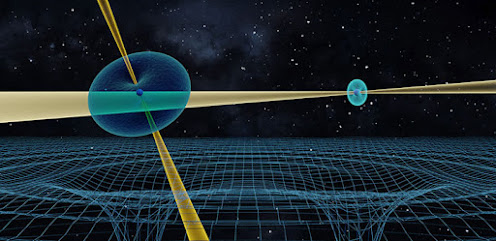
| Researchers have conducted a 16-year long experiment to challenge Einstein’s theory of general relativity. The international team looked to the stars - a pair of extreme stars called pulsars to be precise – through seven radio telescopes across the globe. Credit: Max Planck Institute for Radio Astronomy |
Scientific Frontline: "At a Glance" Summary
- Main Discovery: A 16-year international experiment utilizing a unique double pulsar system confirmed Einstein’s theory of general relativity with unprecedented precision, successfully validating seven distinct predictions including relativistic effects never previously observed.
- Methodology: Researchers employed seven sensitive radio telescopes globally to track the precise radio beams of two pulsars orbiting each other every 147 minutes, utilizing pulsar timing and interferometric measurements to map the system's intense gravitational field and distance (2,400 light-years).
- Key Statistics: The study tested the energy carried by gravitational waves with a precision 25 times greater than the Nobel Prize-winning Hulse-Taylor pulsar results and 1,000 times greater than current gravitational wave detectors, while measuring orbital orientation changes to an accuracy of one part in a million.
- Specific Mechanism: The team successfully detected the Lense-Thirring effect (frame-dragging), where the rotation of the pulsar drags the surrounding spacetime, and observed a specific light deflection angle of 0.04 degrees caused by the strong curvature of space.
- Significance: These findings represent the most rigorous test of gravity in strong-field conditions to date, confirming that general relativity holds firm even at extreme scales and setting a critical benchmark for future attempts to unify gravity with quantum mechanics.













.jpg)