
 |
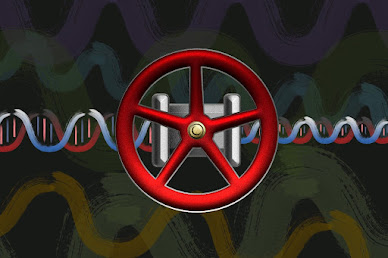
| DNA valve controlling molecular processes along DNA Credit: Thomas Gorochowski |
The work, now published in the journal Nature Communications, offers a fresh perspective on how information is encoded in DNA and new tools for building sustainable biotechnologies.
Despite being invisible to the naked eye, microorganisms are integral for our survival. They operate using DNA, often referred to as the code of life. DNA encodes numerous tools that could be useful to us, but we currently lack a complete understanding of how to interpret DNA sequences.
Matthew Tarnowski, first author and a PhD student in Bristol’s School of Biological Sciences, said: “Understanding the microbial world is tricky. While reading a microbe’s DNA with a sequencer gives us a window into the underlying code, you still need to read a lot of different DNA sequences to understand how it actually works. It’s a bit like trying to learn a new language, but from only a few small fragments of text.”
To tackle this problem, the Bristol team focused on how the information encoded in DNA is read, and specifically, how the flow of cellular processes along DNA are controlled. These biological information flows orchestrate many of the core functions of a cell and an ability to shape them would offer a way to guide cellular behaviors.
Taking inspiration from nature, where it is known that flows on DNA are often complex and interwoven, the team focused on how these flows could be regulated by creating “valves” to tune the flow from one region of DNA to another.












.jpg)