
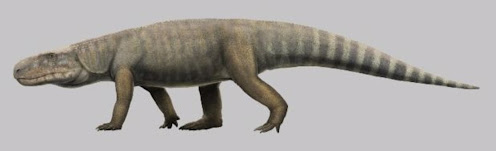
 |
| Credit: Gabriel Ugueto |
A set of Triassic archosaur fossils, excavated in the 1960s in Tanzania, have been formally recognized as a distinct species, representing one of the earliest-known members of the crocodile evolutionary lineage.
Researchers at the University of Birmingham, the Natural History Museum and Virginia Tech University have named the animal Mambawakale ruhuhu. It is among the last to be studied of a collection of fossils dug up nearly 60 years ago from the Manda Beds, a geological formation in southern Tanzania.
The remains, which are the only known example of Mambawakale ruhuhu, include a partial skull, lower jaw, several vertebrae and a hand. From these, the research team were able to identify several distinctive features that set it apart from other archosaurs found in the Manda Beds.
These included a large skull, more than 75 cm in length, and a particularly large nostril, as well as a notably narrow lower jaw and strong variation in the sizes of the teeth at the front of the upper jaws.





.jpg)