. Scientific Frontline

Monday, March 28, 2022

Promising nose spray could prevent and treat COVID-19


A newly discovered small molecule could be sprayed into people’s noses to prevent COVID-19 illness prior to exposure and provide early treatment if administered soon after infection, according to a study in mice led by Cornell researchers.

The study, published March 28 in the journal Nature, employed experimental mice engineered with human receptors for the SARS-CoV-2 virus on their cell surfaces and found that a molecule, called N-0385, inhibited entry of the virus into cells in the body. At Cornell, N-0385 was shown to protect mice from infection prior to exposure, while also providing effective treatment when administered up to 12 hours after exposure. The molecule was developed in collaboration with investigators at the Université de Sherbrooke in Quebec, Canada.

The treatment holds promise for both preventing disease and reducing severity of and mortality from COVID-19 post-infection with a few single daily doses.

“There are very few, if any, small molecule antivirals that have been discovered that work prophylactically to prevent infection,” said Hector Aguilar-Carreno, associate professor of virology in the Department of Microbiology and Immunology in the College of Veterinary Medicine, and a senior author of the paper, “A TMPRSS2 Inhibitor ACTS as a pan-SARS-CoV-2 prophylactic and therapeutic.” Other senior authors include Francois Jean, associate professor of microbiology and immunology at the University of British Columbia in Vancouver, and Richard Leduc, professor of pharmacology at the Université de Sherbrooke.

New trials for alopecia treatment are a success

A new study shows that one in three patients with a severe skin disease were able to regrow hair after being treated with a common arthritis drug.

The study is based on Phase 3 clinical trials using baricitinib, a Janus kinase (JAK) inhibitor, to treat alopecia areata, an often-disfiguring skin disease characterized by rapid loss of scalp hair, and sometimes eyebrows and eyelashes.

Phase 3 clinical trials are the final testing hurdle before a new treatment can be considered for U.S. Food and Drug Administration (FDA) approval.

“This is so exciting, because the data clearly show how effective baricitinib is,” said Dr. Brett King, an associate professor of dermatology at the Yale School of Medicine and lead author of the new study, published March 26 in the New England Journal of Medicine. “These large, controlled trials tell us that we can alleviate some of the suffering from this awful disease.”

Before and after images for participants who received 36 weeks of treatment for alopecia areata with baricitinib.

Alopecia areata is an autoimmune disorder in which the body’s immune system attacks hair follicles. More than 200,000 new cases emerge each year in the United States. Although alopecia areata can develop in patients of any age, it typically occurs in people under the age of 40.

There is currently no FDA-approved treatment for the disease.

For the new study, King and his colleagues conducted two large, randomized trials involving a total of 1,200 people. The participants were adults with severe alopecia areata, who had lost at least half of their scalp hair; many had lost all of their scalp hair.

Let quantum dots grow regularly

With this experimental setup, the researchers check the quality of the quantum dots. Green laser light is used to stimulate the quantum dots that then emit infrared light.
© İsmail Bölükbaşı

With the previous manufacturing process, the density of the structures was difficult to control. Now researchers can create a kind of checkerboard pattern. A step towards application, for example in a quantum computer.

Quantum points could one day form the basic information units of quantum computers. Researchers at the Ruhr University Bochum (RUB) and the Technical University of Munich (TUM) have significantly improved the manufacturing process for these tiny semiconductor structures, together with colleagues from Copenhagen and Basel. The quantum dots are generated on a wafer, a thin semiconductor crystal disc. So far, the density of the structures on it has been difficult to control. Now scientists can create specific arrangements - an important step towards an applicable component that should have a large number of quantum dots.

The team published the results on 28. March 2022 in the journal Nature Communications. A group led by Nikolai Bart, Prof. Dr. Andreas Wieck and Dr. Arne Ludwig from the RUB Chair for Applied Solid State Physics with the team around Christian Dangel and Prof. Dr. Jonathan Finley from the TUM working group semiconductor nanostructures and quantum systems as well as with colleagues from the universities of Copenhagen and Basel.

A tool for predicting the future

MIT researchers created a tool that enables people to make highly accurate predictions using multiple time-series data with just a few keystrokes. The powerful algorithm at the heart of their tool can transform multiple time series into a tensor, which is a multi-dimensional array of numbers (pictured). Credits: Figure courtesy of the researchers Source: MIT

Whether someone is trying to predict tomorrow’s weather, forecast future stock prices, identify missed opportunities for sales in retail, or estimate a patient’s risk of developing a disease, they will likely need to interpret time-series data, which are a collection of observations recorded over time.

Making predictions using time-series data typically requires several data-processing steps and the use of complex machine-learning algorithms, which have such a steep learning curve they aren’t readily accessible to nonexperts.

To make these powerful tools more user-friendly, MIT researchers developed a system that directly integrates prediction functionality on top of an existing time-series database. Their simplified interface, which they call tspDB (time series predict database), does all the complex modeling behind the scenes so a nonexpert can easily generate a prediction in only a few seconds.

The new system is more accurate and more efficient than state-of-the-art deep learning methods when performing two tasks: predicting future values and filling in missing data points.

NUS-Monash University collaboration produces universal flu vaccine candidate

Current influenza vaccines have shortcomings
Credit: NUS Yong Loo Lin School of Medicine

Influenza, commonly referred to as “flu”, is a major global public health concern and a huge economic burden to societies. Seasonal influenza epidemics afflict between 13 to 100 million individuals annually, including three to five million cases of severe illness and 300,000 to 600,000 deaths worldwide. This represents a top global public health concern and an extraordinary economic burden to all societies. Pandemics are less frequent, but are generally more severe and pose a greater threat. Over the past century, there have been at least four devastating pandemics caused by Influenza A virus which took the lives of hundreds of millions of individuals.

Although vaccination arguably represents the most effective way to prevent influenza, current vaccination strategies suffer from certain limitations, chief of which require current influenza vaccines to be updated annually to match circulating strains. This results in low vaccination take-up rates and poor coverage due to inaccurate prediction of circulating strains. Broadly protective, “universal” flu vaccines that do not need to be updated annually have therefore been pursued.

Sunday, March 27, 2022

What Mercury’s Unusual Orbit Reveals About the Sun


Mercury is special. As the closest planet to the Sun, it occupies a region where the Sun’s influence is changing dramatically. The Sun’s magnetic field, which dominates space close to the Sun, is rapidly waning. And Mercury’s orbit – more elliptical or “oval-shaped” than any other planet – allows it to experience a wider range of solar magnetic field conditions than any other planet. As a result, Mercury provides a unique opportunity to study how the Sun’s influence on a planet varies with distance.

In a new study published in Nature Communications, Goddard scientists Norberto Romanelli and Gina DiBraccio used data from NASA’s MESSENGER spacecraft to study the Sun’s changing interaction with Mercury. As Mercury moves through the solar wind, the steady stream of particles escaping the Sun, some of them strike Mercury’s magnetosphere and bounce back towards the Sun. These rebounding solar wind particles generate low-frequency waves that reverberate through space, traveling “upstream” in the solar wind towards the Sun.

Saturday, March 26, 2022

A better way to separate gases

A new membrane material, pictured here, could make purification of gases significantly more efficient, potentially helping to reduce carbon emissions.
Credits: Courtesy of the researchers

Industrial processes for chemical separations, including natural gas purification and the production of oxygen and nitrogen for medical or industrial uses, are collectively responsible for about 15 percent of the world’s energy use. They also contribute a corresponding amount to the world’s greenhouse gas emissions. Now, researchers at MIT and Stanford University have developed a new kind of membrane for carrying out these separation processes with roughly 1/10 the energy use and emissions.

Using membranes for separation of chemicals is known to be much more efficient than processes such as distillation or absorption, but there has always been a tradeoff between permeability — how fast gases can penetrate through the material — and selectivity — the ability to let the desired molecules pass through while blocking all others. The new family of membrane materials, based on “hydrocarbon ladder” polymers, overcomes that tradeoff, providing both high permeability and extremely good selectivity, the researchers say.

The findings are reported in the journal Science, in a paper by Yan Xia, an associate professor of chemistry at Stanford; Zachary Smith, an assistant professor of chemical engineering at MIT; Ingo Pinnau, a professor at King Abdullah University of Science and Technology, and five others.

Red-backed salamanders possess only limited ability to adjust to warming climate

To stay cool and not burn energy, salamanders have evolved strategies such as burrowing under rocks and logs. But if they are hiding to stay cool for much longer periods, they are not foraging and eating, and at the end of a long summer their condition deteriorates.
Credit: David Munoz

If average temperatures rise as projected in eastern North America in coming decades, at least one widespread amphibian species likely will be unable to adjust, and its range may shift northward, according to a new study led by Penn State scientists.

In a novel experiment, researchers devised a method to measure the metabolic rate of red-backed salamanders from different regions exposed to warmer temperatures — analyzing how much more energy the small, hardy woodland amphibians would expend to survive in the forests they now inhabit from Quebec south to North Carolina, and west to Missouri and Minnesota.

To stay cool and not burn energy, salamanders have evolved strategies such as burrowing under rocks and logs, explained study co-author David Miller, associate professor of wildlife population ecology. But if they are hiding to stay cool for much longer periods, they are not foraging and eating, and at the end of a long summer their condition deteriorates.

Friday, March 25, 2022

Quantum Physics Sets a Speed Limit to Electronics

An ultra-short laser pulse (blue) creates free charge carriers, another pulse (red) accelerates them in opposite directions.
Credit: Vienna University of Technology

Semiconductor electronics is getting faster and faster - but at some point, physics no longer permits any increase. The shortest possible time scale of optoelectronic phenomena has now been investigated.

How fast can electronics be? When computer chips work with ever shorter signals and time intervals, at some point they come up against physical limits. The quantum-mechanical processes that enable the generation of electric current in a semiconductor material take a certain amount of time. This puts a limit to the speed of signal generation and signal transmission.

TU Wien (Vienna), TU Graz and the Max Planck Institute of Quantum Optics in Garching have now been able to explore these limits: The speed can definitely not be increased beyond one petahertz (one million gigahertz), even if the material is excited in an optimal way with laser pulses. This result has now been published in the scientific journal "Nature Communications".

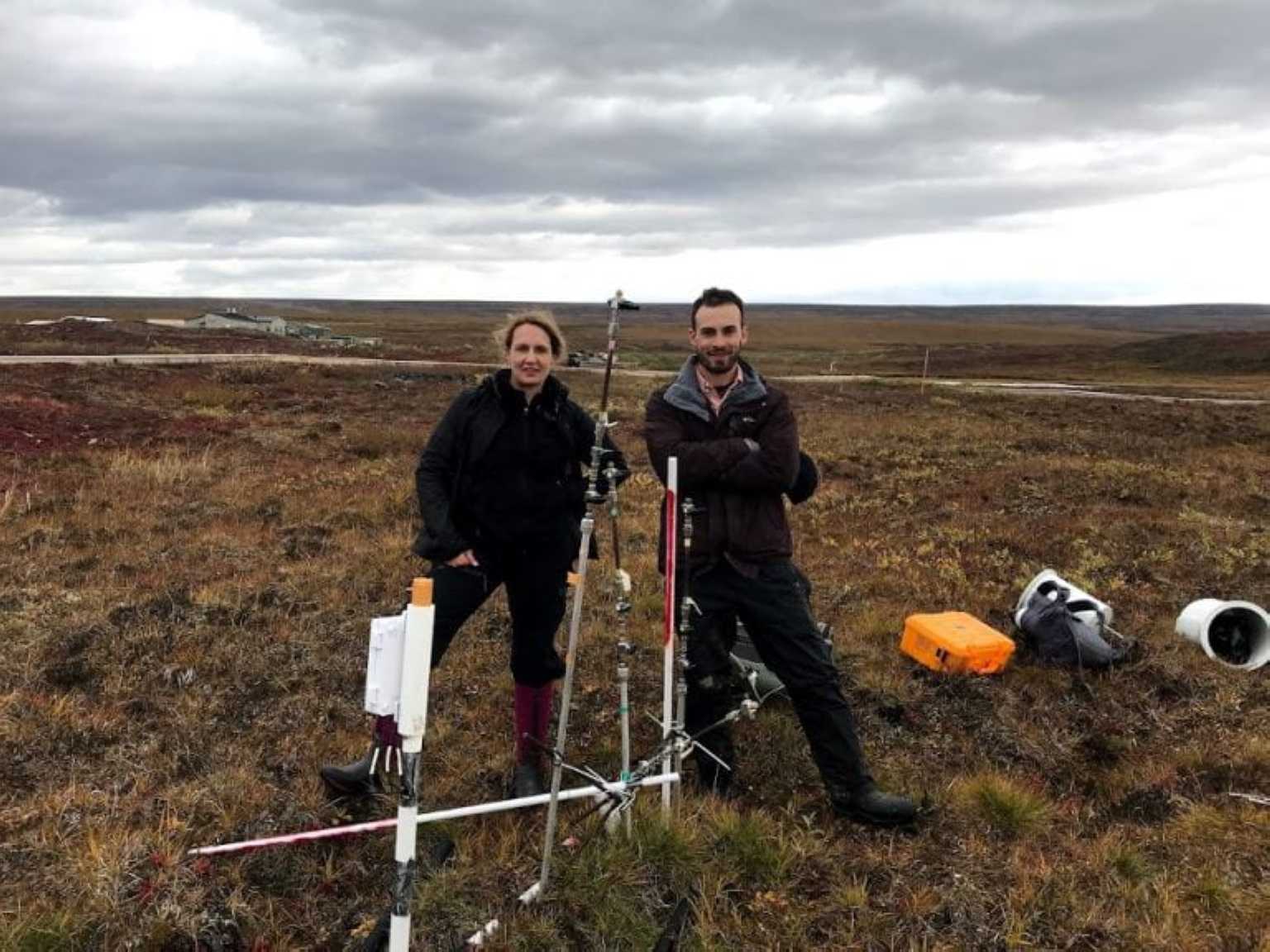
Researchers first to sample permafrost CO2 emissions during fall and winter

A soil sampling device used by Claudia Czimczik (left), UCI professor of Earth system science, and Shawn Pedron, UCI post-doctoral scholar in Earth system science, enabled the researchers to study permafrost at various depths to measure CO2 emissions from Arctic tundra permafrost. The photo was taken at the NSF Toolkit Field Station in Alaska in August 2019.
Credit: Claudia Czimzcik / UCI

The Arctic is warming along with the rest of the planet, and as this is happening, its permafrost – perennially frozen arctic soil that holds a lot of trapped organic matter from dead plants – is thawing. As the permafrost thaws, the organic matter it holds is thawing, too, and this is opening the door for microorganisms to decompose that matter and, in the process, release climate-warming greenhouse gases like carbon dioxide and methane into the atmosphere.

In new research published on today in the journal Geophysical Research Letters, a team led by scientists at the University of California, Irvine report for the first-time direct measurements of the gases emitted from permafrost during the fall and winter months – measurements that can help fill in gaps in permafrost emissions estimates that climate scientists have until now missed.

“It’s the first time we are able to look at the carbon sources that fuel carbon emissions during the fall and winter periods,” said Claudia Czimczik, a professor of Earth system scientist at UCI who’s the senior author of the new study.

Researchers discover new tools in regular blood samples for developing precision therapies for lymphoma

Image: Leppä lab
In a recently completed study, researchers from the University of Helsinki and Helsinki University Hospital Comprehensive Cancer Center investigated the characteristics and clinical significance of circulating tumor DNA (ctDNA) found in the blood of patients with aggressive lymphoma. The study was carried out through Nordic collaboration.

Analyzed in the study were blood samples of lymphoma patients treated in a Nordic Lymphoma Group trial, which were collected before, at the mid-point of and after treatment.

Increasingly accurate diagnostics and more effective therapies

“The analysis of ctDNA in the blood samples revealed significant diagnostic features, not all of which were found in regular tumour biopsies,” says Professor Sirpa Leppä from the University of Helsinki and the HUS Comprehensive Cancer Center.

The researchers found that the concentration of ctDNA in blood before therapy varied considerably between patients and was comparable to the combined volume of the malignant tumors.

“Patients with the highest ctDNA levels at the time of lymphoma diagnosis had the poorest survival probability,” explains MD and PhD student Leo Meriranta.

At the same time, changes in ctDNA concentration during therapy reflected treatment responses in that the patients whose lymphoma was unaffected by the treatment were distinguished from other patients by the ctDNA analyses carried out using the follow-up blood samples.

Ultraviolet Light Can Clean N95 Masks for Reuse Without Hindering Performance

The N95 mask owes its remarkable filtering ability to its three-layer structure. While the fibers in the outer- and innermost layers block large particles such as water droplets, the middle is where much finer, charged fibers electrically attract and trap tiny, submicron aerosols.
Credits: SEM images by A. Vladar/NIST, animation by J. Wang/NIST

To combat COVID-19 amid supply shortages in 2020, health care facilities across the U.S. resorted to disinfecting personal protective equipment (PPE), such as N95 masks, for reuse with methods such as ultraviolet (UV) light. But questions lingered about the safety and efficacy of these methods and how best to implement them. 

Now, in perhaps the most rigorous examination of UV light’s effects on N95 masks yet, researchers at the National Institute of Standards and Technology (NIST) have shown that these masks can be disinfected with little impact on their form or function. In a new study published in the Journal of Research of the National Institute of Standards and Technology, the researchers, with help from federal and private partners, scrutinized UV-exposed N95 masks for traces of virus and looked for changes in the shape of their fibers, ability to filter out aerosols and other properties. 

The results represent a key step toward devising UV standards that could have far-reaching benefits in the future.

Enhancing the electromechanical behavior of a flexible polymer

Qiming Zhang, distinguished professor of electrical engineering, led a team of researchers to develop a robust piezoelectric material that can convert mechanical stress into electricity.
Credit: Tyler Henderson/Penn State

Piezoelectric materials convert mechanical stress into electricity, or vice versa, and can be useful in sensors, actuators and many other applications. But implementing piezoelectrics in polymers — materials composed of molecular chains and commonly used in plastics, drugs and more — can be difficult, according to Qiming Zhang, distinguished professor of electrical engineering.

Zhang and a Penn State-led team of interdisciplinary researchers developed a polymer with robust piezoelectric effectiveness, resulting in 60% more efficient electricity generation than previous iterations. They published their results today (Mar. 25) in Science

“Historically, the electromechanics coupling of polymers has been very low,” Zhang said. “We set out to improve this because the relative softness of polymers makes them excellent candidates for soft sensors and actuators in a variety of areas, including biosensing, sonar, artificial muscles and more.”

To create the material, the researchers deliberately implemented chemical impurities into the polymer. This process, known as doping, allows researchers to tune the properties of a material to generate desirable effects — provided they integrate the correct number of impurities. Adding too little of a dopant could prevent the desired effect from initiating, while adding too much could introduce unwanted traits that hamper the material’s function.  

Breakthrough application of moisture-trapping film


The team comprises Asst Prof Tan Swee Ching (front right), doctoral student Ms Yang Jiachen (third from right) and researchers from HTX.
Credit: National University of Singapore

A team of researchers from the National University of Singapore (NUS) has developed a novel super-hygroscopic material that enhances sweat evaporation within a personal protective suit, to create a cooling effect for better thermal comfort for users such as healthcare workers and other frontline officers. This invention was validated through laboratory tests conducted in collaboration with researchers from HTX (Home Team Science & Technology Agency) in Singapore.

The new desiccant film, which is biocompatible and non-toxic, has a fast absorption rate, high absorption capacity and excellent mechanical properties. This means that the material is very robust and durable for practical applications such as for protective suits worn by healthcare workers. It is also affordable, light-weight, easy to fabricate and reusable.

“Under room temperature of about 35 deg. C, a healthcare worker who doesn't wear a protective suit for one hour typically experiences a heat index of about 64 deg. C. This causes discomfort and prolong thermal strain can result in heat stroke and even death. Our novel composite moisture-trapping film achieves a cooling effect within the protective suit via evaporative cooling – by increasing sweat evaporation from the skin,” explained research team leader Assistant Professor Tan Swee Ching, who is from the Department of Materials Science and Engineering under the NUS College of Design and Engineering.

Molecular key may unlock new treatments for neurodegenerative disorders

Structure of SARM1 in complex with inhibitor.
Credit: Thomas Ve
Researchers have worked out how to successfully switch off a key pathway of nerve fiber breakdown in debilitating neurodegenerative disorders such as Parkinson’s disease, traumatic brain injury and glaucoma.

The study, led by Griffith University’s Institute for Glycomics and Disarm® Therapeutics, a wholly owned subsidiary of pharmaceutical company Eli Lilly, reveals the structural processes behind activation and inhibition of SARM1, a key molecule in the destruction of nerve fibers.

“As a trigger for nerve fiber degeneration, understanding how the enzyme SARM1 works may help us treat several neurodegenerative conditions,” said Dr Thomas Ve from the Institute for Glycomics.

“In this study we show the molecular interactions that can switch SARM1 on and off. This gives us a clear avenue for the design of new drug therapeutics.”

In neurodegenerative conditions like peripheral neuropathy, Parkinson’s disease, amyotrophic lateral sclerosis (ALS), traumatic brain injury and glaucoma, when the nerve fibers are damaged, SARM1 is activated.

“This sparks a cascade of molecular processes that leads to the self-destruction of the nerve cell’s axon, the cable that carries electric impulse away from the body of the nerve cell to the next,’’ Dr Ve said.

Featured Article

What Is: Macrophage

A realistic scientific visualization of a macrophage, a crucial immune cell, actively engulfing bacteria with its extended pseudopods. The i...

Top Viewed Articles