. Scientific Frontline

Monday, August 1, 2022

NIST Researchers Develop Miniature Lens for Trapping Atoms

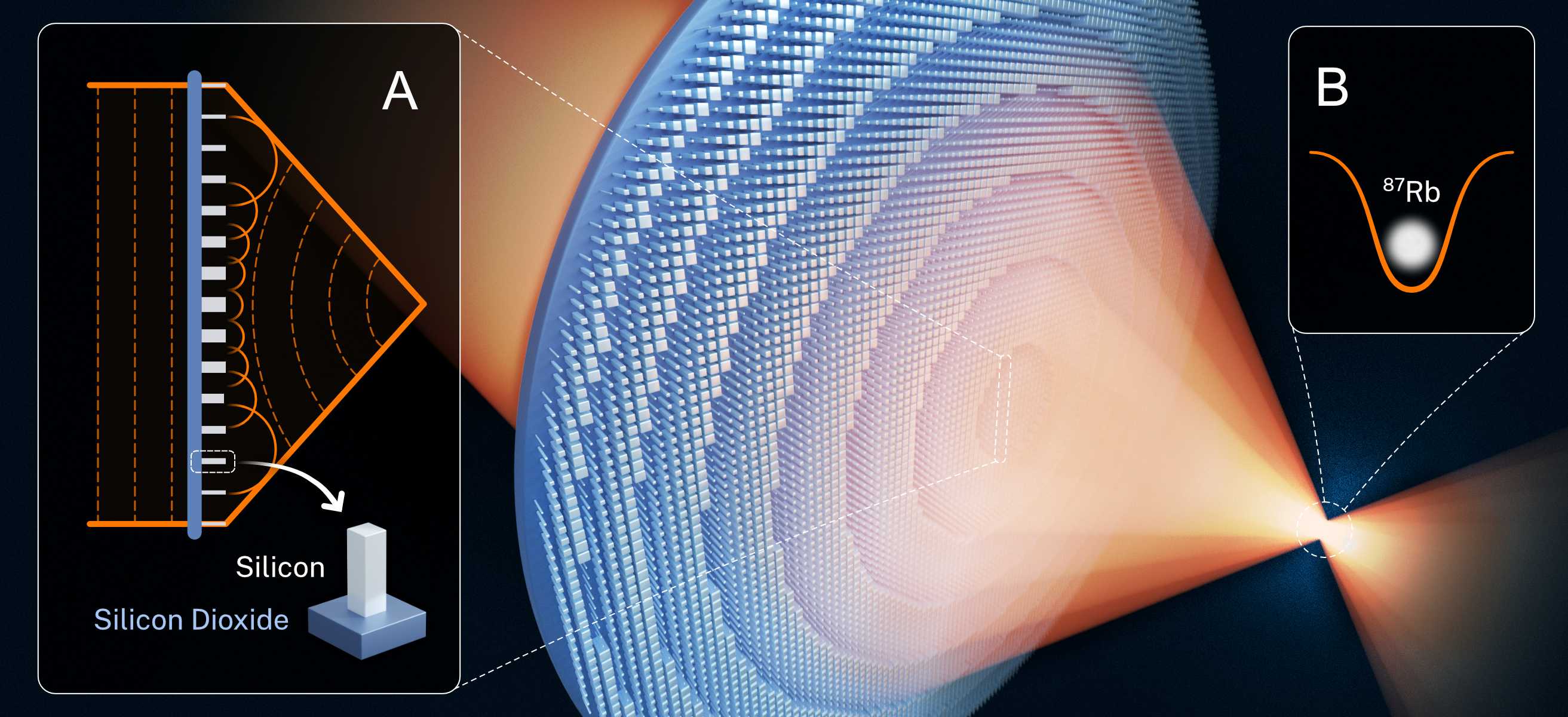
Graphical illustration of light focusing using a planar glass surface studded with millions of nanopillars (referred to as a metalens) forming an optical tweezer. (A) Device cross section depicts plane waves of light that come to a focus through secondary wavelets generated by nanopillars of varying size. (B) The same metalens is used to trap and image single rubidium atoms.
Credit: Sean Kelley/NIST

Atoms are notoriously difficult to control. They zigzag like fireflies, tunnel out of the strongest containers and jitter even at temperatures near absolute zero.

Nonetheless, scientists need to trap and manipulate single atoms in order for quantum devices, such as atomic clocks or quantum computers, to operate properly. If individual atoms can be corralled and controlled in large arrays, they can serve as quantum bits, or qubits — tiny discrete units of information whose state or orientation may eventually be used to carry out calculations at speeds far greater than the fastest supercomputer.

Researchers at the National Institute of Standards and Technology (NIST), together with collaborators from JILA — a joint institute of the University of Colorado and NIST in Boulder — have for the first time demonstrated that they can trap single atoms using a novel miniaturized version of “optical tweezers” — a system that grabs atoms using a laser beam as chopsticks.

Ordinarily, optical tweezers, which garnered the 2018 Nobel Prize in Physics, feature bulky centimeter-size lenses or microscope objectives outside the vacuum holding individual atoms. NIST and JILA have previously used the technique with great success to create an atomic clock.

In the new design, instead of typical lenses, the NIST team used unconventional optics — a square glass wafer about 4 millimeters in length imprinted with millions of pillars only a few hundreds of nanometers (billionths of a meter) in height that collectively act as tiny lenses. These imprinted surfaces, dubbed metasurfaces, focus laser light to trap, manipulate and image individual atoms within a vapor. The metasurfaces can operate in the vacuum where the cloud of trapped atoms is located, unlike ordinary optical tweezers.

Triazavirin to Be Tested for Effectiveness Against Tick-Borne Encephalitis

Triazavirin was developed by scientists of the Ural Federal University and the Ural Branch of the Russian Academy of Sciences.
Credit: UrFU Press Service

The scientific community has provided research recommendations

The Medsintez plant, the manufacturer of the antiviral drug Triazavirin, plans to conduct studies of the drug for effectiveness against tick-borne encephalitis. Aleksandr Petrov, Chairman of the Board of Directors of the Medsintez Plant LLC, notes that the company has already received recommendations from the scientific community. This was reported by TASS.

"The effectiveness of Triazavirin against tick-borne encephalitis is a very interesting topic to study. Scientists are already saying that the drug can be effective against this virus. Currently we are guided by the opinion of scientists, that is why we are considering the possibility of conducting such studies," said Petrov.

He stressed that this year in some regions there is a high activity of ticks and increased detection of cases of encephalitis, that is why Triazavirin research in this area is relevant.

Reference:
Medsintez plant is located in Novouralsk (Sverdlovsk region). It specializes in the production of pharmaceutical products. The plant produces infusion solutions, ready forms of genetically engineered human insulin, solid and liquid forms of drugs. The plant manufactures licensed products and is engaged in the creation of new drugs.

Source/Credit: Ural Federal University

phar080122_01

Black cardamom effective against lung cancer cells

NUS researchers embarked on a scientific study of black cardamom, a spice used in Indian Ayurvedic medicine, as a source of potent bioactive compounds that are effective against lung cancer cells. Source: National University of Singapore

The main challenges associated with existing lung cancer drugs are severe side effects and drug resistance. There is hence a constant need to explore new molecules for improving the survival rate and quality of life of lung cancer patients.

In Indian Ayurvedic medicine, black cardamom has been used in formulations to treat cancer and lung conditions. A team of researchers from the NUS Faculty of Science, NUS Yong Loo Lin School of Medicine, and NUS College of Design and Engineering studied the scientific basis behind this traditional medicinal practice and provided evidence of the cytotoxic effect of black cardamom on lung cancer cells. The research highlighted the spice as a source of potent bioactives, such as cardamonin and alpinetin, which could be used in the treatment or prevention of lung cancer. The study is the first to report the association of black cardamom extract with oxidative stress induction in lung cancer cells, and compare the spice’s effects on lung, breast and liver cancer cells.

The findings could potentially lead to the discovery of safe and effective new bioactives which can prevent or cure cancer formation. The research was first published in the Journal of Ethnopharmacology.

Saturday, July 30, 2022

Analyzing sediments to investigate global warming occurring 56 million years ago

Aitor Payros
Credit: Unai Zorriketa. UPV/EHU

The Department of Geology of the UPV/EHU has examined sediments dating back 56 million years in the Tremp-Graus basin (on the border between Lleida and Huesca). It can be deduced from the study that the global warming episode at that time consisted of three phases in which the distribution of precipitation was different. The data from the study can be used to adjust mathematical models used to predict the effects of current climate change.

Major carbon emissions into the atmosphere and oceans took place 56 million years ago; that led to intense global warming known as the Paleocene-Eocene Thermal Maximum, and is regarded as an ancient analogue of today's anthropogenic warming. “Although the origin or cause of the warming at that time was different, the process was very similar to today’s warming, so it is considered to be similar to today's global warming. The climate is known to have warmed, but other alterations besides warming may occur with climate change. In particular, we wanted to analyze how the hydro-climatic conditions in terms of rainfall changed at that time,” said Aitor Payros, who gained a PhD in Geology at the UPV/EHU.

The UPV/EHU’s Department of Geology has investigated the mid-latitude alluvial and hydro-climatic changes recorded in the Tremp-Graus basin (on the border between Lleida and Huesca) during the Paleocene-Eocene Thermal Maximum, and has concluded that what happened then could in some way be similar to what is already happening today in the southeast of the Iberian Peninsula. To do this, they collected historical data from the region, and discovered geographical as well as hydro-climatic similarities.

Friday, July 29, 2022

Orchid helps insect get a grip

Figure 1: The white egret orchid (Habenaria radiata) resembles a dancing white egret.
Credit: Suetsugu Kenji / Kobe University

Scientific Frontline: "At a Glance" Summary

  • Main Discovery: The elaborate, feather-like fringe of the white egret orchid (Habenaria radiata) functions primarily as a physical supportive platform that stabilizes hawkmoth pollinators during nectar feeding, rather than acting solely as a visual attractant.
  • Methodology: Researchers conducted field experiments by surgically removing the petal fringes from specific plants in their natural habitat and performing detailed behavioral observations of hawkmoth interactions to measure visitation rates and subsequent seed viability.
  • Key Data: Specimens with the fringe removed produced a significantly lower number of healthy seeds per fruit compared to intact plants, despite showing no decrease in the overall fruit production rate or pollinator visitation frequency.
  • Significance: This study overturns the conventional evolutionary assumption that dramatic floral geometries are selected mainly for visual appeal, highlighting the critical role of physical flower-insect mechanics in driving floral diversity.
  • Future Application: These findings provide essential data for biological conservation strategies, emphasizing the need to preserve specific functional morphological traits that facilitate mutualism in endangered wetland plant species.
  • Branch of Science: Evolutionary Biology and Ecology
  • Additional Detail: Contrary to the prior belief that hawkmoths hover continuously while feeding, behavioral analysis confirmed they actively grasp the orchid's fringe with their mid-legs to anchor themselves for effective pollen transfer.

New Optical Switch Could Lead to Ultrafast All-Optical Signal Processing

An artist's illustration of an optical switch, splitting
 light pulses based on their energies.
Credit: Y. Wang, N. Thu, and S. Zhou
Engineers at Caltech have developed a switch—one of the most fundamental components of computing—using optical, rather than electronic, components. The development could aid efforts to achieve ultrafast all-optical signal processing and computing.

Optical devices have the capacity to transmit signals far faster than electrical devices by using pulses of light rather than electrical signals. That is why modern devices often employ optics to send data; for example, think of the fiberoptic cables that provide much faster internet speeds than conventional Ethernet cables.

The field of optics has the potential to revolutionize computing by doing more, at faster speeds, and with less power. However, one of the major limitations of optics-based systems at present is that, at a certain point, they still need to have electronics-based transistors to efficiently process the data.

Now, using the power of optical nonlinearity (more on that later), a team led by Alireza Marandi, assistant professor of electrical engineering and applied physics at Caltech, has created an all-optical switch. Such a switch could eventually enable data processing using photons. The research was published in the journal Nature Photonics on July 28.

Switches are among the simplest components of a computer. A signal comes into the switch and, depending on certain conditions, the switch either allows the signal to move forward or halts it. That on/off property is the foundation of logic gates and binary computation, and is what digital transistors were designed to accomplish. However, until this new work, achieving the same function with light has proved difficult. Unlike electrons in transistors, which can strongly affect each other's flow and thereby cause "switching," photons usually do not easily interact with each other.

Octopus lures from the Marianas are the oldest in the world

UOG archaeologist Michael Carson at the 2013 excavation of Sanhalom in Tinian, near the House of Taga. The excavation uncovered an octopus lure artifact from a layer that Carson has since carbon dated to 1500–1100 B.C., making it the oldest known artifact of its kind in the world.
Credit: MARC | University of Guam

A University of Guam archaeological study has determined that cowrie-shell artifacts found throughout the Marianas were lures used for hunting octopuses and that the devices, which have been found on islands across the Pacific, are the oldest known artifacts of their kind in the world.

The study used carbon dating of archaeological layers to confirm that lures found in Tinian and Saipan were from about 1500 B.C., or 3,500 years ago.

“That’s back to the time when people were first living in the Mariana Islands. So, we think these could be the oldest octopus lures in the entire Pacific region and, in fact, the oldest in the world,” said Michael T. Carson, an archaeologist with the Micronesian Area Research Center at UOG.

The study, titled “Let’s catch octopus for dinner: Ancient inventions of octopus lures in the Mariana Islands of the remote tropical Pacific,” is published in World Archaeology, a peer-reviewed academic journal. Carson, who holds a doctorate in anthropology, is the lead author of the study, assisted by Hsiao-chun Hung from The Australian National University in Canberra, Australia.

The fishing devices were made with cowrie shells, a type of sea snail and a favorite food of octopuses, that were connected by a fiber cord to a stone sinker and a hook.

They have been found in seven sites in the Mariana Islands. The oldest lures were excavated in 2011 from Sanhalom near the House of Taga in Tinian and in 2016 from Unai Bapot in Saipan. Other locations include Achugao in Saipan, Unai Chulu in Tinian, and Mochom at Mangilao Golf Course, Tarague Beach, and Ritidian Beach Cave in Guam.

Bumblebees Appear to Feel Pain

Bees were given the choice between either unheated or noxiously-heated (55°C) feeders with different sucrose concentrations and marked by different colors.
Credit Pippa Ager

New research by a team at Queen Mary University of London shows that bumblebees can modify their response to ‘noxious’ (painful) stimuli in a manner that is viewed in other animals as consistent with the ability to feel pain.

The researchers showed that bumblebees are capable of modifying their response to ‘noxious’ (painful) stimuli in order to get a higher sugar reward. The possibility of insect pain and suffering should therefore be taken seriously, they say.

Queen Mary’s Professor Lars Chittka, author of the new book The Mind of a Bee, who led the research, said “Insects used to be regarded as simple reflex automatons, responding to damaging stimuli only by withdrawal reflexes. Our new work shows that bees’ responses are more flexible and that they can suppress such reflexes when it suits them, for example if there is an extra-sweet treat to be had. Such flexibility is consistent with the capacity of a subjective experience of pain”

Study first-author Matilda Gibbons, PhD student at Queen Mary University of London said, “Scientists traditionally viewed insects as unfeeling robots, which avoid injury with simple reflexes. We've discovered bumblebees respond to harm non-reflexively, in ways that suggest they feel pain. If insects can feel pain, humans have an ethical obligation not to cause them unnecessary suffering. But the UK's animal welfare laws don't protect insects - our study shows that perhaps they should.”

The brains of Neanderthals developed differently from those of modern humans

Fewer chromosome segregation errors in modern human than Neanderthal neural stem cells. Left side: microscopy image of the chromosomes (in cyan) of a modern human neural stem cell of the neocortex during cell division. Right side: same type of image, but of a cell where three amino acids in the two proteins KIF18a and KNL1, involved in chromosome separation, have been changed from the modern human to the Neanderthal variants. These “neanderthalized” cells show twice as many chromosomes separation errors (red arrow). 
Credit: Felipe Mora-Bermúdez / MPI-CBG

Neanderthals are the closest relatives to modern humans. The neocortex, the largest part of the outer layer of the brain, is unique to mammals and crucial for many cognitive capacities. Researchers from the Max Planck Institute of Molecular Cell Biology and Genetics in Dresden and the Max Planck Institute for Evolutionary Anthropology in Leipzig have now discovered that neural stem cells – the cells from which neurons in the developing neocortex derive – spend more time preparing their chromosomes for division in modern humans than in Neanderthals. This results in fewer errors when chromosomes are distributed to the daughter cells in modern humans than in Neanderthals or chimpanzees, and could have consequences for how the brain develops and functions.

After the ancestors of modern humans split from those of Neanderthals and Denisovans, their Asian relatives, about one hundred amino acids, the building blocks of proteins in cells and tissues, changed in modern humans and spread to almost all modern humans. The biological significance of these changes is largely unknown. However, six of those amino acid changes occurred in three proteins that play key roles in the distribution of chromosomes, the carriers of genetic information, to the two daughter cells during cell division.

A paper battery with water switch

The paper battery is composed of two electrochemical cells – at both ends of the paper strip – separated by a water barrier (between the letters "m" and "p") and connected in series.
Credit: Empa

A team of researchers at Empa developed a water-activated disposable paper battery. The researchers suggest that it could be used to power a wide range of low-power, single-use disposable electronics – such as smart labels for tracking objects, environmental sensors and medical diagnostic devices – and minimize their environmental impact. The proof-of-principle study has been published in the journal Scientific Reports.

The battery, devised by Gustav Nyström and his team, is made of at least one cell measuring one centimeter squared and consisting of three inks printed onto a rectangular strip of paper. Salt, in this case simply sodium chloride or table salt, is dispersed throughout the strip of paper and one of its shorter ends has been dipped in wax. An ink containing graphite flakes, which acts as the positive end of the battery (the cathode), is printed onto one of the flat sides of the paper while an ink containing zinc powder, which acts as the negative end of the battery (the anode), is printed onto the reverse side of the paper. Yet another ink containing graphite flakes and carbon black is printed on both sides of the paper, on top of the other two inks. This ink makes up the current collectors connecting the positive and negative ends of the battery to two wires, which are located at the wax-dipped end of the paper.

When a small amount of water is added, the salts within the paper dissolve and charged ions are released, thus making the electrolyte ionically conductive. These ions activate the battery by dispersing through the paper, resulting in zinc in the ink at the anode being oxidized thereby releasing electrons. By closing the (external) circuit these electrons can then be transferred from the zinc-containing anode – via the graphite- and carbon black-containing ink, the wires and the device – to the graphite cathode where they are transferred to – and hence reduce – oxygen from ambient air. These redox reactions (reduction and oxidation) thus generate an electrical current that can be used to power an external electrical device.

It Doesn’t Matter Much Which Fiber You Choose – Just Get More Fiber!

There are lots of choices on the drug store shelves, but which fiber supplement is the right one for you? All of them help, say Duke researchers.
Credit: Duke photo

That huge array of dietary fiber supplements in the drugstore or grocery aisle can be overwhelming to a consumer. They make all sorts of health claims too, not being subject to FDA review and approval. So how do you know which supplement works and would be best for you?

A rigorous examination of the gut microbes of study participants who were fed three different kinds of supplements in different sequences concludes that people who had been eating the least amount of fiber before the study showed the greatest benefit from supplements, regardless of which ones they consumed.

“The people who responded the best had been eating the least fiber to start with,” said study leader Lawrence David, an associate professor of molecular genetics and microbiology at Duke University.

The benefit of dietary fiber isn’t just the easier pooping that advertisers tout. Fermentable fiber -- dietary carbohydrates that the human gut cannot process on its own but some bacteria can digest -- is also an essential source of nutrients that your gut microbes need to stay healthy.

“We’ve evolved to depend on nutrients that our microbiomes produce for us,” said Zack Holmes, former PhD student in the David lab and co-author on two new papers about fiber. “But with recent shifts in diet away from fiber-rich foods, we’ve stopped feeding our microbes what they need.”

New DNA repair-kit successfully fixes hereditary disease in patient-derived cells

Image of patient derived podocyte kidney cells repaired with novel baculovirus-vectored approach pioneered by the Berger team. Podocin (colored in green) is restored to the cell surface as in healthy podocytes.
Credit: Dr Francesco Aulicino, University of Bristol

Genetic mutations which cause a debilitating hereditary kidney disease affecting children and young adults have been fixed in patient-derived kidney cells using a potentially game-changing DNA repair kit. The advance, developed by University of Bristol scientists, is published in Nucleic Acids Research.

In this new study, the international team describe how they created a DNA repair vehicle to genetically fix faulty podocin, a common genetic cause of inheritable Steroid Resistant Nephrotic Syndrome (SRNS).

Podocin is a protein normally located on the surface of specialized kidney cells and essential for kidney function. Faulty podocin, however, remains stuck inside the cell and never makes it to the surface, terminally damaging the podocytes. Since the disease cannot be cured with medications, gene therapy which repairs the genetic mutations causing the faulty podocin offers hope for patients.

Typically, human viruses have been utilized in gene therapy applications to carry out genetic repairs. These are used as a ‘Trojan Horse’ to enter cells carrying the errors. Currently dominating systems include lentivirus (LV), adenovirus (AV) and adeno-associated virus (AAV), which are all relatively harmless viruses that readily infect humans. However, these viruses all share the same limitation in that they are restricted in space within their viral shells. This in turn constrains the amount of cargo they can deliver, namely the DNA kit required for efficient genetic repair, which significantly limits the scope of their application in gene therapy.

COVID vaccine patch fights variants better than needles

A vaccine patch
Credit: University of Queensland

A needle-free vaccine patch could better fight COVID-19 variants, such as Omicron and Delta, than a traditional needle vaccine according to a University of Queensland study in mice.

The research, conducted in partnership with Brisbane biotechnology company Vaxxas, tested the Hexapro SARS-CoV-2 spike vaccine using the Vaxxas high-density microarray patch (HD-MAP) technology, and the results found the patch was far more effective at neutralizing COVID-19 variants.

UQ’s Dr Christopher McMillan said the vaccine patch appeared to counteract new variants more effectively than the current SARs-CoV-2 vaccine delivered by injection.

“The high-density microarray patch is a vaccine delivery platform that precisely delivers the vaccine into the layers of the skin which are rich in immune cells,” Dr McMillan said.

"We found that vaccination via a patch was approximately 11 times more effective at combatting the Omicron variant when compared with the same vaccine administered via a needle."

He said the results extended further than just the Hexapro vaccine.

Thursday, July 28, 2022

How elephants adapt to human development in cities versus farm life

Resized Image using AI by SFLORG
Source: Radboud University Nijmegen

The movement of elephants through wildlife corridors is directly impacted by differing forms of human pressures and development, new research by Elephants Without Borders (EWB) and Radboud University shows. Their study, published today in Frontiers in Conservation, is the first that takes an in-depth look at how varying land-use affects elephants and their use of wildlife corridors.

From 2012 to 2019, the researchers monitored elephants' movements through six wildlife corridors using of motion-detected camera traps in two different human-dominated landscapes: the townships of Kasane and Kazungula, and the farming villages of the Chobe Enclave, both located in the Chobe District.

The study shows that various land-use seemingly affects when elephants use wildlife corridors on an hourly basis. Elephants in agricultural areas largely moved through the corridors predominantly nocturnally, when humans are less active, compared to the urban corridors, where humans and elephants actively mostly overlap.

Carbon Removal Using ‘Blue Carbon’ Habitats “Uncertain and Unreliable”


Restoring coastal vegetation – so called ‘blue carbon’ habitats – may not be the nature-based climate solution it is claimed to be, according to a new study.

In their analysis researchers from the University of East Anglia (UEA), the French Centre National de la Recherche Scientifique (CNRS) and the OACIS initiative of the Prince Albert II of Monaco Foundation, challenge the widely held view that restoring areas such as mangroves, saltmarsh and seagrass can remove large amounts of carbon dioxide (CO2) from the atmosphere.

The findings of their review, published today in the journal Frontiers in Climate, identify seven reasons why carbon accounting for coastal ecosystems is not only extremely challenging but risky.

These include the high variability in carbon burial rates, vulnerability to future climate change, and fluxes of methane and nitrous oxide. The authors, who also looked at information on restoration costs, warn that extra measurements can reduce these risks, but would mean much higher costs.

However, they stress that blue carbon habitats should still be protected and, where possible, restored, as they have benefits for climate adaptation, coastal protection, food provision and biodiversity conservation.

Lead author Dr Phil Williamson, honorary reader in UEA’s School of Environmental Sciences, said: “We have looked into the processes involved in carbon removal and there are just too many uncertainties. The expected climate benefits from blue carbon ecosystem restoration may be achieved, yet it seems more likely they will fall seriously short.

Featured Article

What Is: Quantum Biology

Scientific Frontline: Extended "At a Glance" Summary : Quantum Biology The Core Concept : Quantum biology is the study of non-triv...

Top Viewed Articles