. Scientific Frontline

Wednesday, September 7, 2022

Turning carbon dioxide into valuable products

Professor Ariel Furst (center), undergraduate Rachel Ahlmark (left), postdoc Gang Fan (right), and their colleagues are employing biological materials, including DNA, to achieve the conversion of carbon dioxide to valuable products.
Credits: Gretchen Ertl

Carbon dioxide (CO2) is a major contributor to climate change and a significant product of many human activities, notably industrial manufacturing. A major goal in the energy field has been to chemically convert emitted CO2 into valuable chemicals or fuels. But while CO2 is available in abundance, it has not yet been widely used to generate value-added products. Why not?

The reason is that CO2 molecules are highly stable and therefore not prone to being chemically converted to a different form. Researchers have sought materials and device designs that could help spur that conversion, but nothing has worked well enough to yield an efficient, cost-effective system.

Two years ago, Ariel Furst, the Raymond (1921) and Helen St. Laurent Career Development Professor of Chemical Engineering at MIT, decided to try using something different — a material that gets more attention in discussions of biology than of chemical engineering. Already, results from work in her lab suggest that her unusual approach is paying off.

Two new rocky worlds around an ultra-cool star

The telescopes of the SPECULOOS Southern Observatory gaze out into the stunning night sky over the Atacama Desert, Chile.
Credit: ESO/ P. HorÄlek

An international research team, with the participation of the University of Bern and the National Centre of Competence in Research (NCCR) PlanetS, discovered two "super-Earth" exoplanets. One is located at just the right distance from its star to potentially hold liquid water on its surface.

Most of the planets that have been discovered around other stars – also known as exoplanets – are bad candidates for life as we know it. They are either scorching hot or freezing cold, and the majority consist of nothing but gas. Relatively small terrestrial planets, like our Earth, are difficult to detect. Only a handful are known that receive just the right amount of radiation from their star to allow liquid water on their surface. The reported discovery of a promising candidate for such a world, made by a team of researchers with the participation of the University of Bern and the National Centre of Competence in Research (NCCR) PlanetS, is therefore a significant one. The team published their results in the journal Astronomy & Astrophysics. (As of this posting not yet released)

Tuesday, September 6, 2022

Endangered Amargosa Voles Begin to Repopulate Desert Habitat

This landscape shows the Amargosa Valley at sunset. Amargosa voles are endemic to unique Mojave Desert marshes fed by natural springs and the Amargosa River.
Credit: University of California, Davis

Seven years of carefully planned habitat restoration on private land in the Mojave Desert have yielded hope for the persistence of the endangered Amargosa vole. In early August, a photograph from a wildlife camera placed by researchers from the University of California, Davis, and dated July 3 revealed the presence of one, possibly two, vole pups born from parents that were reintroduced to restored marsh habitat on private land in Shoshone Village, Inyo County.

The Amargosa vole was first discovered in the marshes of Shoshone in the late 1800s but had disappeared by the early 1900s because of habitat conversion to agriculture and other uses that destroyed the marshes. The only other place in the world where the voles persist in the wild is near the town of Tecopa, about 8 miles south of Shoshone.

Restoration of the Shoshone Spring marsh started in 2015 as a joint effort of Shoshone Village, the Amargosa Conservancy, UC Davis and the California Department of Fish and Wildlife (CDFW). The restoration was funded by U.S. Fish and Wildlife Service (USFWS) Section 6 and Partners in Fish and Wildlife grants.

Photosynthesis copycat may improve solar cells

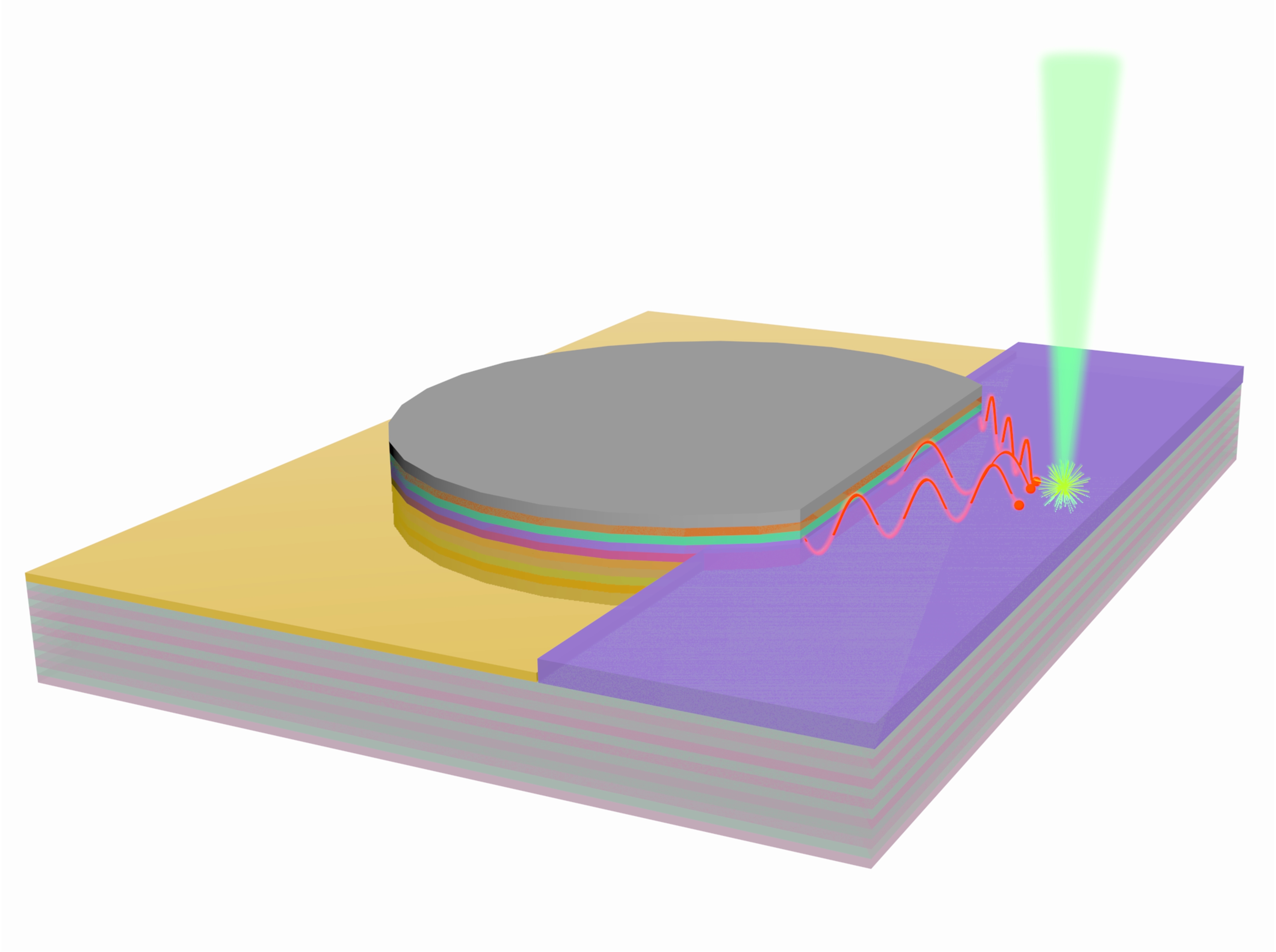
The diagram shows light hitting the semiconductor (purple) layered over the mirror-like photonic structure. The polaritons—mixtures of light, electrons and “holes”—then travel to the detector (truncated disc), where they generate current.
Image credit: Xinjing Huang and Bin Liu, Optoelectronic Components and Materials Group

A relatively new kind of semiconductor, layered atop a mirror-like structure, can mimic the way that leaves move energy from the sun over relatively long distances before using it to fuel chemical reactions. The approach may one day improve the efficiency of solar cells.

“Energy transport is one of the crucial steps for solar energy harvesting and conversion in solar cells,” said Bin Liu, a postdoctoral researcher in electrical and computer engineering and first author of the study in the journal Optica.

“We created a structure that can support hybrid light-matter mixture states, enabling efficient and exceptionally long-range energy transport.”

One of the ways that solar cells lose energy is in leakage currents generated in the absence of light. This occurs in the part of the solar cell that takes the negatively charged electrons and the positively charged “holes,” generated by the absorption of light, and separates them at a junction between different semiconductors to create an electrical current.

Remote-controllable cyborg cockroach

Cyborg cockroach
An insect developed in this study, equipped with a tiny wireless control module that is powered by a rechargeable battery attached to a solar cell.
Credit: RIKEN

An international team led by researchers at the RIKEN Cluster for Pioneering Research (CPR) has engineered a system for creating remote controlled cyborg cockroaches, equipped with a tiny wireless control module that is powered by a rechargeable battery attached to a solar cell. Despite the mechanical devices, ultrathin electronics and flexible materials allow the insects to move freely. These achievements, reported in the scientific journal npj Flexible Electronics on September 5, will help make the use of cyborg insects a practical reality.

Researchers have been trying to design cyborg insects—part insect, part machine—to help inspect hazardous areas or monitor the environment. However, for the use of cyborg insects to be practical, handlers must be able to control them remotely for long periods of time. This requires wireless control of their leg segments, powered by a tiny rechargeable battery. Keeping the battery adequately charged is fundamental—nobody wants a suddenly out-of-control team of cyborg cockroaches roaming around. While it’s possible to build docking stations for recharging the battery, the need to return and recharge could disrupt time-sensitive missions. Therefore, the best solution is to include an on-board solar cell that can continuously ensure that the battery stays charged.

All of this is easier said than done. To successfully integrate these devices into a cockroach that has limited surface area required the research team to develop a special backpack, ultrathin organic solar cell modules, and an adhesion system that keeps the machinery attached for long periods of time while also allowing natural movements.

Engineers Study Bird Flight

Photo credit: Karin Hiselius on Unsplash

People have been fascinated by bird flight for centuries, but exactly how birds can be so agile in the air remains mysterious. A new study, published the week of Sept. 5 in Proceedings of the National Academy of Sciences, uses modeling and aerodynamics to describe how gulls can change the shape of their wings to control their response to gusts or other disturbances. The lessons could one day apply to uncrewed aerial vehicles or other flying machines.

“Birds easily perform challenging maneuvers and they’re adaptable, so what exactly about their flight is most useful to implement in future aircraft?” said Christina Harvey, assistant professor in the Department of Mechanical and Aerospace Engineering at the University of California, Davis, and lead author on the paper.

Harvey began studying gulls as a master’s student in zoology at the University of British Columbia, after earning her bachelor’s degree in mechanical engineering.

“Gulls are very common and easy to find, and they’re really impressive gliders,” she said.

Harvey continued her work on gulls as a doctoral student at the University of Michigan. She recently joined the faculty at UC Davis after completing her Ph.D. in aerospace engineering.

Researchers construct the most complex, complete synthetic microbiome

A bacterial cell culture from the Fischbach lab.
Image credit: L.A. Cicero

The microbial community of over 100 bacterial species could help scientists learn more about the connections between the microbiome and human health.

Key studies in the last decade have shown that the gut microbiome, the collection of hundreds of bacterial species that live in the human digestive system, influences neural development, response to cancer immunotherapies, and other aspects of health. But these communities are complex and without systematic ways to study the constituents, the exact cells and molecules linked with certain diseases remain a mystery.

Stanford University researchers have built the most complex and well-defined synthetic microbiome, creating a community of over 100 bacterial species that were successfully transplanted into mice. The ability to add, remove, and edit individual species will allow scientists to better understand the links between the microbiome and health, and eventually develop first-in-class microbiome therapies.

Many key microbiome studies have been done using fecal transplants, which introduce the entire, natural microbiome from one organism to another. While scientists routinely silence a gene or remove a protein from a specific cell or even an entire mouse, there is no such set of tools to remove or modify one species among the hundreds in a given fecal sample.

Walking and slithering aren’t as different as you think


Abrahamic texts treat slithering as a special indignity visited on the wicked serpent, but evolution may draw a more continuous line through the motion of swimming microbes, wriggling worms, skittering spiders and walking horses.

A new study found that all of these kinds of motion are well represented by a single mathematical model.

“This didn’t come out of nowhere—this is from our real robot data,” said Dan Zhao, first author of the study in the Proceedings of the National Academy of Sciences and a recent Ph.D. graduate in mechanical engineering at the University of Michigan.

“Even when the robot looks like it’s sliding, like its feet are slipping, its velocity is still proportional to how quickly it’s moving its body.”

Unlike the dynamic motion of gliding birds and sharks and galloping horses—where speed is driven, at least in part, by momentum—every bit of speed for ants, centipedes, snakes and swimming microbes is driven by changing the shape of the body. This is known as kinematic motion.

The expanded understanding of kinematic motion could change the way roboticists think about programming many-limbed robots, opening new possibilities for walking planetary rovers, for instance.

Long COVID after mild SARS-CoV-2 infection: persistent heart inflammation might explain heart symptoms

Visualization of heart inflammation by means of MRI: cardiologist Dr Valentina Puntmann monitors a study participant at the Institute for Experimental and Translational Cardiovascular Imaging at University Hospital Frankfurt.
Credit: Goethe-UniversitĂ€t

The research team led by Dr Valentina Puntmann and Professor Eike Nagel from University Hospital Frankfurt and Goethe University Frankfurt followed up around 350 study participants without previously known heart problems who had recovered from a SARS-CoV-2 infection. They found that over half of them still reported heart symptoms almost a year later, such as exercise intolerance, tachycardia and chest pain. According to the study, these symptoms can be attributed to mild but persistent cardiac inflammation. Pronounced structural heart disease is not a characteristic of the syndrome.

After recovering from a SARS-CoV-2 infection, many people complain of persistent heart complaints, such as poor exercise tolerance, palpitations or chest pain, even if the infection was mild and there were no known heart problems in the past. Earlier studies, predominantly among young, physically fit individuals, were already able to show that mild cardiac inflammation can occur after COVID-19. However, the underlying cause of persistent symptoms, and whether this changes over time, was unknown.

A team of medical scientists led by Dr Valentina Puntmann and Professor Eike Nagel from the Institute for Experimental and Translational Cardiovascular Imaging at University Hospital Frankfurt followed up 346 people – half of them women – between the age of 18 and 77 years, in each case around four and eleven months after the documented SARS-CoV-2 infection. For this purpose, the team analyzed the study participants' blood, conducted heart MRIs, and recorded and graded their symptoms using standardized questionnaires.

Boeing Demonstrates Open Autonomy Architecture for Manned-Unmanned Teaming with MQ-25

Boeing conducted approximately 125 test flight hours with the MQ-25 test asset, completing three refueling flights as well as a deck handling demonstration aboard the USS George H.W. Bush in 2021. 
Credit: Boeing

Boeing [NYSE: BA] has digitally demonstrated a new open autonomy architecture for MQ-25 that will allow the U.S. Navy to increase mission effectiveness by integrating manned-unmanned teaming (MUM-T) capability at speed and scale.

The non-proprietary architecture, based on the government-owned Open Mission System specification, is the foundation for advanced MUM-T. A Boeing-led team virtually demonstrated how other aircraft can use MQ-25’s architecture and task it to conduct tanking and intelligence, surveillance and reconnaissance (ISR) missions – all within the mission airspace and without traditional communications with the ship-based ground control station.

Boeing’s MUM-T demonstration included Northrop Grumman’s E-2D Advanced Hawkeye command and control aircraft, Boeing’s P-8A Poseidon maritime patrol and reconnaissance aircraft and Boeing’s F/A-18 Block III Super Hornet fighter jet. Using their existing operational flight program software and data links, the aircraft safely and efficiently tasked four virtual, autonomous MQ-25s to conduct ISR missions. The F/A-18 also used its advanced tactical data links and Boeing’s conceptual “Project Black Ice” crew vehicle interface, which significantly reduced aircrew workload.

How does nature nurture the brain?

Credit: Jessica Rockowitz on Unsplash

After a 60-minute walk in nature, activity in brain regions involved in stress processing decreases. This is the finding of a recent study by the Lise Meitner Group for Environmental Neuroscience at the Max Planck Institute for Human Development, published in Molecular Psychiatry.

Living in a city is a well-known risk factor for developing a mental disorder, while living close to nature is largely beneficial for mental health and the brain. A central brain region involved in stress processing, the amygdala, has been shown to be less activated during stress in people who live in rural areas, compared to those who live in cities, hinting at the potential benefits of nature. “But so far the hen-and-egg problem could not be disentangled, namely whether nature actually caused the effects in the brain or whether the particular individuals chose to live in rural or urban regions”, says Sonja Sudimac, predoctoral fellow in the Lise Meitner Group for Environmental Neuroscience and lead author of the study.

To achieve causal evidence, the researchers from the Lise Meitner Group for Environmental Neuroscience examined brain activity in regions involved in stress processing in 63 healthy volunteers before and after a one-hour walk in Grunewald forest or a shopping street with traffic in Berlin using functional magnetic resonance imaging (fMRI). The results of the study revealed that activity in the amygdala decreased after the walk in nature, suggesting that nature elicits beneficial effects on brain regions related to stress.

Study calls for change in guidance about eating fish during pregnancy

Photo Credit: Neal E. Johnson on Unsplash

A woman’s mercury level during pregnancy is unlikely to have an adverse effect on the development of the child provided that the mother eats fish, according to a new University of Bristol-led study.

The findings, which drew together analyses on over 4,131 pregnant mothers from the Children of the 90s study in the UK, with similar detailed studies in the Seychelles, are published in NeuroToxicology.

Importantly, the researchers also found that it does not appear to matter which types of fish are eaten because the essential nutrients in the fish could be protective against the mercury content of the fish. The more important factor was whether the woman ate fish or not. This contrasts with current advice warning pregnant women not to eat certain types of fish that have relatively high levels of mercury.

Although there are several studies that have considered this question, this research has looked at two contrasting studies of populations with mercury levels measured during pregnancy where the children were followed up at frequent intervals during their childhood.

The first is a study focused on a population in the Seychelles, where almost all pregnant women are fish eaters. The second study considered analyses of data from the University of Bristol’s Children of the 90s study (also known as the Avon Longitudinal Study of Parents and Children (ALSPAC)), based in a relatively industrialized area in south-west England where fish are consumed far less frequently. No summary of the findings from this study has been published before.

Artificial intelligence against child cancer

Stefan Posch
Photo Credit: Uni Halle / Markus Scholz

"Artificial Professor" is the nickname for a new research project at the University Hospital Leipzig and at the Martin Luther University Halle-Wittenberg (MLU). A team of doctors and bioinformatics wants to use self-learning software to significantly improve the therapy of lymphatic cancer (Hodgkin's lymphoma) in children. The second phase of the multi-year project recently began with 40,000 euros in funding from the Mitteldeutsche Kinderkrebsforschung Foundation.

Children affected by lymph gland cancer can now be cured with modern treatment methods such as chemotherapy and radiation in 95 percent of cases. However, intensive treatment in childhood often leads to late damage. Irradiation in particular increases the risk of developing a second cancer later. Long-term studies show massive over-mortality due to second diseases, such as cancer or heart diseases in adulthood.

Therefore, the primary goal of the medical profession is: only as little treatment as necessary. The data analysis developed in the project, based on artificial intelligence, is intended to help and optimize therapy for each individual patient. In the first phase, the researchers first prepared and prepared a unique data set for the big data analysis: a network of 270 child cancer clinics from 21 countries sent the data from the imaging PET examinations anonymously to Leipzig for years. The three-dimensional image series shows how well individual therapies work and how the tumor tissue develops over time.

New forecasting tool can give an early warning of solar storms

Solar flares can reach velocities of up to several million kilometers per hour.
Illustration: Matti Ahlgren/Aalto University

Associate Professor Maarit Korpi-Lagg has received funding from the European Research Council to develop a forecasting tool to locate the source regions for the eruption of solar flares already a few days before they emerge on the Sun’s surface.

The Earth is constantly bombarded by a stream of particles from the Sun, called solar wind. This stream can escalate into storms, which are born from massive solar flares spewing out from the Sun’s highly magnetized active regions. When strong solar storms hit Earth, they can have massive repercussions for telecommunications, global positioning systems and electrical grids.

In July 2012, the most severe solar flare in 150 years was spat out by the Sun. Fortunately, the resulting solar storm missed Earth. Had it been directed toward us; it would have had the potential to leave societies and the global economy in shatters and taken years to recover from.

‘Only the worst solar storms are a real threat to human life. However, the costs of fixing damages and shielding our digitalized infrastructure from them, are very high,’ says Maarit Korpi-Lagg, associate professor at Aalto University.

Iset River Can Be Cleaned Of Heavy Metals With Plants And Bacteria

Irina Kiseleva notes that in large quantities, heavy metals can be radioactive hazardous.
Photo credit: Andrey Fomin

Polluted rivers, such as the Iset River, can be cleaned by plants capable of accumulating dangerous toxicants such as heavy metals in their roots and leaves. Such biotechnology for purification is easy to implement and does not require large expenditures. Now biologists of the Ural Federal University are searching for water plants which could survive in the Ural weather conditions and at the same time effectively cope with the purification of water resources. Irina Kiseleva, Head of the Department of Experimental Biology and Biotechnologies of UrFU, talked about it on the air of Radio "Komsomolskaya Pravda".

"We need a comprehensive approach to the purification of rivers, because in addition to heavy metals there are a number of other organic and inorganic toxic substances. However, with the help of plants we can facilitate this process several times over. In the Ural Region, there are several species of coastal plants that are able to accumulate heavy metals in their leaves. For example, common cattail (sometimes called bulrush) or in warm countries water hyacinth. Yet cattail, which is more accustomed to our climate, purifies water much less effectively than water hyacinth, which, of course, will freeze in the first winter. Therefore, at the university we are working to find local flora plants that can clean the rivers and still survive for several seasons in our climate," says Irina Kiseleva.

Featured Article

What Is: Psychopathy | Part three of the "Dark Tetrad"

Scientific Frontline: Extended "At a Glance" Summary : Psychopathy The Core Concept : Psychopathy is a profound personality disord...

Top Viewed Articles