. Scientific Frontline

Tuesday, September 20, 2022

Creating diamonds to shed light on the quantum world

Sandia National Laboratories’ Andy Mounce makes microscopic sensors to try to understand quantum materials at the Center for Integrated Nanotechnologies. He is one of four employees to earn DOE’s Early Career Research Award.
Photo credit: Bret Latter

Diamonds are a scientist’s best friend. That much is at least true for physicist Andy Mounce, whose work with diamond quantum sensors at Sandia National Laboratories has earned him the DOE’s Early Career Research Award.

As a scientist in Sandia’s Center for Integrated Nanotechnologies, he specializes in making microscopic sensors to try to understand the nature of quantum materials and their electrons’ behavior. Mounce is an expert in creating nitrogen-vacancy defects in artificial diamonds, which are extremely sensitive to the electric and magnetic fields at a nanoscale.

“With these quantum sensors we can study basic properties of low dimensional quantum materials, such as superconducting phases, magnetic phases,” he said. “A quantum material can be anything from a nanostructure to a large material that just has electrons that interact with each other very strongly. The distinguishing property of a quantum material, is that their behavior is defined by quantum mechanics, so not your typical copper conductor”.
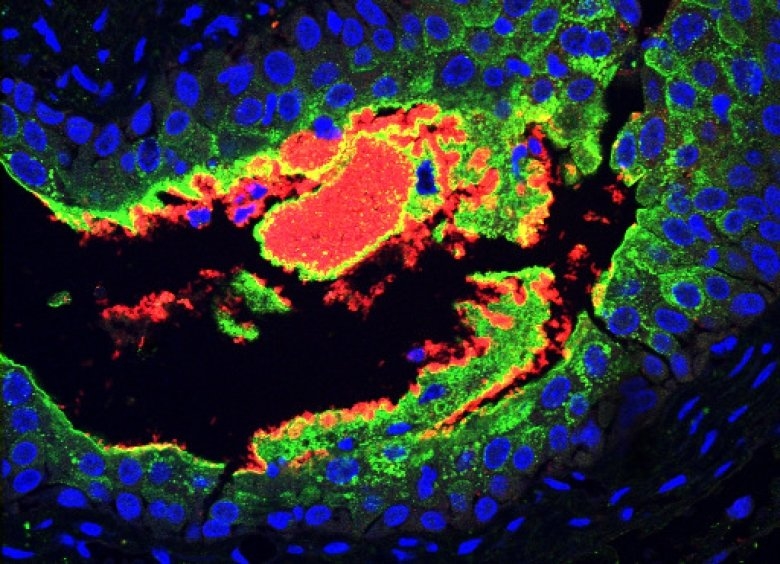
A new study explains the relationship between diabetes and urinary tract infections

The picture shows large lumps of E. coli (in red) that infects the bladder of a mouse with diabetes.
 Photo: Soumitra Mohanty

Reduced immune systems and recurrent infections are common in type 1 and type 2 diabetes. Now researchers at Karolinska Institutet show that people with diabetes have lower levels of the antimicrobial peptide psoriasis, which is part of the body's immune system, which impacts the leaves' cell barrier with increased risk of urinary tract infection. The study is published in Nature Communications.

Diabetes is due to insulin deficiency or reduced insulin sensitivity. The hormone insulin regulates glucose (sugar) and thus energy to the body's cells. In people with type 1 diabetes, the body has stopped making insulin and in type 2 diabetes, cells have become less sensitive to insulin, which contributes to high blood glucose levels. Diabetes is a common disease that affects health in several ways.

Among other things, the innate immune system determinants and many get recurrent infections, such as urinary tract infections caused by E. colibacteria. In people with diabetes, there is an increased risk that these will lead to general blood poisoning, sepsis, which is based on the urinary tract.

Monday, September 19, 2022

New method for measuring high energy density plasmas and facilitating inertial confinement fusion

Physicist Sophia Malko with figures from her ion-stopping paper.
Photo credit: Valeria Ospina-Bohorquez; collage by Kiran Sudarsanan

An international team of scientists has uncovered a new method for advancing the development of fusion energy through increased understanding of the properties of warm dense matter, an extreme state of matter similar to that found at the heart of giant planets like Jupiter. The findings, led by Sophia Malko of the U.S. Department of Energy’s (DOE) Princeton Plasma Physics Laboratory (PPPL), detail a new technique to measure the “stopping power” of nuclear particles in plasma using high repetition-rate ultraintense lasers. The understanding of proton stopping power is particularly important for inertial confinement fusion (ICF).

Powering the sun and stars

This process contrasts with the creation of fusion at PPPL, which heats plasma to million-degree temperatures in magnetic confinement facilities. Plasma, the hot, charged state of matter composed of free electrons and atomic nuclei, or ions, fuels fusion reactions in both types of research, which aim to reproduce on Earth the fusion that powers the sun and stars as a source of safe, clean and virtually limitless energy to generate the world’s electricity.

“Stopping power” is a force acting on charged particles due to collisions with electrons in the matter that result in energy loss. “For example, if you don’t know the proton stopping power you cannot calculate the amount of energy deposited in the plasma and hence design lasers with the right energy level to create fusion ignition,” said Malko, lead author of a paper that outlines the findings in Nature Communications. “Theoretical descriptions of the stopping power in high-energy density matter and particularly in warm dense matter are difficult, and measurements are largely missing,” she said. “Our paper compares experimental data of the loss of proton energy in warm dense matter with theoretical models of stopping power.”

Fossil eggs show dinosaur decline before extinction

Artist’s depiction of Late Cretaceous oviraptorosaurs, hadrosaurs, and tyrannosaurs living in central China
Credit: IVPP 

Nearly 66 million years ago, a large asteroid hit Earth and contributed to the global extinction of dinosaurs, leaving birds as their only living descendants.

Scientists know that a wide variety of dinosaurs lived around the world at the end of the Cretaceous period just before their extinction. However, scientists have debated whether dinosaurs were at their zenith or already in decline prior to their demise. In other words, did dinosaurs go out with a bang or a whimper?

Researchers from the Institute of Vertebrate Paleontology and Paleoanthropology (IVPP) of the Chinese Academy of Sciences, along with their collaborators, now have an answer. They've found evidence to support the hypothesis that dinosaurs were not very diverse before their extinction and had declined overall during the last part of the Cretaceous.

Their findings were published in PNAS on Sept. 19.

Most of the scientific data on the last days of the dinosaurs comes from North America. Although some published studies suggest that dinosaur populations there were thriving quite well before extinction, other more detailed research has suggested that dinosaurs were instead in decline, which set the stage for their eventual mass extinction.

Statin use is not justified for healthy people with high cholesterol

Professor David Diamond, Department of Psychology
Credit: University of South Florida
About 40 million adults in the United States regularly take statins to lower their cholesterol levels and reduce their risk of heart disease and stroke, according to American Heart Association data from 2020.

However, many of them don’t stand to benefit from these drugs based on new research from David Diamond, a neuroscientist and cardiovascular disease researcher in the Department of Psychology at the University of South Florida.

Diamond and his co-authors reviewed literature from medical trials involving patients taking either a statin or placebo. They then narrowed their review to look at study participants with elevated levels of low-density lipoprotein-cholesterol (LDL), the so-called “bad cholesterol,” which can be reduced with a statin. Some individuals with high LDL also had high triglycerides (fat in the blood) and low high-density lipoprotein (HDL), the “good cholesterol,” which put them at the highest risk of having a heart attack.

But others with high LDL were very different. They had low triglycerides and high HDL, which meant they were healthier. People with optimal triglycerides and HDL levels typically exercise, have low blood pressure and low blood sugar, and are at a low risk of a heart attack.

Diamond and his co-authors asked two questions: If people are at a low risk of a heart attack based on having optimal triglycerides and HDL, but they also have high LDL, does that raise their risk? Further, would these people benefit from lowering their LDL with a statin?

Elusive atmospheric wave detected during Tonga volcanic eruption

Satellite image of Tonga volcanic eruption, 2022.
Photo credit: NASA Worldview, NOAA / NESDIS / STAR

The catastrophic eruption of the Hunga Tonga–Hunga Haʻapai volcano in 2022 triggered a special atmospheric wave that has eluded detection for the past 85 years. Researchers from the University of Hawaiʻi at Mānoa, Japan Agency for Marine–Earth Science and Technology (JAMSTEC), and Kyoto University relied on state-of-the-art observational data and computer simulations to discover the existence of Pekeris waves—fluctuations in air pressure that were theorized in 1937 but never proven to occur in nature, until now.

The study was published in the Journal of the Atmospheric Sciences.

The eruption in the South Pacific earlier this year released what was likely the most powerful explosion the world has experienced since the famous 1883 eruption of Mt. Krakatau in Indonesia. The rapid release of energy excited pressure waves in the atmosphere that quickly spread around the world.

The atmospheric wave pattern close to the eruption was quite complicated, but thousands of miles away the disturbances were led by an isolated wave front traveling horizontally at more than 650 miles per hour as it spread outward. The air pressure perturbations associated with the initial wave front were seen clearly on thousands of barometer records throughout the world.

Laser light offers new tool for treating bone cancer

Left: An image of cancerous tissue prepared with the traditional hematoxylin and eosin (H&E) staining method. Right: An image of cancerous tissue prepared with the UV-PAM method. The results are very similar to those produced with the H&E method, but are ready much faster.
Credit: Caltech

Label-free intraoperative histology of bone tissue via deep-learning-assisted ultraviolet photoacoustic microscopy of the many ways to treat cancer, the oldest, and maybe most tried and true, is surgery. Even with the advent of chemotherapy, radiation therapy, and more experimental treatments like bacteria that seek and destroy cancer cells, cancers, very often, simply need to be cut out of a patient's body.

The goal is to remove all of the cancerous tissue while preserving as much of the surrounding healthy material as possible. But because it can be difficult to draw a clean line between cancerous and healthy tissues, surgeons often err on the side of caution and remove healthy tissue to make sure they have taken out all of the cancerous tissue.

This is especially problematic when a patient is suffering from a cancer that afflicts bones; bones present unique challenges during surgery because of how hard they are compared with other tissues and because they grow back much more slowly than other kinds of tissue.

Endangered Mouse Study Shares No-Contact Sampling Method

A salt marsh harvest mouse walks across the bulrush at Grizzly Island Wildlife Area in San Francisco.
 Credit: Cody Aylward/UC Davis

From species of marmots to moles, shrews and mice, many of the world’s endangered mammals are small. Genetic sampling is important for understanding how to conserve and protect their populations. But finding efficient, noninvasive ways to collect genetic samples from small animals can be challenging.

A study from the University of California, Davis, describes a new, noninvasive genetic survey technique for the endangered salt marsh harvest mouse, which lives solely within the tidal marshes of the San Francisco Bay Estuary.

In larger mammals, scientists often collect samples from scat, but the poop of small animals can be so small that it is difficult to detect in the wild.

The new technique, published in the Journal of Mammalogy, uses a combination of bait stations and genetics to sample and identify salt marsh harvest mice, or “salties” as researchers affectionately call them. The species has lost more than 90% of its habitat to development and is also threatened by rising sea levels. That’s why it is imperative that the remaining populations are identified accurately and efficiently, the authors note.

Send in the Drones

The new trailer provides more space for the UAS team to work on perfecting aircrafts for flight.
 Credit: Idaho National Laboratory

Ever since the Wright brothers innovated in the back of their bicycle shop in Dayton, Ohio, aviation has been, at heart, a nuts-and-bolts endeavor. For all the sophisticated equipment Idaho National Laboratory’s Unmanned Aerial Systems team has at its disposal for testing high-tech cameras, radios and sensors, there is still a lot of gearhead ingenuity involved.

Here, a $500,000 high-tech surveillance camera is kept aloft on an aircraft powered by a 1/2-horsepower gasoline engine adapted from a Honda pressure washer. The launching catapult for the plane is basically an oversized potato gun.

The group operates both in Idaho Falls and at the INL Site from a base that includes a 1,000-foot paved runway, a control trailer and a newly built 1,500-square-foot hangar.

‘Workhorses’

The Department of Energy complex has noted INL’s strength in testing unmanned aerial vehicles, or UAVs (better known as drones). Over 20 years, the lab has developed capabilities to test new platforms and evaluate technology not only for DOE but also the Department of Defense and private industry. With 890 square miles of open high-altitude desert, a secure border, and a sophisticated wireless test bed, the INL Site has proven to be a great place for testing unmanned aerial vehicles against real-world conditions like severe weather, temperature swings and day/night operations.

Wildfire Smoke May Have Amplified Arctic Phytoplankton Bloom

Satellite image of plume in eastern Arctic Ocean, Aug. 2014
Source: North Carolina State University

Smoke from a Siberian wildfire may have transported enough nitrogen to parts of the Arctic Ocean to amplify a phytoplankton bloom, according to new research from North Carolina State University and the International Research Laboratory Takuvik (CNRS/Laval University) in Canada. The work sheds light on some potential ecological effects from Northern Hemisphere wildfires, particularly as these fires become larger, longer and more intense.

In the summer of 2014, satellite imagery detected a larger than normal algal bloom in the Laptev Sea, located in the Arctic Ocean approximately 850 kilometers (528 miles) south of the North Pole.

“For a bloom that large to occur, the area would need a substantial influx of new nitrogen supply, as the Arctic Ocean is nitrogen-depleted,” says Douglas Hamilton, assistant professor of marine, earth and atmospheric sciences at NC State and co-first author of a paper describing the work. Hamilton was formerly a research associate at Cornell University, where the research was conducted. “So we needed to figure out where that nitrogen was coming from.”

First, the researchers looked at the “usual suspects” for nitrogen input, such as sea ice melt, river discharge and ocean upwelling, but didn’t find anything that would account for the amount of nitrogen necessary for the bloom to occur.

Deformation fingerprints will help researchers identify and design better metallic materials

Materials science and engineering professors Jean-Charles Stinville and Marie Charpagne captured nanoscale deformation events at the origin of metal failure that can help researchers design new materials for medical, transportation, safety, energy and environmental applications. 
Photo credit: Fred Zwicky

Engineers can now capture and predict the strength of metallic materials subjected to cycling loading, or fatigue strength, in a matter of hours – not the months or years it takes using current methods.

In a new study, researchers from the University of Illinois Urbana-Champaign report that automated high-resolution electron imaging can capture the nanoscale deformation events that lead to metal failure and breakage at the origin of metal failure. The new method helps scientists to rapidly predict the fatigue strength of any alloy, and design new materials for engineering systems subject to repeated loading for medical, transportation, safety, energy and environmental applications.

The findings of the study, led by materials science and engineering professors Jean-Charles Stinville and Marie Charpagne, are published in the journal Science.

Fatigue of metals and alloys – such as the repeated bending of a metal paperclip that leads to its fracture – is the root cause of failure in many engineering systems, Stinville said. Defining the relationship between fatigue strength and the microstructure is challenging because metallic materials display complex structures with features ranging from the nanometer to the centimeter scale.

Astro­physics: Star-child­hood shapes stel­lar evo­lu­tion

Tarantula Nebula: In this famous star-forming region in our neighboring galaxy, the Large Magellanic Cloud, many young stars are still in their molecular clouds, pictured by James Webb Space Telescope.
Hi-Res Zoomable Image
Credits: NASA, ESA, CSA, STScI, Webb ERO Production Team

In classical models of stellar evolution, so far little importance has been attached to the early evolution of stars. Thomas Steindl from the Institute of Astro- and Particle Physics at the University of Innsbruck now shows for the first time that the biography of stars is indeed shaped by their early stage. The study was published in Nature Communications.

From babies to teenagers: stars in their "young years" are a major challenge for science. The process of star formation is particularly complex and difficult to map in theoretical models. One of the few ways to learn more about the formation, structure or age of stars is to observe their oscillations. "Comparable to the exploration of the Earth's interior with the help of seismology, we can also make statements about their internal structure and thus also about the age of stars based on their oscillations" says Konstanze Zwintz. The astronomer is regarded as a pioneer in the young field of asteroseismology and heads the research group "Stellar Evolution and Asteroseismology" at the Institute for Astro- and Particle Physics at the University of Innsbruck. The study of stellar oscillations has evolved significantly in recent years because the possibilities for precise observation through telescopes in space such as TESS, Kepler, and James Webb have improved on many levels. These advances are now also shedding new light on decades-old theories of stellar evolution.

Diabetes: when circadian lipid rhythms go wrong

Circadian clocks in human pancreatic islets control the lipid membrane fluidity. Right, human pancreatic islet cells with compromised clocks bear decreased membrane lipid fluidity, as compared to the islet cells with functional clocks (left)
Resized Image using AI by SFLORG
Credit: 2022. Petrenko et al. (2022) Type 2 diabetes disrupts circadian orchestration of lipid metabolism and membrane fluidity in human pancreatic islets. PLoS Biol 20(8): e3001725.

Like all living beings, human physiological processes are influenced by circadian rhythms. The disruption of our internal clocks due to an increasingly unbalanced lifestyle is directly linked to the explosion in cases of type 2 diabetes. By what mechanism? A team from the University of Geneva (UNIGE) and the University Hospitals of Geneva (HUG), in Switzerland, is lifting part of the veil: this disturbance disrupts the metabolism of lipids in the cells that secrete glucose-regulating hormones. Sphingolipids and phospholipids, lipids located on the cell membrane, seem to be particularly affected. This change in lipid profiles then leads to rigidity of the membrane of these cells. These results, to be read in the journal PLOS Biology, provide further evidence of the importance of circadian rhythms in metabolic disorders.

Lipids have a variety of cellular functions. As one of the main components of cell membranes, they are involved in the signaling pathways through which cells communicate with each other and with their environment. “We have known for some time that the disruption of circadian clocks was closely linked to metabolic diseases, such as type 2 diabetes, where the body is no longer able to regulate blood sugar levels effectively,” explains Charna Dibner, a professor in the Departments of Surgery and of Cellular Physiology and Metabolism, as well as in the Diabetes Centre of the UNIGE Faculty of Medicine and the HUG, who led this research. “It is also established that lipids play a significant role in metabolic disorders. But the impact of circadian rhythms on lipid functions remained unknown.”

New Way to Obtain High-Productivity Proton Conductors Found

Natalya Tarasova works on the creation of new proton conductors.
Photo credit: Ilya Safarov.

Scientists from the Ural Federal University and the Institute of High Temperature Electrochemistry of the Ural Branch of the Russian Academy of Sciences carried out the first demonstration of donor and acceptor doping of perovskite with a barium-lanthanum indite block-layer structure. The fundamental possibility of such a method to significantly improve the conducting properties of the material was shown. The work opens a new way to the creation of solid oxide fuel cell electrolytes. An article describing the research and its results was published in Ceramics International.

One of the goals of global materials science is to obtain the highest possible electrical conductivity of electrolytes for their further use in solid oxide fuel cells. For this purpose, doping is the replacement of part of the atoms in the starting materials by atoms of another chemical element (acceptor doping is replacement by atoms with a lower valence, donor doping is replacement by atoms with a higher valence).

"We used barium-lanthanum iodate as the initial structure and during our studies we substituted some indium atoms for titanium (donor doping) and some lanthanum atoms for calcium (acceptor doping) in it. When acceptor doping, oxygen defects - oxygen vacancies - appeared in the crystal lattice of the initial material. This can ensure the transfer of protons - positively charged hydrogen ions - along the crystal lattice. They get into the structure of layered perovskite from humidified air at 300-500°C. The more oxygen defects and, consequently, the greater the concentration of protons in the perovskite crystal lattice and their mobility, i.e. speed, the higher the values of the electrical conductivity of the material," explains Natalya Tarasova, Professor of the Department of Physical Chemistry and Leading Researcher of the Institute of Hydrogen Energy at UrFU.

Saturday, September 17, 2022

The magneto-optic modulator

Electricity flowing through a metal coil generates electric (purple) and magnetic (faint green) fields. This changes the properties of the substrate, which tunes the resonance ring (red) to different frequencies. The whole setup enables the scientists to convert a continuous beam of light (red on left) into pulses that can carry data through a fiber-optic cable. 
Photo Credit: Brian Long

Many state-of-the-art technologies work at incredibly low temperatures. Superconducting microprocessors and quantum computers promise to revolutionize computation, but scientists need to keep them just above absolute zero (-459.67° Fahrenheit) to protect their delicate states. Still, ultra-cold components have to interface with room temperature systems, providing both a challenge and an opportunity for engineers.

An international team of scientists, led by UC Santa Barbara’s Paolo Pintus, has designed a device to help cryogenic computers talk with their fair-weather counterparts. The mechanism uses a magnetic field to convert data from electrical current to pulses of light. The light can then travel via fiber-optic cables, which can transmit more information than regular electrical cables while minimizing the heat that leaks into the cryogenic system. The team’s results appear in the journal Nature Electronics.

Featured Article

What Is: Abyssopelagic Zone

A master of abyssopelagic survival, the anglerfish overcomes absolute darkness and sparse food supplies with a specialized, light-producing ...

Top Viewed Articles