
 |
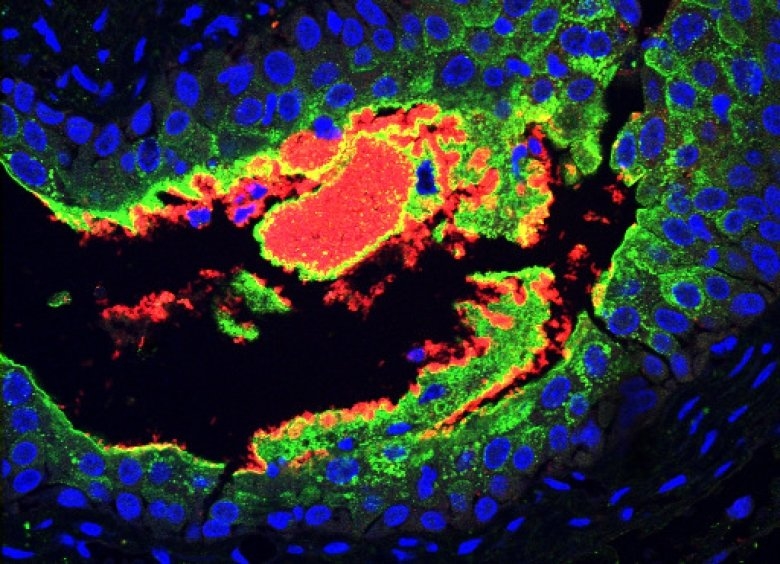
| Experimental DNA fibers with fluorescence (pictured) were used to reveal the speed of DNA replication forks. Credit: Diego Dibitetto/Smolka Lab |
Researchers have uncovered a novel pathway that explains how cancer cells become resistant to chemotherapies, which in turn offers a potential solution for preventing chemo-resistance.
The study, “DNA-PKcs Promotes Fork Reversal and Chemoresistance,” was published Sept. 20 in the journal Molecular Cell.
The research describes for the first time how a type of enzyme – previously known for its roles in DNA repair – prevents DNA damage in cancer cells, making them tolerant to chemotherapy drugs.
“It provides us tools to manipulate and then break chemo-resistance in cancer cells,” said Marcus Smolka, interim director of the Weill Institute for Cell and Molecular Biology and professor of molecular biology and genetics in the College of Agriculture and Life Sciences. Diego Dibitetto, a former postdoctoral researcher in Smolka’s lab who is currently at the University of Bern in Switzerland, is the paper’s first author.
Many anti-cancer drugs work by creating blocks on the DNA of cancer cells as they replicate. During replication, DNA strands entwined in a double helix separate into two individual strands so each strand can be copied, eventually leading to two new double helixes. The junction where this separation and copying occurs is called a replication fork, which unzips down the double helix.








.jpg)