. Scientific Frontline

Wednesday, January 4, 2023

Was That Explosion Chemical or Nuclear?

From left to right: Tim Johnson, Hunter Knox, and Harry Miley bring together different perspectives to better detect underground nuclear explosions. 
Composite Image Credit: by Shannon Colson | Pacific Northwest National Laboratory

If an underground explosion occurs anywhere in the world, there is a good chance that a seismologist can pinpoint it. However, they won’t necessarily be able to tell you what kind of explosion had occurred—whether it is chemical or nuclear in nature. New research from Pacific Northwest National Laboratory (PNNL) scientists makes detecting nuclear explosions easier.

“To a seismologist, chemical and nuclear explosions look identical,” said Harry Miley, Laboratory Fellow and physicist in the National Security Directorate at PNNL. “Radionuclide detection technologies, like the PNNL-developed Xenon International and Radionuclide Aerosol Sampler/Analyzer, known as RASA, can discriminate between the two by detecting radioactive atoms that are created in nuclear explosions. However, we have very little scientific understanding of the geologic containment of these atoms following an explosion.”

When an underground explosion occurs, gases travel through fractures in the ground and escape into the atmosphere. Instruments such as Xenon International and RASA can then detect radionuclide gases, but their chemical signatures may be greatly affected by rock damage that the gases must pass through.

Self-powered, printable smart sensors created from emerging semiconductors could mean cheaper, greener Internet of Things

Simon Fraser University professor Vincenzo Pecunia
Photo Credit: Courtesy of Simon Fraser University

Creating smart sensors to embed in our everyday objects and environments for the Internet of Things (IoT) would vastly improve daily life—but requires trillions of such small devices. Simon Fraser University professor Vincenzo Pecunia believes that emerging alternative semiconductors that are printable, low-cost and eco-friendly could lead the way to a cheaper and more sustainable IoT.

Leading a multinational team of top experts in various areas of printable electronics, Pecunia has identified key priorities and promising avenues for printable electronics to enable self-powered, eco-friendly smart sensors. His forward-looking insights are outlined in his paper published on Dec. 28 in Nature Electronics.

“Equipping everyday objects and environments with intelligence via smart sensors would allow us to make more informed decisions as we go about in our daily lives,” says Pecunia. “Conventional semiconductor technologies require complex, energy-intensity, and expensive processing, but printable semiconductors can deliver electronics with a much lower carbon footprint and cost, since they can be processed by printing or coating, which require much lower energy and materials consumption.”

Movement throttles insulin production

The figure shows the relationships between movement and regulation of the insulin-producing cells in the fruit fly.
Illustration Credit: Sander Liessem / University of Würzburg

If a fruit fly starts to run or fly, its insulin-producing cells are immediately inhibited. This could explain why exercise promotes health.

Insulin is an essential hormone for humans and many other living things. Its most well-known task is to regulate sugar metabolism. How it does this job is well researched. Much less is known about how the activity of the insulin-producing cells and consequently the release of insulin is controlled.

A team from the Biozentrum of the Julius Maximilians University (JMU) Würzburg is now providing news on this question in the journal Current biology in front. The group of Dr. used as the object of investigation. Jan Ache the fruit fly Drosophila melanogaster. Interestingly, this fly also releases insulin after a meal - but the hormone does not come from the pancreas like in humans, but from nerve cells in the brain.

Tuesday, January 3, 2023

Chip Circuit for Light Could Be Applied to Quantum Computations

Future versions of the new photonic circuits will feature low-loss waveguides—the channels through which the single photons travel--some 3 meters long but tightly coiled to fit on a chip. The long waveguides will allow researchers to more precisely choose the time intervals (Δt) when photons exit different channels to rendezvous at a particular location.
Illustration Credit: NIST

The ability to transmit and manipulate the smallest unit of light, the photon, with minimal loss, plays a pivotal role in optical communications as well as designs for quantum computers that would use light rather than electric charges to store and carry information.

Now, researchers at the National Institute of Standards and Technology (NIST) and their colleagues have connected on a single microchip quantum dots — artificial atoms that generate individual photons rapidly and on-demand when illuminated by a laser — with miniature circuits that can guide the light without significant loss of intensity.

To create the ultra-low-loss circuits, the researchers fabricated silicon- nitride waveguides—the channels through which the photons traveled—and buried them in silicon dioxide. The channels were wide but shallow, a geometry that reduced the likelihood that photons would scatter out of the waveguides. Encapsulating the waveguides in silicon dioxide also helped to reduce scattering.

Researchers Demonstrate New Strain Sensors in Health Monitoring, Machine Interface Tech

Image Credit: Shuang Wu.

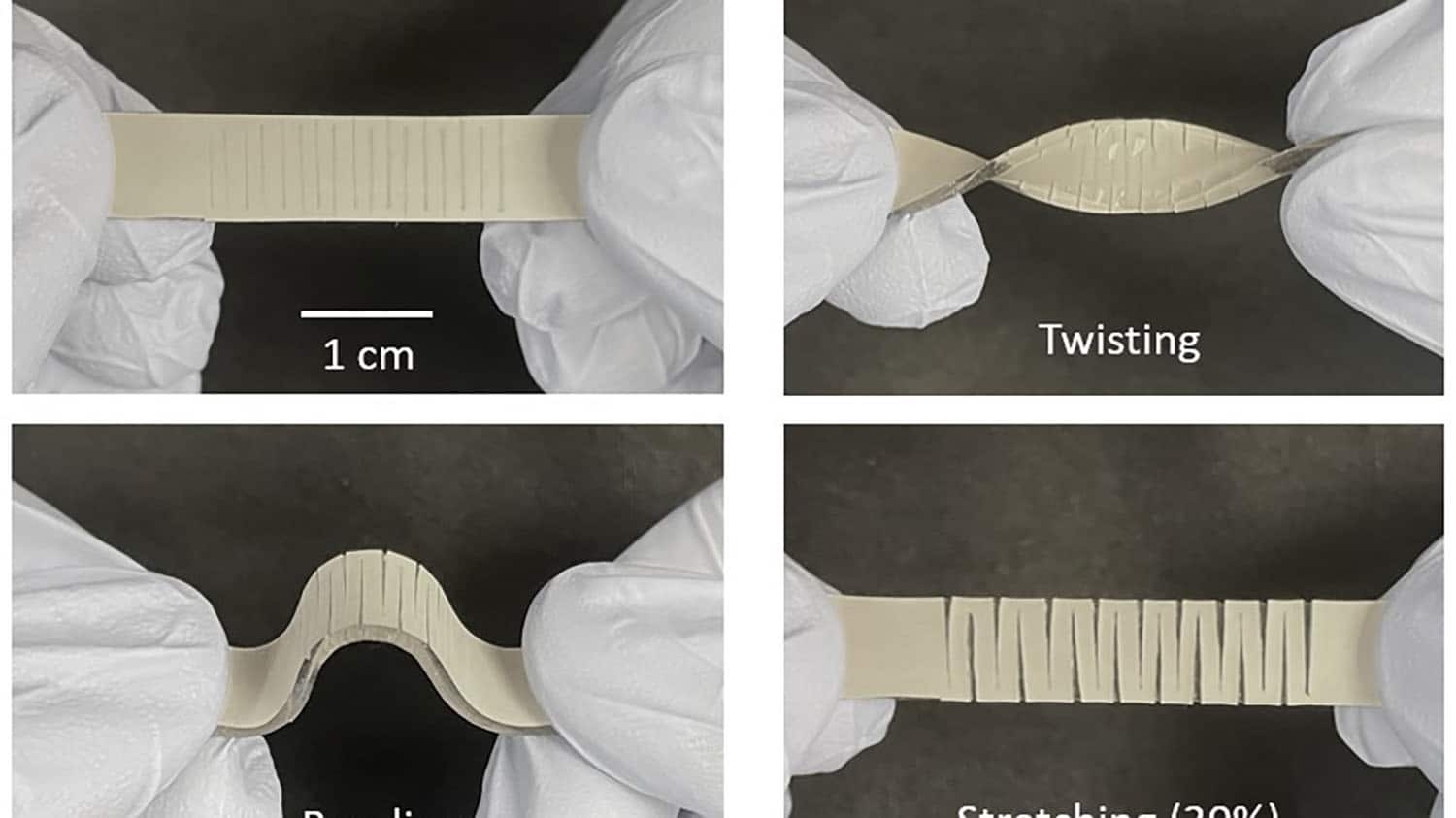
Researchers at North Carolina State University have developed a stretchable strain sensor that has an unprecedented combination of sensitivity and range, allowing it to detect even minor changes in strain with greater range of motion than previous technologies. The researchers demonstrated the sensor’s utility by creating new health monitoring and human-machine interface devices.

Strain is a measurement of how much a material deforms from its original length. For example, if you stretched a rubber band to twice its original length, its strain would be 100%.

“And measuring strain is useful in many applications, such as devices that measure blood pressure and technologies that track physical movement,” says Yong Zhu, corresponding author of a paper on the work and the Andrew A. Adams Distinguished Professor of Mechanical and Aerospace Engineering at NC State.

“But to date there’s been a trade-off. Strain sensors that are sensitive – capable of detecting small deformations – cannot be stretched very far. On the other hand, sensors that can be stretched to greater lengths are typically not very sensitive. The new sensor we’ve developed is both sensitive and capable of withstanding significant deformation,” says Zhu. “An additional feature is that the sensor is highly robust even when over-strained, meaning it is unlikely to break when the applied strain accidently exceeds the sensing range.”

Good hydration linked to healthy aging

NIH findings may provide early clues about increased risks for advanced biological aging and premature death.
Photo Credit: engin akyurt

Adults who stay well-hydrated appear to be healthier, develop fewer chronic conditions, such as heart and lung disease, and live longer than those who may not get sufficient fluids, according to a National Institutes of Health study published in eBioMedicine.

Using health data gathered from 11,255 adults over a 30-year period, researchers analyzed links between serum sodium levels – which go up when fluid intake goes down – and various indicators of health. They found that adults with serum sodium levels at the higher end of a normal range were more likely to develop chronic conditions and show signs of advanced biological aging than those with serum sodium levels in the medium ranges. Adults with higher levels were also more likely to die at a younger age.

“The results suggest that proper hydration may slow down aging and prolong a disease-free life,” said Natalia Dmitrieva, Ph.D., a study author and researcher in the Laboratory of Cardiovascular Regenerative Medicine at the National Heart, Lung, and Blood Institute (NHLBI), part of NIH.

Females perform better than males on a ‘theory of mind’ test across 57 countries

Over the decades, many independent research studies have found that females on average score higher than males on theory of mind tests
Photo Credit: Yuri Levin

Researchers found that females, on average, score higher than males on the widely used ‘Reading the Mind in the Eyes’ Test, which measures ‘theory of mind’ (also known as ‘cognitive empathy’). This finding was observed across all ages and most countries.

The research, published today in the Proceedings of the National Academy of Sciences (PNAS), is the largest study of theory of mind to date.

A fundamental part of human social interaction and communication involves putting ourselves in other people’s shoes, to imagine another person’s thoughts and feelings. This is known as ‘theory of mind’ or ‘cognitive empathy’.

For decades, researchers have studied the development of theory of mind, from infancy to old age. One of the most widely used tests with which to study theory of mind is the ‘Reading the Mind in the Eyes’ Test (or Eyes Test, for short), which asks participants to pick which word best describes what the person in the photo is thinking or feeling, just by viewing photos of the eye region of the face.

Fewer moths, more flies

Insects such as the bumblebee hoverfly Volucella bombylans appear much less frequently than before.
Photo Credit: Carolien van Oijen

The complex relationships between plants and their pollinators have changed dramatically across the last century

In the far north of the planet, climate change is clearly noticeable. A new study in Finland now shows that in parallel there have been dramatic changes in pollinating insects. Researchers from the Martin Luther University Halle-Wittenberg (MLU), the Helmholtz Centre for Environmental Research (UFZ), and the German Centre for Integrative Biodiversity Research Halle-Jena-Leipzig (iDiv) have discovered that the network of plants and their pollinators there has changed considerably since the end of the 19th century. As the scientists warn in an article published in Nature Ecology & Evolution, this could lead to plants being pollinated less effectively. This, in turn, would adversely affect their reproduction.

Their service is invaluable. The army of insects and other animals that pollinates the numerous plants of this earth has an essential function. Without these flower visitors, numerous wild plants could reproduce only poorly - or not at all. Ecosystems would thus no longer be able to function in their current form. More than three quarters of the most important crops depend on pollinators in order to be able to produce a high yield and good quality. A loss of pollinators would therefore also lead to economic losses amounting to billions.

Monday, January 2, 2023

Self-assembling proteins can store cellular “memories”

MIT engineers have devised a way to induce cells to inscribe the history of cellular events in a long protein structure that can be imaged using a light microscope.
Credit: Courtesy of the researchers

As cells perform their everyday functions, they turn on a variety of genes and cellular pathways. MIT engineers have now coaxed cells to inscribe the history of these events in a long protein chain that can be imaged using a light microscope.

Cells programmed to produce these chains continuously add building blocks that encode particular cellular events. Later, the ordered protein chains can be labeled with fluorescent molecules and read under a microscope, allowing researchers to reconstruct the timing of the events.

This technique could help shed light on the steps that underlie processes such as memory formation, response to drug treatment, and gene expression.

“There are a lot of changes that happen at organ or body scale, over hours to weeks, which cannot be tracked over time,” says Edward Boyden, the Y. Eva Tan Professor in Neurotechnology, a professor of biological engineering and brain and cognitive sciences at MIT, a Howard Hughes Medical Institute investigator, and a member of MIT’s McGovern Institute for Brain Research and Koch Institute for Integrative Cancer Research.

Sunday, January 1, 2023

Good and bad feelings for brain stem serotonin

An illustration of the facial expression changes in mice following stimulation and inhibition of the median raphe nucleus
Image Credit: Yu Ohmura

New insights into the opposing actions of serotonin-producing nerve fibers in mice could lead to drugs for treating addictions and major depression.

Scientists in Japan have identified a nerve pathway involved in the processing of rewarding and distressing stimuli and situations in mice.

The new pathway, originating in a bundle of brain stem nerve fibers called the median raphe nucleus, acts in opposition to a previously identified reward/aversion pathway that originates in the nearby dorsal raphe nucleus. The findings, published by scientists at Hokkaido University and Kyoto University with their colleagues in the journal Nature Communications, could have implications for developing drug treatments for various mental disorders, including addictions and major depression.

Previous studies had already revealed that activating serotonin-producing nerve fibers from the dorsal raphe nucleus in the brain stem of mice leads to the pleasurable feeling associated with reward. However, selective serotonin reuptake inhibitors (SSRIs), antidepressant drugs that increase serotonin levels in the brain, fail to exert clear feelings of reward and to treat the loss of ability to feel pleasure associated with depression. This suggests that there are other serotonin-producing nerve pathways in the brain associated with the feelings of reward and aversion.

A glimpse of a cell’s sense of touch

Confocal image of the presomitic mesoderm of a zebrafish embryo. N-cadherin adhesion molecules are shown (they appear black because the image is inverted). This shows the cell borders.
Image Credit: Campàs Lab

A research team at the Cluster of Excellence Physics of Life of TU Dresden and the University of California, Santa Barbara, reveals how cells sense their mechanical environment as they build tissues during embryogenesis.

Building tissues and organs is one of the most complex and essential tasks that cells must accomplish during embryogenesis. In this collective task, cells communicate through a variety of communication methods, including biochemical signals - similar to a cell's sense of smell - and mechanical cues - the cell's sense of touch. Researchers in a variety of disciplines have been fascinated by cell communication for decades. Professor Otger Campàs together with his colleagues from the Physics of Life (PoL) Cluster of Excellence at Technische Universität Dresden and from the University of California Santa Barbara (UCSB) have now been able to unravel another mystery surrounding the question of how cells use their sense of touch to make vital decisions during embryogenesis. Their paper has now been published in the journal Nature Materials.

Russian Scientists Learned to Create Analogues of Space Ice

Astronomers from Ural Federal University have grown ice in a vacuum installation.
Photo Credit: Aldebaran S

Employees of the Ural Federal University's Youth Research Laboratory of Astrochemical Research grew the first samples of interstellar ice analogs and for the first time obtained test infrared spectra of these ices (the quality of the spectra is not inferior to those obtained in foreign laboratories). Obtaining analogues of interstellar ice in the laboratories is important because it will help to analyze data from telescopes, in particular James Webb (JWST), and to determine the chemical composition of interstellar ice and its structure in space.

"Until a year ago, experiments to obtain spectra of interstellar ice analogs were conducted only abroad. Now we can conduct them in Russia as well. The quality of the obtained spectra is not inferior to those obtained in foreign laboratories. It is also important to note that one of the key elements of our experimental setup, the turbomolecular pump, is made in Russia," Anton Vasyunin, Head of the Scientific Laboratory for Astrochemical Research at UrFU, commented on the results.

Interstellar ice forms in the cold formation regions of stars and planets from atoms and molecules that freeze at low temperatures from gas on the surface of microscopic cosmic dust particles. Studies of interstellar ice are necessary to understand the chemical evolution of the galaxy and to find answers to fundamental questions, in particular about the origin of life in the universe.

Tuesday, December 20, 2022

Network neuroscience theory best predictor of intelligence

U. of I. Professor Aron Barbey, pictured, and co-author Evan Anderson found that taking into account the features of the whole brain – rather than focusing on individual regions or networks – allows the most accurate predictions of intelligence.     
Photo Credit: Fred Zwicky

Scientists have labored for decades to understand how brain structure and functional connectivity drive intelligence. Researchers report a new analysis offers the clearest picture yet of how various brain regions and neural networks contribute to a person’s problem-solving ability in a variety of contexts, a trait known as general intelligence, researchers report.

They detail their findings in the journal Human Brain Mapping.

The study used “connectome-based predictive modeling” to compare five theories about how the brain gives rise to intelligence, said Aron Barbey, a professor of psychology, bioengineering and neuroscience at the University of Illinois Urbana-Champaign who led the new work with first author Evan Anderson, now a researcher for Ball Aerospace and Technologies Corp. working at the Air Force Research Laboratory.

“To understand the remarkable cognitive abilities that underlie intelligence, neuroscientists look to their biological foundations in the brain,” Barbey said. “Modern theories attempt to explain how our capacity for problem-solving is enabled by the brain’s information-processing architecture.”

Antimalarial Drug Proves Ineffective at Saving Children’s Lives

A drug used for the initial treatment of malaria failed to improve child survival in real world circumstances.
Photo Credit: Matthis Kleeb, Swiss TPH

Rectal artesunate, a promising antimalarial drug, has no beneficial effect on the survival of young children with severe malaria when used as an emergency treatment in resource-constrained settings. These are the results of a large-scale study conducted by the Swiss Tropical and Public Health Institute and local partners in three African countries.

Rectal artesunate (RAS) proves ineffective at saving the lives of young children suffering from severe malaria, according to the results of a new study. A viewpoint about these findings was published in The Lancet Infectious Diseases.

The study, which investigated a large-scale roll-out of RAS in the Democratic Republic of the Congo, Nigeria and Uganda, found that when used as an emergency treatment under real-world conditions, RAS did not improve the odds of survival for young children with severe malaria.

Diving birds are more prone to extinction, says new study

Diving birds like puffins are highly adapted for their environment, but that means they can't adapt so well to changing conditions.
Photo Credit: Michael Blum

Diving birds like penguins, puffins and cormorants may be more prone to extinction than non-diving birds, according to a new study by the Milner Centre for Evolution at the University of Bath. The authors suggest this is because they are highly specialized and therefore less able to adapt to changing environments than other birds.

The ability to dive is quite rare in birds, with less than a third of the 727 species of water bird using this way of hunting for food.

Evolutionary scientists Joshua Tyler and Dr Jane Younger studied of the evolution of diving in modern waterbirds to investigate how diving impacted: the physical characteristics of the birds (morphology); how the species evolved to increase diversity (rate of speciation); and how prone the species were to extinction.

The study, published in Proceedings of the Royal Society B, found that diving evolved independently 14 times, and that once a group had evolved the ability to dive, subsequent evolution didn’t reverse this trait.

The researchers found that body size amongst the diving birds had evolved differently depending on the type of diving they did.

Featured Article

What Is: Abyssopelagic Zone

A master of abyssopelagic survival, the anglerfish overcomes absolute darkness and sparse food supplies with a specialized, light-producing ...

Top Viewed Articles