. Scientific Frontline

Wednesday, January 18, 2023

New ‘chain mail’ material of interlocking molecules is tough, flexible and easy to make

The individual building blocks of a catenane are polyhedral molecules — a type of adamantane — that link arms to form a 2D mesh or 3D network that is sturdy but flexible.
Illustration Credit: Tianqiong Ma, UC Berkeley

University of California, Berkeley, chemists have created a new type of material from millions of identical, interlocking molecules that for the first time allows the synthesis of extensive 2D or 3D structures that are flexible, strong and resilient, like the chain mail that protected medieval knights.

The material, called an infinite catenane, can be synthesized in a single chemical step.

French chemist Jean-Pierre Sauvage shared the 2016 Nobel Prize in Chemistry for synthesizing the first catenane — two linked rings. These structures served as the foundation for making molecular structures capable of moving, which are often referred to as molecular machines.

But the chemical synthesis of catenanes has remained laborious. Adding each additional ring to a catenane requires another round of chemical synthesis. In the 24 years since Sauvage created a two-ring catenane, chemists have achieved, at most, a mere 130 interwoven rings in quantities too small to see without an electron microscope.

Cyborg Cells Could Be Tools for Health and Environment

UC Davis biomedical engineers have created semi-living “cyborg cells” that have many of the capabilities of living cells but are unable to divide and grow. The cells could have applications in medicine and environmental cleanup.
Illustration Credit: Cheemeng Tan, UC Davis.

Biomedical engineers at the University of California, Davis, have created semi-living “cyborg cells.” Retaining the capabilities of living cells, but unable to replicate, the cyborg cells could have a wide range of applications, from producing therapeutic drugs to cleaning up pollution. The work was published in Advanced Science.

Synthetic biology aims to engineer cells that can carry out novel functions. There are essentially two approaches in use, said Cheemeng Tan, associate professor of biomedical engineering at UC Davis and senior author on the paper. One is to take a living bacterial cell and remodel its DNA with new genes that give it new functions. The other is to create an artificial cell from scratch, with a synthetic membrane and biomolecules.

The first approach, an engineered living cell, has great flexibility but is also able to reproduce itself, which may not be desirable. A completely artificial cell cannot reproduce but is less complex and only capable of a limited range of tasks.

Data Reveal a Surprising Preference in Particle Spin Alignment

New data show that local fluctuations in the nuclear strong force may influence the spin orientation of particles called phi mesons (made of two quarks held together by the exchange of gluons).
Illustration Credit: Brookhaven National Laboratory

Given the choice of three different “spin” orientations, certain particles emerging from collisions at the Relativistic Heavy Ion Collider (RHIC), an atom smasher at the U.S. Department of Energy’s (DOE) Brookhaven National Laboratory, appear to have a preference. As described in a paper just published in Nature by RHIC’s STAR collaboration, the results reveal a preference in global spin alignment of particles called phi mesons. Conventional mechanisms—such as the magnetic field strength or the swirliness of the matter generated in the particle collisions—cannot explain the data. But a new model that includes local fluctuations in the nuclear strong force can.

“It could be that the strong force fluctuations are the missing factor. Previously we hadn’t realized the strong force can influence particle spin in this way,” said Aihong Tang, a STAR physicist at Brookhaven who was involved in the analysis.

This explanation is still subject to debate and further verification is needed, the STAR physicists say. But if it proves to be true, “these measurements give us a way to gauge how large the local fluctuations in the strong force are. They provide a new avenue to study the strong force from a different perspective,” Tang said.

Boeing Awarded NASA Sustainable Flight Demonstrator Contract

SFD Rendering
NASA has selected Boeing and its industry team to lead the development and flight testing of a full-scale Transonic Truss-Braced Wing (TTBW) demonstrator airplane.
Image Credit: Boeing

NASA has selected Boeing and its industry team to lead the development and flight testing of a full-scale Transonic Truss-Braced Wing (TTBW) demonstrator airplane.

The technologies demonstrated and tested as part of the Sustainable Flight Demonstrator (SFD) program will inform future designs and could lead to breakthrough aerodynamics and fuel efficiency gains.

When combined with expected advancements in propulsion systems, materials and systems architecture, a single-aisle airplane with a TTBW configuration could reduce fuel consumption and emissions up to 30% relative to today's most efficient single-aisle airplanes, depending on the mission. The SFD program aims to advance the civil aviation industry's commitment to reaching net zero carbon emissions by 2050, as well as the goals set forth in the White House's U.S. Aviation Climate Action Plan.

Artifacts, Begone! NIST Improves Its Flagship Device for Measuring Mass

For the first time, scientists have integrated a quantum resistance standard directly into mass measurements made with the one-of-a-kind NIST-4 Kibble balance. Using the quantum standard in this way increases the accuracy of the measurements. This animation shows how the new quantum resistance standard, called QHARS, works. The QHARS device uses a sheet of graphene (a single layer of carbon atoms) attached to superconducting electrical contacts. When cooled to low temperature and placed in a strong magnetic field, electrons in the graphene begin moving in closed loops, a phenomenon known as the quantum Hall effect. This behavior results in the graphene having a specific resistance, providing an absolute reference for measuring current in the NIST-4 Kibble balance. 
Video Credit: Sean Kelley/NIST

In a brightly lit subterranean lab at the National Institute of Standards and Technology (NIST) sits a room-sized electromechanical machine called the NIST-4 Kibble balance.

The instrument can already measure the mass of objects of roughly 1 kilogram, about as heavy as a quart of milk, as accurately as any device in the world. But now, NIST researchers have further improved their Kibble balance’s performance by adding to it a custom-built device that provides an exact definition of electrical resistance. The device is called the quantum Hall array resistance standard (QHARS), and it consists of a set of several smaller devices that use a quirk of quantum physics to generate extremely precise amounts of electrical resistance. The researchers describe their work in a Nature Communications paper.

Study indicates likely cause of common penis birth-defect

The prevalence of hypospadias has increased by 11.5% in recent decades, making it the most common genital malformation in newborn males.
Photo Credit: Carlo Navarro

An alarming increase in the occurrence of the most common genital malformation in male babies, hypospadias, is likely due to environmental factors, such as toxicant exposure, which alter epigenetic programming in a forming penis. 

That’s according to a new study in Scientific Reports that identified a direct link between hypospadias tissue samples and the presence of epigenetic alterations, or changes to the molecular factors and processes around DNA that determine how genes behave. Conversely, epigenetic alternations were not found in penile tissue samples taken from the foreskin of healthy babies without hypospadias, according to the Washington State University-led analysis. 

The research helps answer long-standing questions surrounding the increased frequency and potential root cause of hypospadias, a birth defect in which the opening of the urethra is located on the underside of the penis instead of the tip. 

Scientists Suggest New Approach to Targeted Treatment of Bacterial Infections

Photo Source: Ural Federal University

It is based on the nanosystem with polyoxometalate

Chemists from the Ural Federal University have proposed a new approach to targeted treatment of affected areas of the human body, in particular, bacterial infections. It is based on a nanosystem, the core of which is polyoxometalate (containing molybdenum and iron). A broad-spectrum antibiotic, tetracycline, is attached to the surface of the polyoxometalate. This approach makes it possible to fight bacteria more effectively by targeting them. The results of the study are published in the journal Inorganics.

"The polyoxometalate ion is a charged nanoparticle that can be used as a base. It is very small - 2.5 nanometers. This allows it to easily penetrate cells and the walls of blood vessels. Drugs and additional substances (vector molecules) can be "planted" on it to help the system reach a specific affected organ. In this case, the drug is distributed less throughout the rest of the body. This reduces side effects, especially of highly toxic drugs," explains Margarita Tonkushina, a Researcher at the Section of Chemical Material Science and the Laboratory of Functional Design of Nanoclusters of Polyoxometalates at UrFU.

Old yellow enzyme helps algae against light stress

Biologist Anja Hemschemeier researches green algae.
Photo Credit: RUB, Marquard

Old yellow enzymes have been known for almost 100 years, but their function for organisms is largely in the dark. A Bochum research team publishes initial findings on microalgae.

Old yellow enzymes, or OYEs for short, from the English Old Yellow Enzymes, were discovered in the 1930s and have been heavily researched since then. Because these biocatalysts - colored yellow by an auxiliary molecule - can carry out reactions that are very valuable for the chemical industry, such as pre-medication or fragrance substances. Although OYEs are found in many organisms, their natural role for these living beings is hardly known - possibly because the scientific focus was on biotechnological use. Researchers around private lecturer Dr. Anja Hemschemeier and Prof. Dr. Thomas Happe from the Ruhr University Bochum now shows that an OYE of the unicellular green algae Chlamydomonas reinhardtii is important for the vegetable unicellular organism to protect itself from light stress. The researchers published their results in the journal "Plant Direct" from 15. Published January 2023.

New study to tackle role of environmental contamination in the growing problem of antibiotic resistance

Photo Credit: Volodymyr Hryshchenko

Environmental factors, including pollution, that might help ‘superbugs’ become resistant to antibiotics is set to be investigated by the University of Surrey. Findings will help address this serious public health problem by identifying trends and emerging areas that require further research.

During this new eighteen-month study, funded by the One Health European Joint Project, Surrey researchers will embark on work to catalogue the evidence of the effects of environmental factors on antibiotic resistance.  

Dr Giovanni Lo Iacono, Senior Lecturer in Biostatistics and Epidemiology at the University of Surrey, said:
“The World Health Organization has declared antimicrobial resistance as one of the top 10 global public health threats facing humanity. The danger of it cannot be underestimated as it limits treatment options for those who need it most and means that certain infections can become uncontrollable.”

Antibiotic resistance, which is a form of wider antimicrobial resistance, is the ability of bacteria to withstand antibiotics and has led to increasing treatment failure for commonplace infections. Misuse and overuse of antibiotics were previously believed to be the sole cause of this threat. However, the role of environmental factors such as contamination of water or soil by antibiotics, potentially impacting the food chain, is now being recognized.

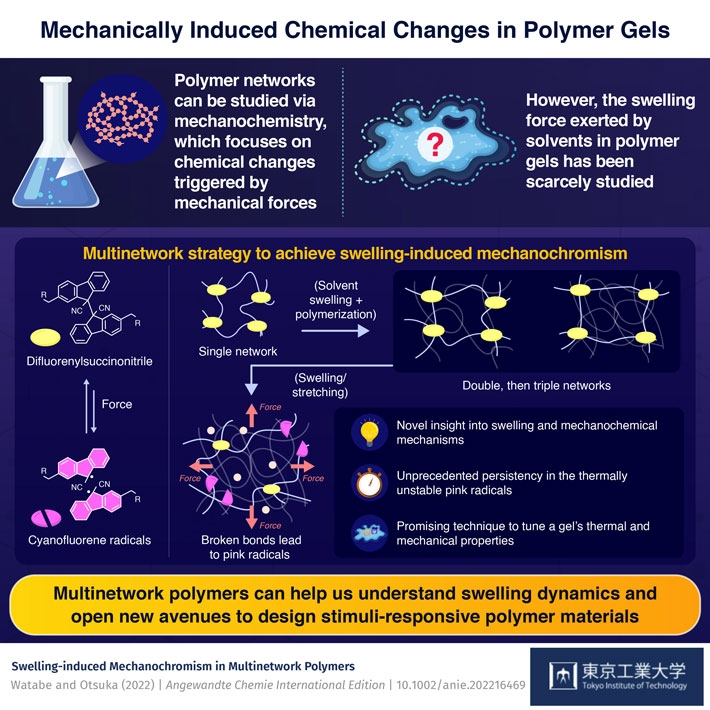
Studying Polymer Gels Through the Lens of Mechanochemistry and Solvent Swelling


Multinetwork polymer gels with color-changing linkers sensitive to mechanical stimuli provide a solid platform to study the dynamics of solvent swelling, as shown by researchers from Tokyo Tech. This innovative approach allowed them to gain detailed insight into the mechanical forces that a gel is subjected to when swollen after absorbing a solvent. Their findings will pave the way to developing new, mechanically responsive materials for many applications.

Polymer gels have become a staple technology in various fields, ranging from optics and drug delivery to carbon capture and batteries. However, there are still many open questions about gels and their network structure, which has prevented scientists from linking their remarkable macroscopic properties to specific molecular mechanisms.

One interesting way to tackle this puzzle is to study it from the lens of mechanochemistry; that is, chemical reactions that are triggered by mechanical stimuli such as compression, stretching, and grinding. To make this process easier, scientists can weave mechanophores into polymer networks. These are molecules that undergo predictable chemical changes upon exposure to mechanical stress. While there are many ways to apply mechanical forces to activate mechanophores in a gel, one has been studied in much less detail than others: solvent swelling.

Tumultuous migration on the edge of the Hot Neptune Desert

Did hot Neptunes ever exist? While astronomers observe gas giants and small rocky planets close to their stars, the SPICE DUNE project is investigating the ‘‘desert’’ of Neptune-sized planets.
Illustration Credit: © Elsa Bersier - CFPArts / ESBDi Genève

A UNIGE team reveals the eventful migration history of planets bordering the Hot Neptune Desert, these extrasolar planets that orbit very close to their star.

 All kinds of exoplanets orbit very close to their star. Some look like the Earth, others like Jupiter. Very few, however, are similar to Neptune. Why this anomaly in the distribution of exoplanets? Researchers from the University of Geneva (UNIGE) and the National Centre of Competence in Research (NCCR) PlanetS have observed a sample of planets located at the edge of this Hot Neptune Desert to understand its creation. Using a technique combining the two main methods of studying exoplanets (radial velocities and transits), they were able to establish that a part of these exoplanets has migrated in a turbulent way near their star, which pushed them out of the orbital plane where they were formed. These results are published in the specialized journal Astronomy & Astrophysics.

Tuesday, January 17, 2023

Wearable, Printable, Shapeable Sensors Detect Pathogens and Toxins in the Environment

“Using the sensor, we can pick up trace levels of airborne SARS-CoV-2, or we can imagine modifying it to adapt to whatever the next public health threat might be,” Omenetto said. Here, a sensor is embedded on a drone.
Photo Credit: Courtesy of Silklab

Researchers at Tufts School of Engineering have developed a way to detect bacteria, toxins, and dangerous chemicals in the environment using a biopolymer sensor that can be printed like ink on a wide range of materials, including wearable items such as gloves, masks, or everyday clothing.

Using an enzyme similar to that found in fireflies, the sensor glows when it detects these otherwise invisible threats. The new technology is described in the journal Advanced Materials.

The biopolymer sensor, which is based on computationally designed proteins and silk fibroin extracted from the cocoons of the silk moth Bombyx Mori, can also be embedded in films, sponges, and filters, or molded like plastic to sample and detect airborne and waterborne dangers, or used to signal infections or even cancer in our bodies.

The researchers demonstrated how the sensor emits light within minutes as it detects the SARS-CoV-2 virus that causes COVID, anti-hepatitis B virus antibodies, the food-borne toxin botulinum neurotoxin B, or human epidermal growth factor receptor 2 (HER2), an indicator of the presence of breast cancer.

Ancient chimaeras were suction feeders, not shell crushers, new research shows

Iniopera reconstruction
Resized Image using AI by SFLORG
Photo Credit: Richard Dearden / University of BIrmingham

A rare three-dimensional fossil of an ancient chimaera has revealed new clues about the diversity of these creatures in the Carboniferous period, some 300 million years ago.

Research led by the Muséum national d'histoire naturelle (MNHN) and the University of Birmingham has shown that an ancient relative of chimaeras – jawed vertebrates that are related to sharks and rays – fed by sucking in prey animals underwater.

The fossil, from a genus called Iniopera, is the only suction feeder to be identified among chimaeras, and quite different from living chimaeras, which feed by crushing mollusks and other hard-shelled prey between their teeth. The research is published in the journal PNAS.

New method for designing tiny 3D materials could make fuel cells more efficient

Authors of the study Professor Richard Tilley and Dr Lucy Gloag.
Photo Credit: UNSW Sydney / Courtesy of the researchers 

Researchers have developed an innovative technique for creating nanoscale materials with unique chemical and physical properties.

Scientists from UNSW Sydney have demonstrated a novel technique for creating tiny 3D materials that could eventually make fuel cells like hydrogen batteries cheaper and more sustainable.

In the study published in Science Advances, researchers from the School of Chemistry at UNSW Science show it’s possible to sequentially ‘grow’ interconnected hierarchical structures in 3D at the nanoscale which have unique chemical and physical properties to support energy conversion reactions.

In chemistry, hierarchical structures are configurations of units like molecules within an organization of other units that themselves may be ordered. Similar phenomena can be seen in the natural world, like in flower petals and tree branches. But where these structures have extraordinary potential is at a level beyond the visibility of the human eye – at the nanoscale.

Excavation of massive underground caverns for DUNE halfway complete

When complete later this year, this cavern will be around 500 feet long, 65 feet wide and 90 feet high. It will be one of three caverns that will provide space to house particle detector modules and other equipment for the Deep Underground Neutrino Experiment.
Photo Credit: David Smith, Fermilab

Deep below the surface in South Dakota, construction crews have been working tirelessly to carve out a network of caverns and tunnels that one day will house a huge neutrino experiment. Their efforts are paying off: With almost 400,000 tons of rock extracted from the earth, the excavation is now half complete.

Once finished, the Long-Baseline Neutrino Facility will be the site of the international Deep Underground Neutrino Experiment. DUNE will focus on studying neutrinos, elusive particles that may hold the answers to many of the universe’s mysteries, such as why our universe is made of matter and how black holes and neutron stars are born. More than 1,000 scientists and engineers from over 30 countries are a part of LBNF/DUNE.

LBNF will provide the space, infrastructure and particle beam for DUNE, hosted by the U.S. Department of Energy’s Fermi National Accelerator Laboratory. It includes underground caverns for a near detector at Fermilab, about 40 miles west of Chicago, and a far detector located 800 miles away at the Sanford Underground Research Facility in South Dakota.

Featured Article

Ketamine high NOT related to treatment success for people with alcohol problems

Photo Credit:  Treedeo.St Studios Scientific Frontline: "At a Glance" Summary Main Discovery : The intensity of the acute psychede...

Top Viewed Articles