. Scientific Frontline

Thursday, January 26, 2023

Kill Dates for Re-Exposed Black Mosses

Cape Rasmussen, one of the study sites mentioned in the paper.
Photo Credit: Derek J. Ford.

In their new paper for the Geological Society of America journal Geology, Dulcinea Groff and colleagues used radiocarbon ages (kill dates) of previously ice-entombed dead black mosses to reveal that glaciers advanced during three distinct phases in the northern Antarctic Peninsula over the past 1,500 years.

The terrestrial cryosphere and biosphere of the Antarctic Peninsula are changing rapidly as “first responders” to polar warming. We know from other studies that large glaciers of the Antarctic Peninsula are responding quickly to warmer summer air temperatures, and scientists have modeled that the glaciers expanded in the past because of cooler temperatures, and not increased precipitation. However, we know much less about how this plays out at sea level where ice, ocean, and sensitive coastal life interact. Knowing when glaciers advanced and retreated in the past would improve our understanding of biodiverse coastal ecosystems—thriving with seals, penguins, and plants—and their sensitivity in the Antarctic Peninsula. One of the limitations of reconstructing glacier history is that there are not that many types of terrestrial archives we can use to constrain past glacier behavior. Re-exposed dead plants, abandoned penguin colonies, and rocks can be dated to better know the timing of permanent snow or glacier advance in the past.

Rapid plant evolution may make coastal regions more susceptible to flooding and sea level rise

Brady Stiller, University of Notre Dame
Photo Credit: Courtesy University of Notre Dame

Evolution has occurred more rapidly than previously thought in the Chesapeake Bay wetlands, which may decrease the chance that coastal marshes can withstand future sea level rise, researchers at the University of Notre Dame and collaborators demonstrated in a recent publication in Science.

 Jason McLachlan, an associate professor in the Department of Biological Sciences, evaluated the role evolution plays in ecosystems in the Chesapeake Bay by studying a type of grass-like plant, Schoenoplectus americanus, also called chairmaker’s bulrush. The research team used a combination of historical seeds found in core sediment samples, modern plants, and computational models to demonstrate that “resurrected” plants were allocating more resources in their roots below ground, allowing them to store carbon more quickly than modern plants.

New virus discovered in whales, dolphins across the Pacific

Photo Credit: Richard Sagredo

A novel virus, potentially fatal to whales and dolphins, has been discovered by researchers at the University of Hawaiʻi Health and Stranding Lab. Prior to its discovery in 10 whale and dolphin host species across the Pacific, the virus was found in only a single marine mammal worldwide, a Longman’s beaked whale stranded on Maui in 2010. The findings were published in Frontiers in Marine Science.

The discovery of beaked whale circovirus (BWCV) in whales and dolphins expands the knowledge of marine mammal species that can become infected with the disease. Circoviruses are DNA viruses that cause disease in birds, pigs and dogs, and in severe cases can become fatal.

“Our study found Cuvier’s beaked whales tested positive for BWCV in Saipan and American Samoa, nearly 4,000 miles away from the first discovered case,” said Kristi West, director of the UH Health and Stranding Lab. “The positive cases found outside of Hawaiʻi were surprising, and indicates that this virus is spread across the Central and Western Pacific and may have a global presence in marine mammals.”

Small-scale octopus fisheries can provide sustainable source of vital nutrients for tropical coastal communities

Photo Credit: Blue Ventures

Research led by Cambridge scientists, and published in Nature Food, shows that tropical small-scale octopus fisheries offer a sustainable source of food and income to communities that face food insecurity, where the prevalence of undernourishment can exceed 40% and stunting in children under five commonly exceeds 30%. 

The high micronutrient density of octopus - including vitamin B12, copper, iron and selenium - means that human populations only need to eat a small quantity to supplement a diet primarily comprising staple plant crops. The new research shows that just a small amount of production in a tropical small-scale octopus fishery can deliver the micronutrient needs to a relatively large number of people.

The fast growth and adaptability of octopuses to environmental change can also facilitate sustainable production, and catch methods in the fisheries - primarily consisting of hand techniques, small-scale lines, pots and traps - are less environmentally harmful than those of large industrial fishing.

Health impact of chemicals in plastics is handed down two generations

UC Riverside mouse study finds paternal exposure to phthalates increases risk of metabolic diseases in progeny
Photo Credit: Meruyert Gonullu

Fathers exposed to chemicals in plastics can affect the metabolic health of their offspring for two generations, a University of California, Riverside, mouse study reports.

Plastics, which are now ubiquitous, contain endocrine disrupting chemicals, or EDCs, that have been linked to increased risk of many chronic diseases; parental exposure to EDCs, for example, has been shown to cause metabolic disorders, including obesity and diabetes, in the offspring.

Most studies have focused on the impact of maternal EDC exposure on the offspring’s health. The current study, published in the journal Environmental International, focused on the effects of paternal EDC exposure.

Led by Changcheng Zhou, a professor of biomedical sciences in the School of Medicine, the researchers investigated the impact of paternal exposure to a phthalate called dicyclohexyl phthalate, or DCHP, on the metabolic health of first generation (F1) and second generation (F2) offspring in mice. Phthalates are chemicals used to make plastics more durable.

Astronomers use novel technique to find starspots

Sunspots
Image Credit: HMI / SFLORG/ Via ESO Helioviewer

Astronomers have developed a powerful technique for identifying starspots, according to research presented this month at the 241st meeting of the American Astronomical Society, and published in the journal Monthly Notices of the Royal Astronomical Society

Our sun is at times dotted with sunspots, cool dark regions on the stellar surface generated by strong magnetic fields, which suppress churning motions and impede the free escape of light. "On other stars, these phenomena are called starspots," said Lyra Cao, lead author of the study and a graduate student in astronomy at The Ohio State University. 

“Our study is the first to precisely characterize the spottiness of stars and use it to directly test theories of stellar magnetism,” said Cao. “This technique is so precise and broadly applicable that it can become a powerful new tool in the study of stellar physics.”

Use of the technique will soon allow Cao and her colleagues to release a catalog of starspot and magnetic field measurements for more than 700,000 stars – increasing the number of these measurements available to scientists by three orders of magnitude.

Researchers Unveil New Collection of Human Brain Atlases that Chart Postnatal Development

Surface-volume atlases from 2 weeks to 24 months.
Image Credit: © 2023, Ahmad et al., CCBY 4.0

Led by Pew-Thian Yap, PhD, researchers at the UNC School of Medicine created monthly infant brain atlases to help researchers analyze the developing brain in detail to investigate neurological disorders and other conditions.

Human brain atlases can be used by medical professionals to track normative trends over time and to pinpoint crucial aspects of early brain development. By using these atlases, they are able to see what typical structural and functional development looks like, making it easier for them to spot the symptoms of abnormal development, such as attention-deficit / hyperactivity disorder (ADHD), dyslexia, and cerebral palsy.

Pew-Thian Yap, PhD, professor in the UNC Department of Radiology, and colleagues in the department and the Biomedical Research Imaging Center (BRIC) have created a new collection of month-by-month infant brain atlas (IBA) that capture fine spatiotemporal details of the early developing brain.

Supplementation with amino acid serine eases neuropathy in diabetic mice

From left: Michal Handzlik and Christian Metallo
Photo Credit: Salk Institute

Approximately half of people with type 1 or type 2 diabetes experience peripheral neuropathy—weakness, numbness, and pain, primarily in the hands and feet. The condition occurs when high levels of sugar circulating in the blood damage peripheral nerves. Now, working with mice, Salk Institute researchers, in collaboration with the University of California San Diego, have identified another factor contributing to diabetes-associated peripheral neuropathy: altered amino acid metabolism.

The study, published in Nature, adds to growing evidence that some often-underappreciated, “non-essential” amino acids play important roles in the nervous system. The findings may provide a new way to identify people at high risk for peripheral neuropathy, as well as a potential treatment option. The team included UC San Diego bioengineering professor Prashant Mali, microbiome expert professor Rob Knight and pathologist Nigel A. Calcutt.

“We were surprised that dialing up and down a non-essential amino acid had such a profound effect on metabolism and diabetic complications,” says senior author Christian Metallo, a professor in Salk’s Molecular and Cell Biology Laboratory. “It just goes to show that what we think of as dogma can change under different circumstances, such as in disease conditions.”

Evolutionary Tuning of a Cellular “Powerhouse”

Profiles of the subunits of individual complexes (top) and overall representation of all around 5200 protein signals in MitCOM.
Image Source | Credit: AG Fackler/Pfanner/Becker

Mitochondria are membrane-enclosed structures found in all cells of higher organisms, where they produce most of the necessary energy (“powerhouses of the cell”). In addition, these organelles serve important functions in the synthesis and degradation of certain biomolecules as well as in numerous intercellular signaling processes. In close collaboration, a team of researchers led by Prof. Dr. Nikolaus Pfanner and Prof. Dr. Bernd Fakler from the University of Freiburg Institutes of Biochemistry and Physiology, respectively, and by Prof. Dr. Thomas Becker from the Institute of Biochemistry at the University of Bonn has now applied a newly developed analytical method to comprehensively map the structural organization of proteins in mitochondria. The results provide initial insight into the structure and organization of the mitochondrial proteins in protein machineries of varying complexity, thus laying the foundation for future studies of new protein functions and structures. This study was published in the journal Nature.

Comprehensive picture of the composition of protein complexes indispensable

Mechanical forces in the nervous system play a corrective role

The researchers visualized the forces acting on dendrites during pruning by measuring their lengths (blue/red) and the angles at dendritic branchpoints: A) before, B) after dendrite severing,
Image Credit: WWU - Rumpf Lab

Researchers at Münster University show in the fruit fly how mechanical tearing cuts neural connections

Nerve cells communicate with one another via long processes known as axons and dendrites, or, more generally, neurites. During development, these processes first grow and form connections with other cells, for example synapses with other nerve cells. Any neurites which are not properly linked, or are no longer needed, are removed by a corrective mechanism known as “pruning”. Such pruning processes can appear drastic, and neurites sometimes seem to be severed directly from the nerve cell. Researchers headed by Dr. Sebastian Rumpf from the Institute of Neuro- and Behavioral Biology at Münster University has now found the mechanism of neurite severing. In a study published in the Journal of Cell Biology, the team show that in sensory nerve cells of the fruit fly Drosophila melanogaster, pruning occurs through mechanical tearing.

Mercury Helps to Detail Earth’s Most Massive Extinction Event

The Karoo Basin in South Africa yields clues about the largest mass extinction in earth's history
Photo Credit: Juanita Swart

Scientific Frontline: "At a Glance" Summary

  • Main Discovery: Mercury isotope signatures found in the southern hemisphere provide definitive evidence linking the Latest Permian Mass Extinction (LPME) to massive volcanic eruptions in the Siberian Traps.
  • Methodology: Researchers analyzed the isotopic composition of mercury preserved in sedimentary rock samples from the Sydney Basin in Australia and the Karoo Basin in South Africa to match chemical signatures with volcanic emissions.
  • Key Data: The event eradicated 80-90% of life on Earth; radiogenic dating and stratigraphic analysis reveal the terrestrial extinction began 200,000 to 600,000 years prior to the primary marine collapse at 251.9 million years ago.
  • Significance: The findings establish that the extinction was not an instantaneous catastrophe but a prolonged biotic crisis that originated on land due to volcanic carbon dioxide emissions and subsequent rapid warming before impacting the oceans.
  • Future Application: These historical data points serve as critical models for predicting the long-term ecological consequences of modern climate change, which mirrors the LPME's rapid injection of greenhouse gases.
  • Branch of Science: Earth Sciences (Geochemistry, Geochronology, and Sedimentology)
  • Additional Detail: This study marks the first time mercury isotope compositions from high southern latitudes have been utilized to bridge significant gaps in the global geological record regarding this extinction event.

Power of cancer drugs may see boost by targeting newly identified pathway

Proteins labeled with colored tags fill the main compartment — but not the nuclei (blue) — of human cervical cancer cells. Green cells contain the protein TRPV2, red cells contain STING, and yellow and orange cells contain a mixture of both. The proteins are part of a newly discovered DNA-protection pathway that potentially could be targeted to improve cancer therapies, according to researchers at Washington University School of Medicine in St. Louis.
Image Credit: Lingzhen Kong

Cells zealously protect the integrity of their genomes, because damage can lead to cancer or cell death. The genome — a cell’s complete set of DNA — is most vulnerable while it is being duplicated before a cell divides. Cancer cells constantly are dividing, so their genomes are constantly in jeopardy.

Researchers at Washington University School of Medicine in St. Louis has identified a previously unknown signaling pathway cells use to protect their DNA while it is being copied. The findings, published in the journal Molecular Cell, suggest that targeting this pathway potentially could boost the potency of cancer therapeutics.

“A cell that can’t protect its genome is going to die,” said senior author Zhongsheng You, a professor of cell biology and physiology. “This entire pathway we found exists to protect the genome so the cell can survive in the face of replication stress. By combining inhibitors of this pathway with chemotherapy drugs that target the DNA replication process, we potentially could make such drugs more effective.”

Pioneering approach advances study of CTCF protein in transcription biology

Scientists at St. Jude collaborated to better understand CTCF. L to R: Beisi Xu, PhD, Chunliang Li, PhD; Judith Hyle; Mohamed Nadhir Djekidel, PhD.
Photo Credit: St. Jude Children's Research Hospital

Scientists at St. Jude Children’s Research Hospital used the auxin-inducible degron 2 system on CTCF, bringing the novel approach to bear on a fundamental protein.

CTCF is a critical protein known to play various roles in key biological processes such as transcription. Scientists at St. Jude Children’s Research Hospital used a next-generation protein degradation technology to study CTCF. Their work revealed the superiority of the approach in addition to providing functional insights into how CTCF regulates transcription. The study, published today in Genome Biology, paves the way for more clear, nuanced studies of CTCF.

Transcription is an essential biological process where DNA is copied into RNA. The process is the first required step in a cell to take the instructions housed in DNA and ultimately translate that code into the amino acid or polypeptide building blocks that become active proteins. Dysregulated transcription plays a role in many types of pediatric cancer. Finding ways to modify or target aspects of the transcriptional machinery is a novel frontier in the search for vulnerabilities that can be exploited therapeutically.

While the biology of CTCF has been extensively studied, how the different domains (parts) of CTCF function in relation to transcription regulation remains unclear.

Fossils of Arctic primate relatives tell climate-adaptation story

Artist's reconstruction of Ignacius dawsonae surviving six months of winter darkness in the extinct warm temperate ecosystem of Ellesmere Island, Arctic Canada.
Illustration Credit: Kristen Miller, Biodiversity Institute, University of Kansas.

Two sister species of near-primate, called “primatomorphans,” dating back about 52 million years have been identified by researchers at the University of Kansas as the oldest to have dwelled north of the Arctic Circle. The findings was published in the peer-reviewed journal PLOS ONE.

According to lead author Kristen Miller, doctoral student with KU’s Biodiversity Institute and Natural History Museum, both species — Ignacius mckennai and I. dawsonae — descended from a common northbound ancestor who possessed a spirit “to boldly go where no primate has gone before.”

The specimens were discovered on Ellesmere Island, Nunavut, Canada, in layers of sediment linked with the early Eocene, an epoch of warmer temperatures that could foretell how ecosystems will fare in coming years due to human-driven climate change.

“No primate relative has ever been found at such extreme latitudes,” Miller said. “They’re more usually found around the equator in tropical regions. I was able to do a phylogenetic analysis, which helped me understand how the fossils from Ellesmere Island are related to species found in midlatitudes of North America — places like New Mexico, Colorado, Wyoming and Montana. Even down in Texas we have some fossils that belong to this family as well.”

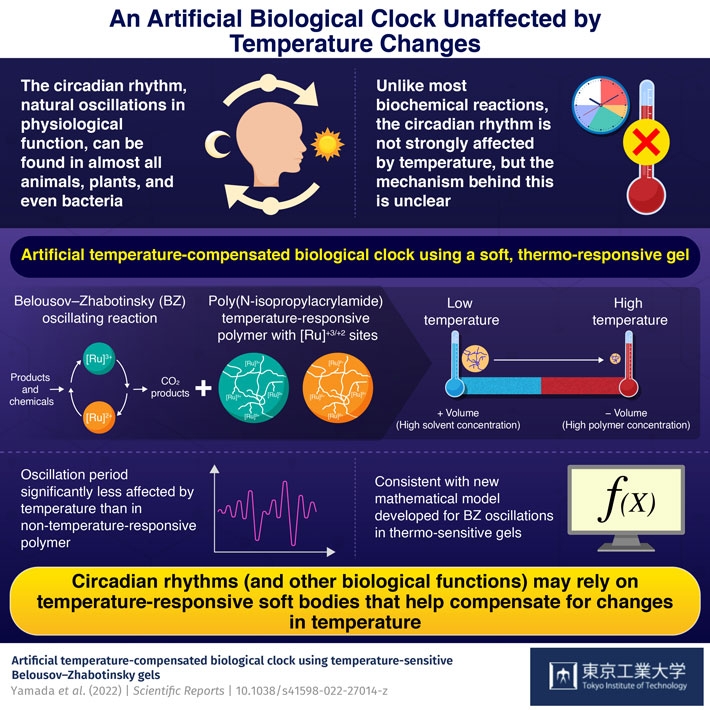
Mimicking an Enigmatic Property of Circadian Rhythms through an Artificial Chemical Clock


An innovative temperature-compensation mechanism for oscillating chemical reactions based on temperature-responsive gels has been recently reported by researchers at Tokyo Tech. Their experimental findings, alongside a detailed mathematical analysis, hint at the possibility that circadian rhythms found in nature may all rely on a similar mechanism, allowing their period to remain independent of temperature.

Circadian rhythms are natural, internal oscillations that synchronize an organism's behaviors and physiological processes with their environment. These rhythms normally have a period of 24 hours and are regulated by internal chemical clocks that respond to cues from outside the body, such as light.

Although well studied in animals, plants, and bacteria, circadian rhythms all share an enigmatic property—the oscillation period is not significantly affected by temperature, even though the rate of most biochemical reactions changes exponentially with temperature. This clearly indicates that some sort of temperature-compensation mechanism is at play. Interestingly, some scientists have managed to replicate such temperature-invariant qualities in certain oscillating chemical reactions. However, these reactions are often troublesome and require extremely precise adjustments on the reacting chemicals.

Featured Article

Ketamine high NOT related to treatment success for people with alcohol problems

Photo Credit:  Treedeo.St Studios Scientific Frontline: "At a Glance" Summary Main Discovery : The intensity of the acute psychede...

Top Viewed Articles