. Scientific Frontline

Tuesday, October 19, 2021

Interferon does not improve outcomes for hospitalized adults with COVID-19

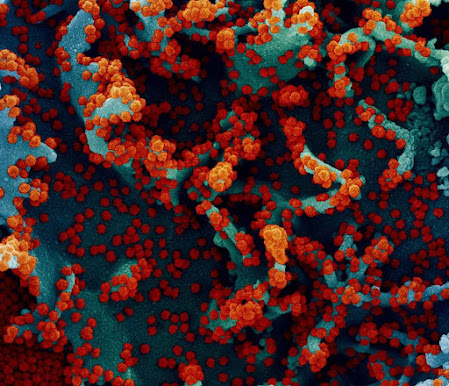
Colorized scanning electron micrograph of a human cell
heavily infected with SARS-CoV-2 virus particles (red). NIAID
 A clinical trial has found that treatment with the immunomodulator interferon beta-1a plus the antiviral remdesivir was not superior to treatment with remdesivir alone in hospitalized adults with COVID-19 pneumonia. In addition, in a subgroup of patients who required high-flow oxygen, investigators found that interferon beta-1a was associated with more adverse events and worse outcomes. These findings were published today in the journal The Lancet Respiratory Medicine.

The study, called the Adaptive COVID-19 Treatment Trial 3 (ACTT-3), took place from August 5, 2020 to December 21, 2020. It was sponsored and funded by the National Institute of Allergy and Infectious Diseases (NIAID), part of the National Institutes of Health.

Interferon beta-1a has the same amino acid sequence as a naturally occurring protein called interferon beta, which is in a class of proteins called type 1 interferons. Infected cells normally produce type 1 interferons to help the immune system fight pathogens, especially viruses. Interferon beta has both antiviral and anti-inflammatory properties.

Laboratory studies have shown that the normal type 1 interferon response is suppressed after infection with SARS-CoV-2, the virus that causes COVID-19. In addition, previous studies of hospitalized patients with COVID-19 demonstrated reduced production of interferon in response to SARS-CoV-2 infection in many patients, and this was associated with more severe disease. Other laboratory studies and clinical data supported the hypothesis that treatment with interferon beta-1a might improve health outcomes in people with COVID-19.

Monday, October 18, 2021

Fasting is required to see the full benefit of calorie restriction in mice

Over the last few decades, scientists have discovered that long-term calorie restriction provides a wealth of benefits in animals: lower weight, better blood sugar control, even longer lifespans.

Researchers have largely assumed that reduced food intake drove these benefits by reprogramming metabolism. But a new study from University of Wisconsin­–Madison researchers finds that reduced calorie intake alone is not enough; fasting is essential for mice to derive full benefit.

The new findings lend support to preliminary evidence that fasting can boost health in people, as trends like intermittent fasting continue to hold sway. These human and animal studies have added to the growing picture of how health is controlled by when and what we eat, not just how much.

The research further emphasizes the complexity of nutrition and metabolism and provides guidance to researchers trying to untangle the true causes of diet-induced health benefits in animals and humans.

The researchers discovered that, combined with eating less, fasting reduces frailty in old age and extends the lifespan of mice. And fasting alone can improve blood sugar and liver metabolism.

Surprisingly, mice that ate fewer calories but never fasted died younger than mice that ate as much as they wanted, suggesting that calorie restriction alone may be harmful.

Cell fitness used to determine outcomes in COVID patients

Cell fitness has been identified as a way of predicting health outcomes in COVID patients, according to a University of Queensland study.

The study investigated a cellular fitness marker, known as hfwe-Lose, to identify sub-optimal cells in patients who had been hospitalized or died from COVID at the start of the pandemic.

UQ Diamantina Institute’s Dr Arutha Kulasinghe said researchers conducted post-mortem analysis on COVID-infected lung tissues and found that the cell fitness marker influenced a person’s immune response to infection.

“We found that patients with acute lung injury had higher levels of the biomarker in their lower respiratory tract and areas of cell death,” Dr Kulasinghe said.

“More importantly, we also found that the cell fitness marker outperformed conventional methods, such as age, inflammation and co-existing diseases, in predicting health outcomes, such as hospitalization and death, in COVID patients.”

Assessing the level of risk in developing severe COVID infection is an important consideration in the management of the current pandemic.

Dr Kulasinghe said the study findings might be useful in the early triage of patients who test positive for COVID as the cell fitness marker could be identified via a simple nasal swab.

“The cell fitness marker would enable medical teams to identify patients more likely to develop severe symptoms, provide closer monitoring and earlier access to hospitalization and intensive care,” he said.

“We are now looking to validate our findings in larger patient populations to determine the robustness of the marker.

“The cell fitness marker is part of the body’s process for removing unwanted cells."

This study was conducted in partnership with the University of Copenhagen

Source/Credit: University of Queensland

scn101821_04

J&J coronavirus vaccine produces low antibody response

Photo by Frank Merino from Pexels
In a head-to-head comparison of the three widely used coronavirus vaccines in the United States, the Johnson & Johnson vaccine yielded a strikingly lower antibody response in a Stanford School of Medicine-led study published in the Journal of the American Society of Nephrology.

The study, which analyzed early vaccine immune response in 2,099 dialysis patients, found that 33% of those vaccinated with Johnson & Johnson did not develop coronavirus antibodies, compared with 4% of those who received the Pfizer-BioNTech vaccine and 2% who received the Moderna vaccine. The study is one of the first to compare immune response associated with antibody levels using the same blood test for all three vaccines.

“We weren’t expecting this large a difference between vaccines,” said Shuchi Anand, MD, assistant professor of nephrology and a lead author of the study. “Since part of the rationale for boosters is waning antibody response, our study strongly argues for the need for booster shots for Johnson & Johnson, particularly in the immunocompromised population.”

Less protection

Pablo Garcia, MD, a postdoctoral scholar in nephrology and co-lead author of the study, agreed that people vaccinated with the J&J vaccine are probably less protected from the coronavirus and will “most likely need a booster shot.”

The researchers, who set out to analyze antibody response in the early post-vaccination period, collaborated with a nonprofit dialysis provider that treats kidney patients undergoing dialysis in California, Tennessee, Texas and New Jersey. The tests were conducted between 28 and 60 days after each patient had been fully vaccinated.

A new treatment for glaucoma?

Photo by Ksenia Chernaya from Pexels
A Northwestern Medicine study in mice has identified new treatment targets for glaucoma, including preventing a severe pediatric form of glaucoma, as well as uncovering a possible new class of therapy for the most common form of glaucoma in adults.

In people with high pressure glaucoma, fluid in the eye doesn’t properly drain and builds up pressure on the optic nerve, leading to vision loss. It affects 60 million people worldwide and is the most common cause of blindness in people over 60 years old.

While there are a few treatments available for open angle glaucoma, the most common form of glaucoma in adults (eye drops, oral medication, laser treatments), there are no cures, and a severe form of glaucoma in children between birth and three years old known as primary congenital glaucoma can only be treated with surgery.

“Although primary congenital glaucoma is much rarer than open angle glaucoma, it is devastating for children,” said corresponding author Dr. Susan Quaggin, chief of nephrology and hypertension in the Department of Medicine at Northwestern University Feinberg School of Medicine. “New treatments and new classes of treatments are urgently needed to slow vision loss in both forms.

Using gene editing, the scientists in the study developed new models of glaucoma in mice that resembled primary congenital glaucoma. By injecting a new, long-lasting and non-toxic protein treatment (Hepta-ANGPT1) into mice, the scientists were able to replace the function of genes that, when mutated, cause glaucoma. With this injectable treatment, the scientists also successfully prevented glaucoma from ever forming in one model. This same therapy, when injected into the eyes of healthy adult mice, reduced pressure in the eyes, supporting it as a possible new class of therapy for the most common cause of glaucoma in adults (high intraocular pressure open angle glaucoma).

The study, “Cellular crosstalk regulates the aqueous humor outflow pathway and provides new targets for glaucoma therapies," was published Oct. 18 in the journal Nature Communications. (PDF)

The next step is to develop the appropriate delivery system for the successful new protein treatment in patients and bring it to production, Quaggin said.

Uncovering the secrets of ultra-low frequency gravitational waves

An artist's impression of the colliding bubbles that can produce extremely low frequency gravitational waves during a cosmological phase transition in the early Universe.
Image credit: Riccardo Buscicchio.

New methods of detecting ultra-low frequency gravitational waves can be combined with other, less sensitive measurements to deliver fresh insights into the early development of our universe, according to researchers at the University of Birmingham.

Gravitational waves - ripples in the fabric of Einstein's spacetime - that cross the universe at the speed of light have all sorts of wavelengths, or frequencies. Scientists have not yet managed to detect gravitational waves at extremely low ‘nanohertz’ frequencies, but new approaches currently being explored are expected to confirm the first low frequency signals quite soon.

The main method uses radio telescopes to detect gravitational waves using pulsars – exotic, dead stars, that send out pulses of radio waves with extraordinary regularity. Researchers at the NANOGrav collaboration, for example, use pulsars to time to exquisite precision the rotation periods of a network, or array, of millisecond pulsars – astronomers’ best approximation of a network of perfect clocks - spread throughout our galaxy. These can be used to measure the fractional changes caused by gravitational waves as they spread through the universe.

How can we eat without cooking the planet?


Oxford experts in the run up to the COP26 climate conference, Professor Jebb points out that agriculture accounts for more CO2 emissions than transportation, and she says ‘It is the single biggest cause of harm to nature.’   We need governments to make some structural changes in the food system, says Professor Jebb, but, meanwhile, we can all make a start by doing three things:    Avoid eating too much  Cut down on waste  Reduce consumption of meat and dairy

She says, some people have given up meat altogether but, Professor Jebb maintains, 'Although animals produce emissions, they are an important part of our agriculture eco-systems and provide important nutrients.'   But we need to reduce the global demand for meat, so countries that currently eat a lot of meat need to cut down. That would be good for health and the environment.  ‘Eating less meat will be  a win for people and the planet,’ she says.

Source/Credit: University of Oxford

en101821_01

Genetic risk for clinical depression linked to physical symptoms

Dr Enda Byrne
People with higher genetic risk of clinical depression are more likely to have physical symptoms such as chronic pain, fatigue and migraine, University of Queensland researchers have found.

Dr. Enda Byrne from UQ’s Institute for Molecular Bioscience said depression was a serious disorder with lifetime risks of poor health.

“A large proportion of people with clinically-diagnosed depression present initially to doctors with physical symptoms that cause distress and can severely impact on people’s quality of life,” Dr. Byrne said.

Our research aimed to better understand the biological basis of depression and found that assessing a broad range of symptoms was important.

“Ultimately, our research aimed to better understand the genetic risks and generate more accurate risk scores for use in research and healthcare.”

Despite recent breakthroughs, Dr. Byrne said finding additional genetic risk factors was difficult because of the variety of patient ages, their symptoms, responses to treatment and additional mental and physical disorders.

Sunday, October 17, 2021

Invasive Species Increasingly Threaten Protected Areas Worldwide

China's famous Red Marshes, a protected area and vital shorebird
habitat that is increasingly being overrun by invasive grasses
that are smothering the red plants.
Photo credit: Hong'an Ding

Scientific Frontline: "At a Glance" Summary

  • Main Discovery: Invasive species, specifically non-native cordgrass, are aggressively displacing native flora in protected coastal wetlands, effectively converting critical habitats into "green deserts" despite successful mitigation of human disturbances.
  • Methodology: Researchers utilized remote sensing technology to analyze a 30-year time series of satellite imagery from Google Earth Engine, comparing rates of wetland loss and cordgrass invasion across seven major protected areas and unprotected control sites along China’s Yellow Sea.
  • Key Data: While wetland loss caused by human activities was significantly slower in protected zones, the expansion of invasive plants was substantially higher in four of the protected areas compared to their unprotected counterparts.
  • Significance: The study challenges the prevailing ecological theory that human disturbance is the primary driver of biological invasion, demonstrating that protected areas remain highly vulnerable to invasive species even when human impact is minimized.
  • Future Application: Conservation management protocols must be updated to include active defense mechanisms against biological invaders in low-elevation mudflats, rather than relying solely on the restriction of human activity to maintain ecosystem health.
  • Branch of Science: Marine Conservation Biology and Coastal Ecology
  • Additional Detail: The research specifically highlighted the degradation of China's "Red Beach" marshes, a vital migratory bird stopover where iconic native red succulent plants are being smothered by invasive grasses.

Friday, October 15, 2021

Carbon from a cosmic source

Partners in space: massive stars often occur in close binary systems in which one star takes mass from its companion. New research has now shown that these systems produce about twice as much carbon as individual, massive stars. © ESO/M. Kornmesser / S.E. de Mink
Computer simulations show that binary stars produce a large amount of this vital element

Many things work better in pairs. The production of chemical elements is no exception. Many elements are formed inside stars during fusion processes. Carbon plays an important role in this because it is the basis of life and thus ultimately of human beings. But how effective is the cosmic source of this important building block? A study led by the Max Planck Institute for Astrophysics shows that massive stars produce twice as much carbon when they have a companion star.

The researchers know that massive stars are essential in the synthesis of all heavy elements – from carbon and oxygen to iron. Although most of these stellar heavyweights are born in multiple star systems, previous models have looked almost exclusively at single stars. An international team led by Robert Farmer from the Max Planck Institute for Astrophysics in Garching has now calculated the carbon footprint of massive stars that are partners in a binary system.

Featured Article

First Global Map Reveals the Deep Reach of Ocean Tides into Coastal Rivers

Photo Credit:  Jon Flobrant Scientific Frontline: Extended "At a Glance" Summary : Riverine Tidal Dynamics The Core Concept : The ...

Top Viewed Articles