
 |
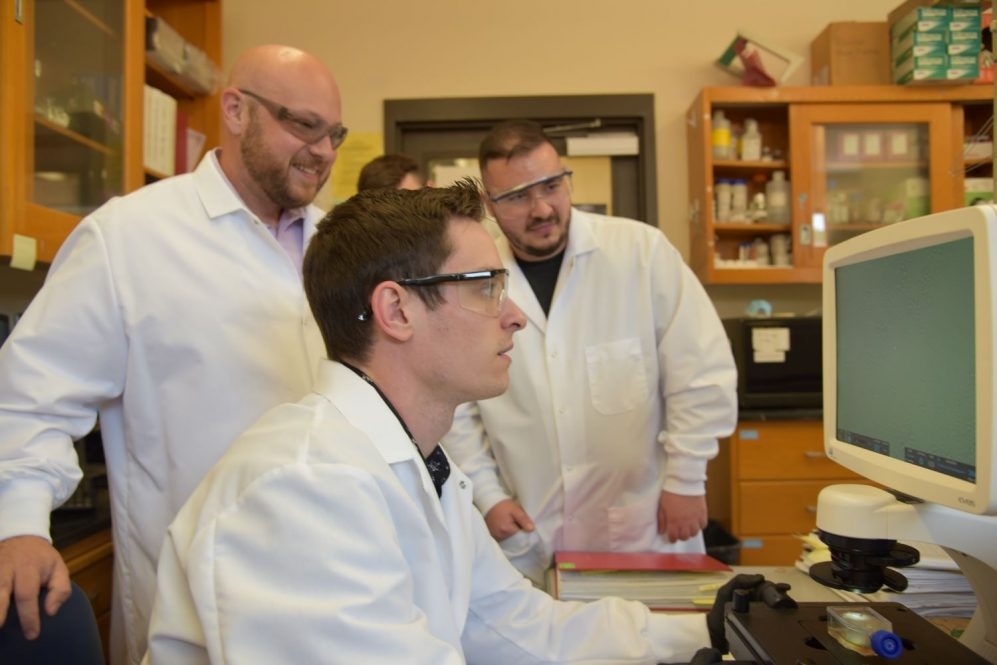
| Associate Professor Steven Szczepanek (standing, left) with graduate students Tyler Gavitt (seated) and Arlind Mara (standing, right). Photo Credit: Jason Sheldon/UConn |
Researchers in the College of Agriculture, Health and Natural Resources are working to unlock a decades-long mystery that has hampered development of a walking pneumonia vaccine.
Associate Professor Steven Szczepanek and Professor Steven Geary from the Department of Pathobiology and Veterinary Science, along with former graduate students Tyler Gavitt and Arland Mara, published findings that help explain how Mycoplasma pneumoniae (Mp) hijacks our immune system following vaccination.
They shared their findings in two recent publications in Nature journal npj Vaccines.
Mp is a common pathogen that causes walking pneumonia. While this respiratory infection is not typically severe, it is a common co-pathogen with illnesses that spread in the same way, like the flu or COVID-19, which can cause more severe illnesses, especially in older or immunocompromised adults.
In the 1960s, scientists began working to develop an Mp vaccine. They killed the bacteria and injected it into human subjects, thinking it would provide protection from actual infection. But that’s not what happened.
.jpg)


.jpg)


.jpg)