. Scientific Frontline

Sunday, February 5, 2023

Researchers identify the neurons that synchronize female preferences with male courtship songs in fruit flies

Researchers discovered the strength of the response of a specific component of the auditory neuron circuit (shown in green) partly explain the fruit flies’ preferences for specific rhythms.
Image Credit: Takuro S. Ohashi 

When it comes to courtship, it is important to ensure that one is interacting with a member of the same species. Animals use multiple sensory systems to confirm that potential mates are indeed suitable, with acoustic communication playing an important role in their decision making.   

Although these differences have previously been reported at the behavioral level, it is not known how the neuronal circuitry underlying this decision-making has diverged between species. Now, in a new publication in Scientific Reports, a research group at Nagoya University in Japan has investigated how the auditory processing pathway has evolved and diverged between fruit fly species.  

Males of several species of Drosophila (fruit flies), which are regularly used in neuroscience research, vibrate their wings rhythmically during courtship, producing a courtship song. The temporal components of these songs differ between species, allowing female flies to distinguish between potential mates. 

Decades-old crustaceans coaxed from lake mud give up genetic secrets revealing evolution in action

 An ancient Daphnia pulicaria individual resurrected from South Center Lake (Minnesota, USA). This individual was hatched from an egg recovered from sediments that date back to circa 1418-1301 A. D. OU scientists have recently studied other members of this species to understand rapid evolution to human-caused pollution in lake ecosystems.
Image Credit: Dagmar Frisch

Human actions are changing the environment at an unprecedented rate. Plant and animal populations must try to keep up with these human-accelerated changes, often by trying to rapidly evolve tolerance to changing conditions.

University of Oklahoma researchers Lawrence Weider, professor of biology, and Matthew Wersebe, a biology doctoral candidate, demonstrated rapid evolution in action by sequencing the genomes of a population of Daphnia pulicaria, an aquatic crustacean, from a polluted lake.  

The research, which was conducted as part of Wersebe’s doctoral dissertation, was recently published in the Proceedings of the National Academy of Sciences.  Wersebe and Weider revived decades-old Daphnia resting eggs from lake sediments, a method known as resurrection ecology, which has been refined in Weider’s lab over the past several decades. They then sequenced the entire genomes of 54 different Daphnia individuals from different points-in-time, allowing them to study the genetics and evolution of the population.

Study reveals new clues about how 'Earth's thermostat' controls climate

The Amazon, Earth’s largest river, transporting weathering solutes from the Andes to the Atlantic Ocean in Brazil.
Photo Credit: Michael Vite

Rocks, rain and carbon dioxide help control Earth’s climate over thousands of years — like a thermostat — through a process called weathering. A new study led by Penn State scientists may improve our understanding of how this thermostat responds as temperatures change.

“Life has been on this planet for billions of years, so we know Earth’s temperature has remained consistent enough for there to be liquid water and to support life,” said Susan Brantley, Evan Pugh University Professor and Barnes Professor of Geosciences at Penn State. “The idea is that silicate rock weathering is this thermostat, but no one has ever really agreed on its temperature sensitivity.”

Because many factors go into weathering, it has been challenging to use results of laboratory experiments alone to create global estimates of how weathering responds to temperature changes, the scientists said.

The team combined laboratory measurements and soil analysis from 45 soil sites around the world and many watersheds to better understand weathering of the major rock types on Earth and used those findings to create a global estimate for how weathering responds to temperature.

Friday, February 3, 2023

Antibody possible treatment for severe fatty liver disease

Micrograph of non-alcoholic fatty liver disease (NAFLD). Masson's trichrome & Verhoeff stain. The liver has a prominent (centrilobular) macrovesicular steatosis (white/clear round/oval spaces) and mild fibrosis (green). The hepatocytes stain red.  Macrovesicular steatosis is lipid accumulation that is so large it distorts the cell's nucleus.
Image Credit: Nephron CC BY-SA 3.0

There is currently no drug for treating non-alcoholic fatty liver disease, which affects many people with type 2 diabetes and which can result in other serious liver diseases. A study led by researchers from Karolinska Institutet has now identified a drug candidate for the treatment of fatty liver. The preclinical study, published in the Journal of Hepatology, indicates that an antibody that blocks the protein VEGF-B presents a possible therapeutic option for fatty liver disease.

“Fatty liver is associated with several serious and sometimes fatal diseases,” says the study’s first author Annelie Falkevall, researcher at the Department of Medical Biochemistry and Biophysics, Karolinska Institutet, Sweden. “With the therapeutic principle that we’ve developed, it might be possible to prevent fatty liver and hopefully lower the risk of liver failure and terminal liver cancer.”

For decades, obesity and overweight have been a common global disease that, amongst other problems, has caused a sharp rise in the incidence of type 2 diabetes. According to the Swedish Diabetes Association, there are 500,000 cases of diabetes in Sweden alone, of which 85 to 90 percent are type 2.

Harmful bacteria can elude predators when in mixed colonies

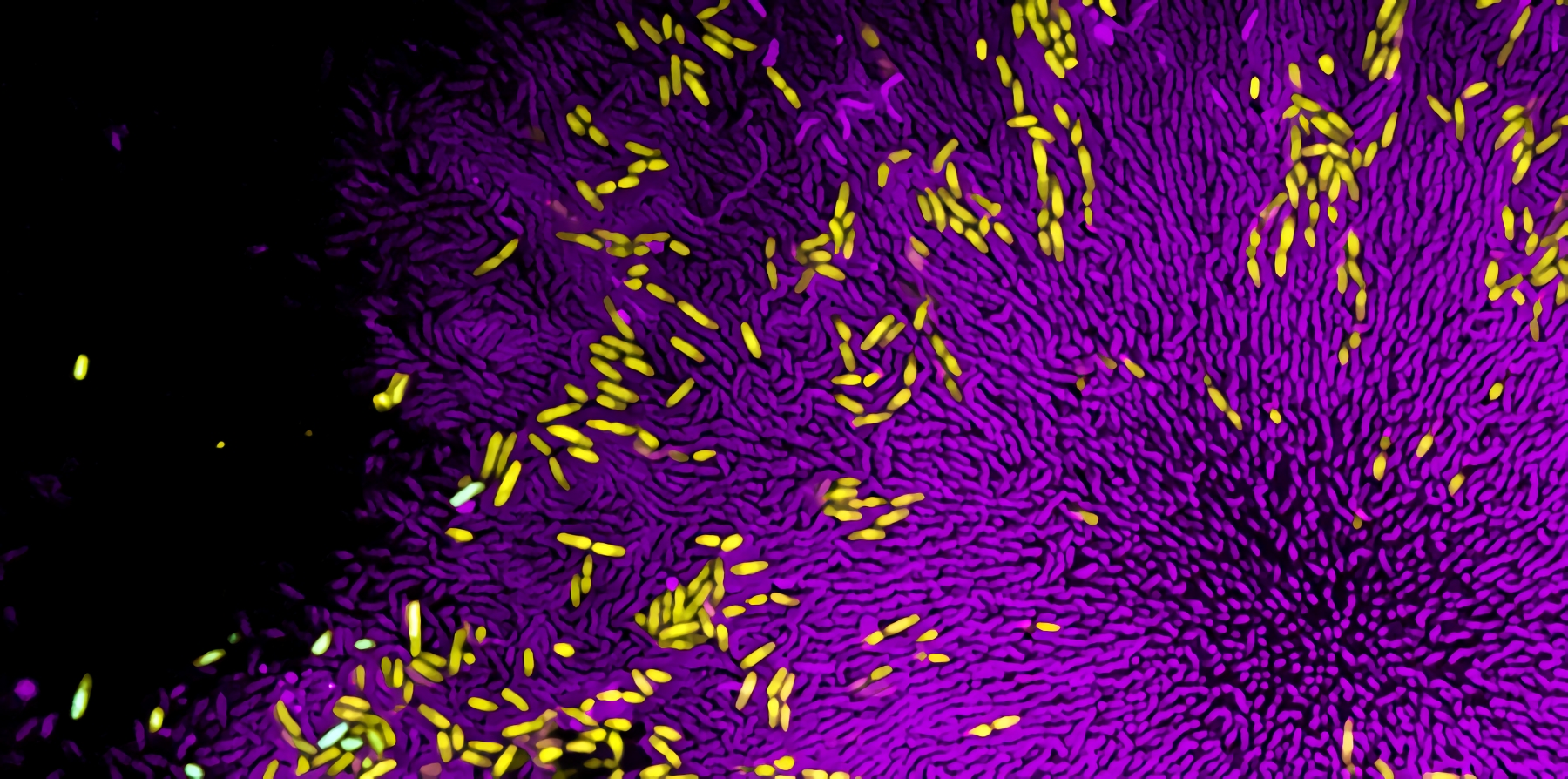
 Colonies of the bacterium V. cholerae (purple) insulate E. coli (yellow) from its natural predator
Image Credit: James Winans

Efforts to fight disease-causing bacteria by harnessing their natural predators could be undermined when multiple species occupy the same space, according to a study by Dartmouth College researchers.

When growing in mixed colonies, some harmful bacteria may be able to withstand attacks from the bacteria and viruses that target them by finding protection inside groups of rival species, according to a report published in the Proceedings of the National Academy of Sciences.

The researchers found that the intestinal bacterium Escherichia coli became surrounded by tightly packed colonies of Vibrio cholerae — which causes the deadly disease cholera — when the species were grown together. These clusters protected E. coli from the bacteria Bdellovibrio bacteriovorus that preys on both species individually, but in the study could only kill the outer layer of V. cholerae. This left the unscathed cells of E. coli and V. cholerae insulated within the colonies free to multiply.

Robots and A.I. team up to discover highly selective catalysts

Close up of the semi-automated synthesis robot used to generate training data
Photo Credit: ICReDD

Researchers used a chemical synthesis robot and computationally cost effective A.I. model to successfully predict and validate highly selective catalysts.

Artificial intelligence (A.I.) has made headlines recently with the advent of ChatGPT’s language processing capabilities. Creating a similarly powerful tool for chemical reaction design remains a significant challenge, especially for complex catalytic reactions. To help address this challenge, researchers at the Institute for Chemical Reaction Design and Discovery and the Max Planck Institut für Kohlenforschung have demonstrated a machine learning method that utilizes advanced yet efficient 2D chemical descriptors to accurately predict highly selective asymmetric catalysts—without the need for quantum chemical computations.  

“There have been several advanced technologies which can “predict” catalyst structures, but those methods often required large investments of calculation resources and time; yet their accuracy was still limited,” said joint first author Nobuya Tsuji. “In this project, we have developed a predictive model which you can run even with an everyday laptop PC.”

Signal transmission in the immune and nervous system using NEMO

Jörg Tatzelt, Konstanze Winklhofer and Simran Goel (from left) carried out the investigations together.
 Photo Credit: RUB, Marquard

Certain biomolecules in the form of active complexes temporarily accumulate in cells. This can be crucial for their functionality.

When transmitting signals within cells, many individual steps interlock. Among other things, proteins are provided with certain building blocks that switch their function on or off. In order to ensure fast signal transmission, these building blocks accumulate in the cell at certain locations for a limited time; Researchers speak of biomolecular condensates. A team around Prof. Dr. Konstanze Winklhofer, head of the Molecular Cell Biology Chair at the Ruhr University Bochum, has shown that the NEMO protein also forms condensates and which mechanism underlies NEMO condensate formation. The findings are important for understanding signal transmissions in the immune and nervous systems. The researchers report in the Life Science Alliance journal.

Thursday, February 2, 2023

Small isolated wetlands are pollution-catching powerhouses

Photo Credit: Herbert Aust

Small isolated wetlands that are full for only part of the year are often the first to be removed for development or agriculture, but a new study shows that they can be twice as effective in protecting downstream lake or river ecosystems than if they were connected to them. 

Using a new method involving satellite imagery and computer modelling, researchers from the University of Waterloo found that since these small wetlands are disconnected, pollutants such as nitrogen and phosphorous get trapped. This is the first study to use satellite data for estimating nutrient retention. 

All wetlands act like sponges, providing flood protection by absorbing the vast volume of water that can be suddenly released from rainfall or snowmelt. Improving water quality, providing habitat, increasing biodiversity and trapping carbon are just some of the many environmental benefits wetlands provide. Their destruction increases our vulnerability to the extreme effects of climate change, including flooding, drought and the frequency of storms. 

Researchers devise a new path toward ‘quantum light’

Photo Credit: Scientific Frontline stock image

The researchers, from the University of Cambridge, along with colleagues from the US, Israel and Austria, developed a theory describing a new state of light, which has controllable quantum properties over a broad range of frequencies, up as high as X-ray frequencies. Their results are reported in the journal Nature Physics.

The world we observe around us can be described according to the laws of classical physics, but once we observe things at an atomic scale, the strange world of quantum physics takes over. Imagine a basketball: observing it with the naked eye, the basketball behaves according to the laws of classical physics. But the atoms that make up the basketball behave according to quantum physics instead.

“Light is no exception: from sunlight to radio waves, it can mostly be described using classical physics,” said lead author Dr Andrea Pizzi, who carried out the research while based at Cambridge’s Cavendish Laboratory. “But at the micro and nanoscale so-called quantum fluctuations start playing a role and classical physics cannot account for them.”

Algae bio hacks itself in adapting to climate change

Phytoplankton - the foundation of the oceanic food chain.
Photo Credit: NOAA

Clear evidence that marine phytoplankton are much more resilient to future climate change than previously thought is the focus of a study published in Science Advances by an international team of scientists, including University of Hawaiʻi at Mānoa oceanography professor David Karl.

“Knowing how marine algae will respond to global warming and to associated decline of nutrients in upper ocean waters is crucial for understanding the long-term habitability of our planet,” said Karl.

Combining data from the long-term Hawaiʻi Ocean Time-series program at UH Mānoa with new climate model simulations conducted on one of South Korea’s fastest supercomputers, the scientists revealed that a mechanism, known as nutrient uptake plasticity, allows marine algae to adapt and cope with nutrient-poor ocean conditions that are expected to occur over the next decades in response to global warming of the upper ocean.

Featured Article

Hidden magma oceans could shield rocky exoplanets from harmful radiation

UNDER ARMOR? Deep layers of molten rock inside some super-earths could generate powerful magnetic fields—potentially stronger than Earth’s—a...

Top Viewed Articles