
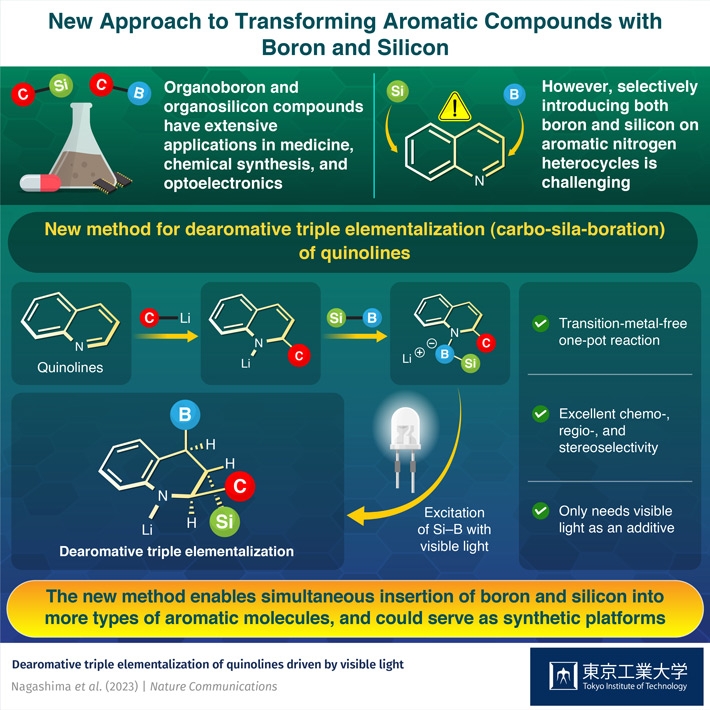
A technique for easily modifying quinolines with carbon, boron, and silicon groups simultaneously has been unveiled by scientists at Tokyo Tech. With organoboron and organosilicon compounds becoming more and more important in pharmaceuticals, the novel technique could facilitate the development of new drugs. Moreover, modified quinolines can be readily used as convenient scaffolds for synthesizing organic chemicals.
In recent years, organic chemicals containing boron (B) and silicon (Si) have found applications in various fields, including optoelectronics and pharmaceuticals. Moreover, they can also serve as building blocks for complex organic chemicals. As a result, scientists are actively looking for new ways to leverage these versatile chemical tools as well as produce more kinds of organosilicon and organoboron compounds.
One limitation of the synthesis methods currently available for these chemicals is that we cannot introduce multiple B- and Si-containing groups in aromatic nitrogen heterocycles, i.e., carbon rings in which one of the carbon atoms is replaced by a nitrogen atom. If we could produce and freely transform such molecules, it would unlock the synthesis of several compounds relevant in medicinal chemistry.
.jpg)
.jpg)


.jpg)

.jpg)

.png)


.jpg)