. Scientific Frontline

Thursday, November 11, 2021

New Bird Identified by SDSU Biologists and Collaborators

The Inti tanager (Photo: Ryan Terrill)

The vivid yellow Inti tanager was discovered in Bolivia and Peru.

“If we want to sustain ecosystems, we have to know all the players.”

After persuading his parents to bring home a bird feeder from his relatives’ hardware store, Kevin Burns became captivated by watching his avian visitors. He would flip through pages in a bulky encyclopedia to know which kind of bird was flitting about.

Now an ornithologist and professor of biology at San Diego State University, Burns’s childhood fascination led him and his collaborators to identify a new bird, Heliothraupis oneilli, not previously described in any field guide.

The bird’s common name, the Inti tanager, is named after the word for sun in Quechua, the Indigenous language of the tropical mountainous area it inhabits, befitting of its vivid yellow feathers and tendency to sing during midday.

Burns’s colleagues from Louisiana State University first spotted the bird while leading a birdwatching tour over twenty years ago, in the foothills of the Andes mountains in Peru. But they were not able to collect enough genetic material to analyze until 2011 when they found additional Inti tanagers breeding in nearby Bolivia during the rainy season.

Black hole found hiding in star cluster outside our galaxy

This artist’s impression shows a compact black hole 11 times as massive as the Sun and the five-solar-mass star orbiting it. The two objects are located in NGC 1850, a cluster of thousands of stars roughly 160 000 light-years away in the Large Magellanic Cloud, a Milky Way neighbour. The distortion of the star’s shape is due to the strong gravitational force exerted by the black hole.   Not only does the black hole’s gravitational force distort the shape of the star, but it also influences its orbit. By looking at these subtle orbital effects, a team of astronomers were able to infer the presence of the black hole, making it the first small black hole outside of our galaxy to be found this way. For this discovery, the team used the Multi Unit Spectroscopic Explorer (MUSE) instrument at ESO’s Very Large Telescope in Chile.  Credit: ESO/M. Kornmesser
Hi-Res Zoomable Image

Using the European Southern Observatory’s Very Large Telescope (ESO’s VLT), astronomers have discovered a small black hole outside the Milky Way by looking at how it influences the motion of a star in its close vicinity. This is the first time this detection method has been used to reveal the presence of a black hole outside of our galaxy. The method could be key to unveiling hidden black holes in the Milky Way and nearby galaxies, and to help shed light on how these mysterious objects form and evolve.

This image shows NGC1850, a cluster of thousands of stars roughly
160 000 light-years away in the Large Magellanic Cloud.
Credit: ESO, NASA/ESA/M. Romaniello
Hi-Res Zoomable image and Full Caption
The newly found black hole was spotted lurking in NGC 1850, a cluster of thousands of stars roughly 160 000 light-years away in the Large Magellanic Cloud, a neighbor galaxy of the Milky Way.

“Similar to Sherlock Holmes tracking down a criminal gang from their missteps, we are looking at every single star in this cluster with a magnifying glass in one hand trying to find some evidence for the presence of black holes but without seeing them directly,” says Sara Saracino from the Astrophysics Research Institute of Liverpool John Moores University in the UK, who led the research now accepted for publication in Monthly Notices of the Royal Astronomical Society. “The result shown here represents just one of the wanted criminals, but when you have found one, you are well on your way to discovering many others, in different clusters.”

This first “criminal” tracked down by the team turned out to be roughly 11 times as massive as our Sun. The smoking gun that put the astronomers on the trail of this black hole was its gravitational influence on the five-solar-mass star orbiting it.

Wednesday, November 10, 2021

Development of a curious robot to study coral reef ecosystems

A grant by the National Science Foundation to researchers at the Woods Hole Oceanographic Institution (WHOI) and Syracuse University aims to open new avenues of robotic study of coral reefs by developing autonomous underwater vehicles capable of navigating complex environments and of collecting data over long periods of time. The team led by WHOI computer scientist Yogesh Girdhar aims to build a robot capable of navigating a reef ecosystem and measuring the biomass, biodiversity, and behavior of organisms living in or passing through a reef over extended periods of time.

Coral reefs support the health of the ocean and support large numbers of people worldwide. About one in four marine organisms relies on reefs at some point in their lifecycle, and hundreds of millions of people derive food, jobs, and protection from storms and erosion from reef ecosystems. A 2020 report on the status of coral reefs worldwide put the value of benefits reefs provide at $2.7 trillion per year. Despite this, reefs are in decline around the world as a result of rising temperatures, ocean acidification, pollution, and other threats. And scientists are scrambling to better understand complex reef ecosystems and devise ways to deal with a growing crisis.

“The tools we have right now to study coral reefs are pretty primitive,” said Girdhar. “The robots and the sensors we have at the moment can’t capture the spatial and temporal diversity of a reef at the same time. We want to amplify the capability of scientists in the field and the tools they’re using.”

Baby teeth may one day help identify kids at risk for mental disorders later in life

Like the rings of a tree, teeth contain growth lines that may reveal clues about childhood experiences. The thickness of growth marks in primary (or “baby”) teeth may help identify children at risk for depression and other mental health disorders later in life, according to a ground-breaking investigation led by researchers at Massachusetts General Hospital (MGH) using data from a world-renowned health study in Bristol and published in JAMA Network Open.

The team analyzed 70 primary teeth collected from 70 children enrolled in the Children of the 90s study (also known as the Avon Longitudinal Study of Parents and Children) based at the University of Bristol. Parents donated primary teeth (specifically, the pointed teeth on each side of the front of the mouth known as canines) that naturally fell out of the mouths of children aged 5 to 7.

The results of this study could one day lead to the development of a much-needed tool for identifying children who have been exposed to early-life adversity, which is a risk factor for psychological problems, allowing them to be monitored and guided towards preventive treatments, if necessary.

The origin of this study traces back several years, when senior author Erin C. Dunn, ScD, MPH, learned about work in the field of anthropology that could help solve a longstanding problem in her own research. Dunn is a social and psychiatric epidemiologist and an investigator in MGH’s Psychiatric and Neurodevelopmental Genetics Unit. She studies the effects of childhood adversity, which research suggests is responsible for up to one-third of all mental health disorders. Dunn is particularly interested in the timing of these adverse events and in uncovering whether there are sensitive periods during child development when exposure to adversity is particularly harmful. Yet Dunn notes that she and other scientists lack effective tools for measuring exposure to childhood adversity. Asking people (or their parents) about painful experiences in their early years is one method, but that’s vulnerable to poor recall or reluctance to share difficult memories. “That’s a hindrance for this field,” says Dunn.

Gamma ray discovery could advance understanding of UFOs’ role in the evolution of galaxies

Black holes can launch extremely powerful winds, so they’re not eating everything. They are like powerful vacuum cleaners that eject some of the dirt that gets near it instead of sucking in everything. These ejections, which are tsunami-like winds, are made of highly ionized gas. When they interact with the interstellar medium, they create powerful shock waves. – Marco Ajello, an associate professor in Clemson College of Science’s Department of Physics and Astronomy who is co-leading the study.

Using data gathered by the Large Area Telescope onboard NASA’s Fermi Gamma-ray Space Telescope and a stacking technique combining signals too weak to be observed on their own, researchers detected gamma rays from UFOs in several nearby galaxies for the first time, providing a basis for scientists to understand what happened in our own Milky Way galaxy.

UFOs are ultra-fast outflows — powerful winds launched from very near supermassive black holes that scientists believe play an important role in regulating the growth of the black hole itself and its host galaxy.

Clemson University scientists’ collaborative research is published in The Astrophysical Journal. Partners include the College of Charleston, the University of Chicago, and a host of other researchers who are part of the Fermi-LAT Collaboration, which includes hundreds of scientists from 12 countries. “Gamma rays from Fast Black-Hole Winds” outlines the detection of gamma-ray emission from UFOs launched by supermassive black holes.

Methane’s Short Lifespan Presents Golden Opportunity to Quickly Address Climate Change

Berkeley Lab researcher Sebastien Biraud
(Courtesy Sebastien Biraud)
SĂ©bastien Biraud is a Berkeley Lab scientist leading an effort to identify and mitigate some of the largest emitters of methane in California’s Southern San Joaquin Valley. Methane is a short-lived air pollutant and greenhouse gas capable of warming the atmosphere about 80 times as fast as the far longer-lived carbon dioxide over 20 years. This month the U.S. and European Union launched the Global Methane Pledge at the United Nations Climate Change conference, in recognition of the chance countries have to slow climate change by tackling methane emissions–possibly even before the end of this decade. Countries joining the pledge commit to a collective goal of reducing global methane emissions by at least 30% from 2020 levels before 2030 with a particular focus on sources of high emissions.

Since 2019 Biraud and team have been setting up a framework for pinpointing and monitoring these “super emitters” in California’s Southern San Joaquin Valley where more than 50% of methane emissions can be traced back to less than 10% of super emitters from the dairy and oil and gas industries. Their goal is to identify the super emitters at the scale of individual oil wells, fields, or entire regions, quantify the amount of methane emitted, then use that information to help inform mitigation approaches across California and elsewhere.

Q. Why monitor methane? Why is it important to identify methane super-emitters?

Methane is emitted during energy production, raising livestock, and the decay of organic waste in landfills. Methane is what we call a “short-lived” climate forcer because it stays in the atmosphere for far less time than other greenhouse gasses such as carbon dioxide – 10 years versus more than 100 years for CO2. The molecular structure of methane is such that it is capable of warming the atmosphere about 80 times as fast as carbon dioxide. That’s bad news for warming as there’s evidence that methane could cause more warming over the next 10 years than CO2.

Although this is clearly a challenge, this also presents a great opportunity to act: by reducing methane emissions, we can reduce methane induced-warming and slow down the rate of warming. If we do this right, there’s potential to see results from cuts to methane emissions in as little as 10 years.

And that’s where super-emitters come in. Multiple atmospheric studies have identified that methane emissions have been significantly underestimated by greenhouse gas inventories for the U.S., California, and select cities. Other studies have provided compelling evidence indicating that in California a relatively small number of super-emitters – in some cases 1 to 10% of potential sources – contribute more than half of the methane emissions. We can’t make the reductions needed without addressing these super emitters.

Study pinpoints molecular targets of transplant rejection

Researchers from the University of Sydney and Monash University have made a significant discovery that uncovers what is happening at the molecular level when an organ transplant is recognized as foreign by the immune system.

Working in mice, the team identified the precise molecular targets of transplant rejection and showed how this knowledge could potentially be used in the future to improve immune monitoring of clinical transplant recipients.

The study is published in the Journal of Clinical Investigation.

Each year around 1500 Australian lives are saved through organ transplants, but the risk of that transplant being rejected remains significant. Rejection occurs when a person’s immune system recognizes the organ as foreign and starts to attack it, just like it would a virus.

“While the early outcomes of organ transplants are excellent, the long-term results aren’t nearly as good with many people losing their transplant within 10 to 15 years,” said senior author Associate Professor Alexandra Sharland from the University of Sydney’s Charles Perkins Centre and Faculty of Medicine and Health.

Clinicians currently detect transplant rejection through a range of techniques, including monitoring organ function via blood tests or more invasive procedures such as regular biopsies of the transplanted organ.

Tiny crystal at a distance safely measures powerful electric fields

Sandia National Laboratories researcher Israel Owens holds the optical sensor used to house the crystal that proved central to his team’s successful attempts to measure very high voltages. The two red spots on each side of the crystal are due to laser light reflecting off the side mirrors used to direct light through the middle of the crystal. The actual experiments used green laser light.
Photo by David Bret Latter

Ever since the first human placed a bare hand on an uninsulated electric line, people have refrained from personally testing energetic materials. Even meters made of metal can melt at high voltages.

Now, using a crystal smaller than a dime and a laser smaller than a shoebox, a Sandia National Laboratories team has safely measured 20 million volts without physically contacting the electrical flow. (Residential voltage is generally 120 volts.)

“No one had directly measured voltages this large anywhere in the world before our experiment,” said Sandia scientist Israel Owens of his team’s unique electrical and optical work, recently published in Nature’s Scientific Reports. “For measuring high voltages, the technique is safe, efficient and inexpensive.”

“When you have a high voltage over short distances, sensors break down,” said Sandia manager Bryan Oliver. “Israel’s diagnostic can survive these high electric fields and thus enable us to determine the voltage in an environment where that was previously not possible.”

Rapidly evolving species more likely to go extinct, study suggests

Pleurosaurus from the Late Jurassic, some 150 million years ago, of southern Germany, a remarkable, long-bodied swimming rhynchocephalian.

Researchers at the University of Bristol have found that fast evolution can lead to nowhere.

In a new study of lizards and their relatives, Dr Jorge Herrera-Flores of Bristol’s School of Earth Sciences and colleagues have discovered that ‘slow and steady wins the race’.

Evolutionary tree of the tuatara, lizards and snakes.
During the time of the dinosaurs the extinct relatives of the
tuatara evolved rapidly, whereas lizards and snakes evolved slowly.
Credit: Dr Tom Stubbs
The team studied lizards, snakes and their relatives, a group called the Lepidosauria. Today there are more than 10,000 species of lepidosaurs, and much of their recent success is a result of fast evolution in favorable circumstances. But this was not always the case.

Mr Herrera-Flores explained: “Lepidosaurs originated 250 million years ago in the early Mesozoic Era, and they split into two major groups, the squamates on the one hand, leading to modern lizards and snakes, and the rhynchocephalians on the other, represented today by a single species, the tuatara of New Zealand. We expected to find slow evolution in rhynchocephalians, and fast evolution in squamates. But we found the opposite.”

Tuesday, November 9, 2021

Can't find your keys? You need a chickadee brain

Mountain Chickadee
For the first time, researchers have shown that there is a genetic component underlying the amazing spatial memories of mountain chickadees.

These energetic half-ounce birds hide thousands of food items every fall and rely on these hidden stores to get through harsh winters in the mountains of the West. To find these caches, chickadees use highly specialized spatial memory abilities. Although the genetic basis for spatial memory has been shown for humans and other mammals, direct evidence of that connection has never before been identified in birds.

Their research, “The Genetic Basis of Spatial Cognitive Variation in a Food-Caching Bird,” published Nov. 3 in the journal Current Biology. The research is a collaboration among scientists from the Cornell Lab of Ornithology; the University of Colorado, Boulder; the University of Nevada, Reno; and the University of Oklahoma.

“We all use spatial memory to navigate our environment,” said lead author Carrie Branch, a postdoctoral researcher at the Cornell Lab of Ornithology. “Without memory there’s no learning and an organism would have to start from scratch for every task. So, it really is life and death for these birds to be able to remember where they stashed their food. We’ve been able to show that natural selection is shaping their ability to remember locations.”

If natural selection (survival of the fittest) is shaping chickadee memory, certain criteria have to be met. There has to be variation in the trait: Some chickadees are indeed better than others at re-finding their stores. There has to be a fitness advantage: Birds that perform better on a spatial memory task are more likely to survive and produce offspring. Importantly, variation in the trait must have a genetic basis.

Biodiversity 'time machine' uses artificial intelligence to learn from the past

Experts can make crucial decisions about future biodiversity management by using artificial intelligence to learn from past environmental change, according to research at the University of Birmingham.

A team, led by the University’s School of Biosciences, has proposed a ‘time machine framework’ that will help decision-makers effectively go back in time to observe the links between biodiversity, pollution events and environmental changes such as climate change as they occurred and examine the impacts they had on ecosystems.

In a new paper, published in Trends in Ecology and Evolution, the team sets out how these insights can be used to forecast the future of ecosystem services such as climate change mitigation, food provisioning and clean water.

Using this information, stakeholders can prioritize actions which will provide the greatest impact.

Principal investigator, Dr Luisa Orsini, is an Associate Professor at the University of Birmingham and Fellow of The Alan Turing Institute. She explained: “Biodiversity sustains many ecosystem services. Yet these are declining at an alarming rate. As we discuss vital issues like these at the COP26 Summit in Glasgow, we might be more aware than ever that future generations may not be able to enjoy nature’s services if we fail to protect biodiversity.”

Biodiversity loss happens over many years and is often caused by the cumulative effect of multiple environmental threats. Only by quantifying biodiversity before, during and after pollution events, can the causes of biodiversity and ecosystem service loss be identified, say the researchers.

Common Household Noises May Be Stressing Your Dog

Researchers at the University of California, Davis, have found that people may not recognize that their dog is stressed when exposed to common household noises. While it’s well established that sudden loud noises, such as fireworks or thunderstorms, commonly trigger a dog’s anxiety, a new study finds even common noises, such as a vacuum or microwave, can be a trigger. The study was published in Frontiers in Veterinary Science.

The research found that high-frequency, intermittent noises such as the battery warning of a smoke detector are more likely to cause a dog anxiety, rather than low-frequency, continuous noise.

“We know that there are a lot of dogs that have noise sensitivities, but we underestimate their fearfulness to noise we consider normal because many dog owners can’t read body language,” said lead author Emma Grigg, a research associate and lecturer at the UC Davis School of Veterinary Medicine.

Signs of anxiety

Some common signs of a dog’s anxiety include cringing, trembling or retreating, but owners may be less able to identify signs of fear or anxiety when behaviors are more subtle. For example, stressed dogs could pant, lick their lips, turn their head away or even stiffen their body. Sometimes their ears will turn back, and their head will lower below their shoulders. Grigg suggests owners better educate themselves on anxiety-related behavior.

Researchers conducted a survey of 386 dog owners about their dogs’ responses to household sounds and examined recorded dog behaviors and human reactions from 62 videos available online. The study found that owners not only underestimated their dogs’ fearfulness, but the majority of people in videos responded with amusement rather than concern over their dog’s welfare.

Fossil elephant cranium reveals key adaptations

A remarkably well-preserved fossil elephant cranium from Kenya is helping scientists understand how its species became the dominant elephant in eastern Africa several million years ago, a time when a cooler, drier climate allowed grasslands to spread and when habitually bipedal human ancestors first appeared on the landscape. Dated to 4.5 million years ago and recovered from a site on the northeast side of Lake Turkana, it is the only well-preserved elephant cranium—the portion of the skull that encloses the brain—from that time. It is about 85% intact and holds a wealth of previously unavailable anatomical detail, according to University of Michigan paleontologist William Sanders.

Known by its museum number, KNM-ER 63642, the roughly 2-ton cranium belonged to a massive adult male of the species Loxodonta adaurora, an extinct evolutionary cousin of modern African elephants but not a direct ancestor.

Preparators from the National Museums of Kenya at the Ileret research facility of the Turkana Basin Institute, starting manual preparation and supplementing the field consolidation (chemical hardening) of Loxodonta adaurora cranium KNM-ER 63642. From left to right: Cliff Onyango, Robert Moru and Christopher Kiarie.
Image credit: Steve Jabo, Smithsonian Institution

KNM-ER 63642 is both impressively immense and unexpectedly modern in aspect, displaying adaptations that likely gave L. adaurora an edge when competing with other large mammals for grasses, according to Sanders, lead author of a study published online Oct. 21 in the journal Palaeovertebrata. Co-authors include Meave and Louise Leakey, who led the recovery effort and who are best known for the discovery of early hominid specimens and artifacts from Lake Turkana and elsewhere.

Codetta Program Deciphers Genetic Code in 250,000 Genomes

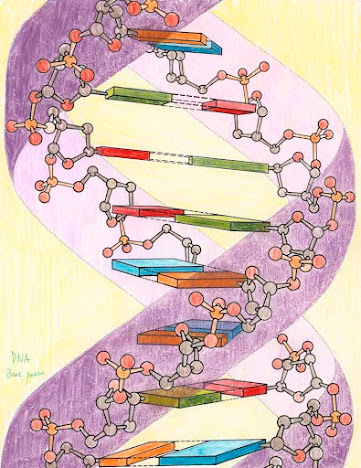
Within DNA, four chemical bases (shown in green, red, blue, and orange)
strung together in long strands contain the instructions for building proteins.
Credit: Irving Geis/HHMI
Codetta, a new computational method for predicting genetic codes, could reveal insights into how some organisms have modified a code once thought to be universal.

In the 1800s, the Rosetta Stone – an ancient rock slab inscribed with three languages – helped scholars decode Egyptian hieroglyphics. Now, a computer program is doing something similar for the genetic code.

The program, named Codetta, can read the genome sequence of any organism, and then spit out its genetic code: the biological key that translates genetic information into instructions for building proteins. Across most of the tree of life, this code is universal. But scientists have found a handful of exceptions – in some organisms, genetic info codes for instructions different from those in other life-forms.

In the largest screen to date for such alternative genetic codes, the program scanned more than 250,000 genome sequences from bacteria and archaea and identified five never-before-seen codes, Harvard University’s Kate Shulgina and Howard Hughes Medical Investigator Sean Eddy report November 9, 2021, in the journal, eLife. “I told Kate that her new codes are going straight into the textbooks,” Eddy says.

The team’s method is faster, more rigorous, and more comprehensive than previous efforts, says Ken Wolfe, an evolutionary geneticist at University College Dublin who was not involved with the research. “They looked at every genome that’s available for bacteria and archaea – essentially, all the data that exists.”

The work’s practical implications are immediate: scientists using Codetta, which is freely available, will be able to correctly predict which proteins an organism is making. But the program might unlock more sweeping biological insights too.

Adding herbs and spices to meals may help lower blood pressure

Photo by Taryn Elliott from Pexels
Seasoning your food generously with herbs and spices isn’t just a great way to make your meals tastier — new research found it may have benefits for your heart’s health, as well.

In a controlled-feeding study, the researchers found that seasoning foods with 6.5 grams, or about 1.3 teaspoons, of herbs and spices a day was linked with lower blood pressure after four weeks.

Penny Kris-Etherton, Evan Pugh University Professor of Nutritional Sciences, and Kristina Petersen, assistant professor of nutritional sciences at Texas Tech University and co-principal investigator of the study while at Penn State, said the findings offer people a simple way to help improve their heart health.

“Adding herbs and spices to your food is a great way to add flavor without adding extra sodium, sugar or saturated fat,” Kris-Etherton said. “And, if you go a step further and add these seasonings to foods that are really good for you, like fruits and vegetables, you can potentially get even more health benefits by consuming that extra produce.”

According to the researchers, cardiometabolic diseases like heart disease, strokes and type two diabetes continue to be one of the leading causes of death in the United States. One of the ways health professionals aim to improve heart health is by monitoring and improving blood pressure.

One way people can improve their blood pressure is by limiting their sodium intake, usually by adding less salt to their meals. Petersen said that while people have long been encouraged to season their food with herbs and spices instead of salt to boost flavor without added sodium, less was known about whether herbs and spices have health benefits of their own.

“As nutritionists, we’re interested in new ways we can use diet to benefit health, and cardiovascular health in particular,” Petersen said. “We were curious about how herbs and spices could affect heart health, since they are versatile and can be added to many different types of food.”

Featured Article

What Is: Macrophage

A realistic scientific visualization of a macrophage, a crucial immune cell, actively engulfing bacteria with its extended pseudopods. The i...

Top Viewed Articles