. Scientific Frontline

Wednesday, January 26, 2022

Nearly 1,000 mysterious strands revealed in Milky Way’s center

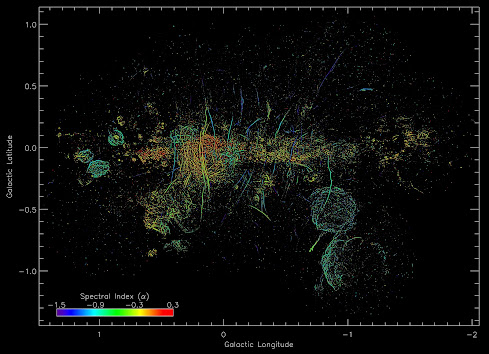
An image showing the spectral index for filaments.
Credit: Northwestern University/SAORO/Oxford University

An unprecedented new telescope image of the Milky Way galaxy’s turbulent center has revealed nearly 1,000 mysterious strands, inexplicably dangling in space.

Stretching up to 150 light years long, the one-dimensional strands (or filaments) are found in pairs and clusters, often stacked equally spaced, side by side like strings on a harp. Using observations at radio wavelengths, Northwestern University’s Farhad Yusef-Zadeh discovered the highly organized, magnetic filaments in the early 1980s. The mystifying filaments, he found, comprise cosmic ray electrons gyrating the magnetic field at close to the speed of light. But their origin has remained an unsolved mystery ever since.

Now, the new image has exposed 10 times more filaments than previously discovered, enabling Yusef-Zadeh and his team to conduct statistical studies across a broad population of filaments for the first time. This information potentially could help them finally unravel the long-standing mystery.

The study is now available online and has been accepted for publication by The Astrophysical Journal Letters.

“We have studied individual filaments for a long time with a myopic view,” said Yusef-Zadeh, the paper’s lead author. “Now, we finally see the big picture — a panoramic view filled with an abundance of filaments. Just examining a few filaments makes it difficult to draw any real conclusion about what they are and where they came from. This is a watershed in furthering our understanding of these structures.”

Yusef-Zadeh is a professor of physics and astronomy at Northwestern’s Weinberg College of Arts and Sciences and a member of the Center for Interdisciplinary Exploration and Research in Astrophysics (CIERA).

Omicron genetics and early transmission patterns are characterized in new study

The Omicron variant was first detected in Botswana
in October 2021 and has quickly spread throughout the world
Credit: Justice Hubane / Unsplash
The Omicron variant of SARS-CoV-2 diverged from previous SARS-CoV-2 variants as a result of adaptive evolution, in which beneficial mutations are passed on to future generations through natural selection, rather than through recombination between previous variants, according to a large international team of researchers. The study, which published recently in Nature, is the first to describe the genomic profile of Omicron and explore the origins of the variant.

“We have seen SARS-CoV-2 generate three major variants — Alpha, Delta and Omicron — in about 16 months, which is very surprising because other viruses do not make such repeated big evolutionary leaps,” said Maciej Boni, associate professor of biology, Penn State, who led the recombination analysis for this global collaboration. “The latest variant — Omicron — is extraordinary because of the even bigger jump it made in the evolution of its spike protein.”

Boni noted that compared to previous variants, Omicron’s spike protein has more than 30 mutations, many of which are known to influence host antibody neutralization.

“Given that Omicron made such a big leap forward evolutionarily speaking, we wanted to investigate why and how this may have happened,” he said.

To do that, the team — which was led by the Centre for Epidemic Response and Innovation in South Africa — analyzed all 686 Omicron sequences that were available by Dec. 7, 2021. They found that Omicron falls within the B.1.1 lineage, which also includes the Alpha variant. Interestingly, the team found that Omicron is genetically distinct from Alpha, as well as any other known variants of interest.

Kirigami Robotic Grippers Are Delicate Enough to Lift Egg Yolks


Engineering researchers from North Carolina State University have demonstrated a new type of flexible, robotic grippers that are able to lift delicate egg yolks without breaking them, and that are precise enough to lift a human hair. The work has applications for both soft robotics and biomedical technologies.

The work draws on the art of kirigami, which involves both cutting and folding two-dimensional (2D) sheets of material to form three-dimensional (3D) shapes. Specifically, the researchers have developed a new technique that involves using kirigami to convert 2D sheets into curved 3D structures by cutting parallel slits across much of the material. The final shape of the 3D structure is determined in large part by the outer boundary of the material. For example, a 2D material that has a circular boundary would form a spherical 3D shape.

“We have defined and demonstrated a model that allows users to work backwards,” says Yaoye Hong, first author of a paper on the work and a Ph.D. student at NC State. “If users know what sort of curved, 3D structure they need, they can use our approach to determine the boundary shape and pattern of slits they need to use in the 2D material. And additional control of the final structure is made possible by controlling the direction in which the material is pushed or pulled.”

Tuesday, January 25, 2022

Using nanodiamonds as sensors just got easier

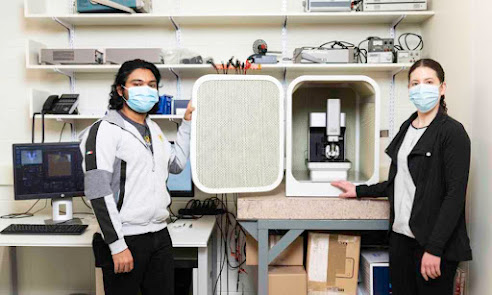
University of Rochester PhD student Dinesh Bommidi (left) and Andrea Pickel, an assistant professor of mechanical engineering, used an atomic force microscope to locate and move nanodiamond sensors. University of Rochester photo / J. Adam Fenster

For centuries people have placed the highest value on diamonds that are not only large but flawless.

Scientists, however, have discovered exciting new applications for diamonds that are not only incredibly small but have a unique defect.

In a recent paper in Applied Physics Letters, researchers at the University of Rochester describe a new way to measure temperature with these defects, called nitrogen vacancy centers, using the light they emit. The technique, adapted for single nanodiamonds by Andrea Pickel, assistant professor of mechanical engineering, and Dinesh Bommidi, a PhD student in her lab, allowed them to precisely measure, for the first time, the duration of these light emissions, or “excited state lifetimes,” at a broad range of temperatures.

The discovery earned the paper recognition as an American Institute of Physics “Scilight,” a showcase of what AIP considers the most interesting research across the physical sciences.

The Rochester method gives researchers a less complicated, more accurate tool for using nitrogen vacancy centers to measure the temperature of nanoscale-sized materials. The approach is also safe for imaging sensitive nanoscale materials or biological tissues and could have applications in quantum information processing.

Hungry yeast are tiny, living thermometers

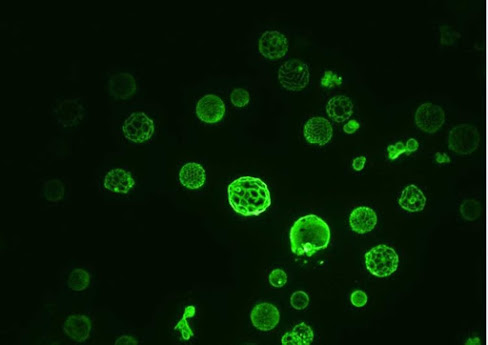
This fluorescence microscopy image shows yeast vacuoles that have undergone phase separation.Luther Davis/Alexey Merz/University of Washington

Membranes are crucial to our cells. Every cell in your body is enclosed by one. And each of those cells contains specialized compartments, or organelles, which are also enclosed by membranes.

Membranes help cells carry out tasks like breaking down food for energy, building and dismantling proteins, keeping track of environmental conditions, sending signals and deciding when to divide.

Biologists have long struggled to understand precisely how membranes accomplish these different types of jobs. The primary components of membranes — large, fat-like molecules called lipids and compact molecules like cholesterol — make great barriers. In all but a few cases, it’s unclear how those molecules help proteins within membranes do their jobs.

In a paper published Jan. 25 in the Proceedings of the National Academy of Sciences, a team at the University of Washington looked at phase separation in budding yeast — the same single-celled fungus of baking and brewing fame — and reports that living yeast cells can actively regulate a process called phase separation in one of their membranes. During phase separation, the membrane remains intact but partitions into multiple, distinct zones or domains that segregate lipids and proteins. The new findings show for the first time that, in response to environmental conditions, yeast cells precisely regulate the temperature at which their membrane undergoes phase separation. The team behind this discovery suggests that phase separation is likely a “switch” mechanism that these cells use to govern the types of work that membranes do and the signals they send.

How a Smart Electric Grid Will Power Our Future

The Electricity Infrastructure Operations Center, located at PNNL, allows researchers to evaluate electric grid scenarios in the context of current industry conditions.
Photo by Andrea Starr | Pacific Northwest National Laboratory

A novel plan that offers partnership in keeping the United States electric grid stable and reliable could be a win-win for consumers and utility operators.

The largest ever simulation of its kind, modeled on the Texas power grid, concluded that consumers stand to save about 15 percent on their annual electric bill by partnering with utilities. In this system, consumers would coordinate with their electric utility operator to dynamically control big energy users, like heat pumps, water heaters and electric vehicle charging stations.

This kind of flexible control over energy supply and use patterns is called “transactive” because it relies on an agreement between consumers and utilities. But a transactive energy system has never been deployed on a large scale, and there are a lot of unknowns. That’s why the Department of Energy’s Office of Electricity called upon the transactive energy experts at Pacific Northwest National Laboratory to study how such a system might work in practice. The final multi-volume report was released today.

Hayden Reeve, a PNNL transactive energy expert and technical advisor, led a team of engineers, economists and programmers who designed and executed the study.

Novel research identifies fresh 'mixers' in river pollution 'cocktail'

Researchers from the Universities of Manchester, Birmingham and Mahavir Cancer Sansthan collecting field data along the River Ganga in Bihar
Photo - Aman Gaurav

Water quality in rivers is affected by underpinning ‘natural’ hydrogeological and biogeochemical processes, as well as interactions between people and their environment that are accelerating stress on water resources at unprecedented rates.

Pollutants can move at different speeds and accumulate in varying quantities along rivers where the mix of the complex ‘cocktail’ of chemicals that is making its way towards the ocean is constantly changing, a new study reveals.

Researchers have discovered characteristic breakpoints – often found when a tributary joins the main river or significant point sources exist – can change the behavior of some compounds, causing the concentration of these chemicals to change drastically, depending on where they are on their journey down the river.

Experts discovered the phenomenon after piloting a new, systematic approach to understanding hydrogeochemical dynamics in large river systems along the entire length of India’s River Ganges (Ganga) – from close to its source in the Himalayas down to the Indian Ocean.

This new research approach proven successful at the iconic Ganga can be applied to other large river systems across the world – hopefully shedding new light on how to tackle the global challenge of aquatic pollution by multiple interacting contaminants.

Calculating the best shapes for things to come

Wei Lu 
Professor  Mechanical Engineering 
University of Michigan
Maximizing the performance and efficiency of structures—everything from bridges to computer components—can be achieved by design with a new algorithm developed by researchers at the University of Michigan and Northeastern University.

It’s an advancement likely to benefit a host of industries where costly and time-consuming trial-and-error testing is necessary to determine the optimal design. As an example, look at the current U.S. infrastructure challenge—a looming $2.5 trillion backlog that will need to be addressed with taxpayer dollars.

Planners searching for the best way to design a new bridge need to answer a string of key questions. How many pillars are needed? What diameter do those pillars need to be? What should the radius of the bridge’s arch be? The new algorithm can determine the combination that gives the highest load capacity with lowest cost.

The team tested their algorithm in four optimization scenarios: designing structures to maximize their stiffness for carrying a given load, designing the shape of fluid channels to minimize pressure loss, creating shapes for heat transfer enhancement, and minimizing the material of complex trusses for load bearing. The new algorithm reduced the computational time needed to reach the best solution by roughly 100 to 100,000 times over traditional approaches. In addition, it outperformed all other state-of-the-art algorithms.

“It’s a tool with the potential to influence many industries—clean energy, aviation, electric vehicles, energy efficient buildings,” said Wei Lu, U-M professor of mechanical engineering and corresponding author of the study in Nature Communications.

The new algorithm plays in a space called topology optimization—how best to distribute materials within a given space to get the desired results.

“If you really want to design something rationally, you’re talking about a large number of calculations, and doing those can be difficult with time and cost considerations,” Lu said. “Our algorithm can reduce the calculations and facilitate the optimization process.”

Worldwide assessment of protected areas

According to a TUM-led study, mountain habitats as seen here in Pakistan’s Deosai National Park are quite well protected. Many other habitats do not yet have this level of protection.
Image: Ch. Hof / TUM

Protected areas are among the most effective tools for preserving biodiversity. However, new protected areas are often created without considering existing ones. This can lead to an overrepresentation of the biophysical characteristics, such as temperature or topography, that define a certain area. A research group at the Technical University of Munich (TUM) has now assessed a global analysis of the scope of protection of various biophysical conditions.

Protected areas are important for maintaining populations of various species. They ensure that many animals and plants do not lose their habitat and thus help to protect endangered species and safeguard biodiversity.

The worldwide protected area network is steadily growing in number and extent. “From a conservation standpoint, this is generally a welcome trend. But the uncoordinated expansion of protected areas can result in wasted resources worldwide if care is not taken to protect as many species communities and environmental conditions as possible,” says Dr. Christian Hof, the director of the junior research group “MintBio – Climate change impacts on biological diversity in Bavaria: Multidimensional Integration for better BIOdiversity projections” under the auspices of the Bavarian climate research network bayklif at TUM.

Do you see faces in things?

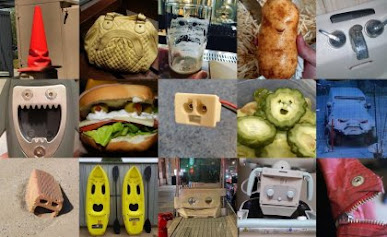
Composite image: Dr Jessica Taubert
Seeing faces in everyday objects is a common experience, but research from The University of Queensland has found people are more likely to see male faces when they see an image on the trunk of a tree or in burnt toast over breakfast.

Dr Jessica Taubert from UQ’s School of Psychology said face pareidolia, the illusion of seeing a facial structure in an everyday object, tells us a lot about how our brains detect and recognize social cues.

“The aim of our study was to understand whether examples of face pareidolia carry the kinds of social signals that faces normally transmit, such as expression and biological sex,” Dr Taubert said.

“Our results showed a striking bias in gender perception, with many more illusory faces perceived as male than female.

“As illusory faces do not have a biological sex, this bias is significant in revealing an asymmetry in our face evaluation system when given minimal information.

“The results demonstrate visual features required for face detection are not generally sufficient for the perception of female faces.”

More than 3800 participants were shown numerous examples of face pareidolia and inanimate objects with no facial structure and they were asked to indicate whether each example had a distinct emotional expression, age, and biological sex, or not.

Monday, January 24, 2022

Overweight dogs respond well to high-protein, high-fiber diet

Overfed dogs experience some of the same maladies associated with overweight and obesity in humans. A new study finds that overweight dogs also benefit from a high-protein, high-fiber weight loss regimen. 
Photo by www.pixel.la, CC0 1.0 Universal Public Domain Dedication

A study of overweight dogs fed a reduced calorie, high-protein, high-fiber diet for 24 weeks found that the dogs’ body composition and inflammatory markers changed over time in ways that parallel the positive changes seen in humans on similar diets. The dogs achieved a healthier weight without losing too much muscle mass, and their serum triglycerides, insulin and inflammatory markers all decreased with weight loss.

All such changes are beneficial, said University of Illinois Urbana-Champaign animal sciences professor Kelly Swanson, who led the new research.

Mixed Reality and AI to aid surgeons with keyhole heart valve surgery

Cardiac surgeons could in the future be conducting procedures virtually before even stepping into an operating theatre thanks to researchers from the University of West of England who are working with cardiac surgeons from the University of Bristol on new technology that will allow surgeons to better predict risks and help prevent the conversion of a keyhole heart valve operation to open heart surgery.

The research team from UWE Bristol’s Big Data lab and Faculty of Health and Applied Sciences (HAS) is developing technology that uses artificial intelligence (AI), augmented reality (AR) and virtual reality (VR) to assist cardiac surgeons in planning and preparing for complex keyhole heart valve surgery. The team is initially collaborating with the Bristol Heart Institute (BHI), a Specialist Research Institute at the University of Bristol, whose surgeons will test the system when preparing for minimally invasive cardiac valve surgery (MICVS).

Compared to conventional open-heart surgery involving cutting through the breastbone to reach the heart, MICVS is less intrusive as the heart is accessed through smaller incisions using endoscopic instruments. And patient recovery time is generally quicker after this keyhole surgery.

However, MICVS is complex and requires hours of pre-operative planning and preparation.

Dr Hunaid Vohra, Consultant Cardiac Surgeon and Honorary Senior Lecturer and Researcher at the BHI, who is collaborating with UWE Bristol, said: “In the operating room, despite pre-planning, it is currently very common to find unexpected challenges, as every patient’s height, weight and heart-lung anatomy is different. And patients’ frailty varies.

Mystery of sweet potato origin uncovered

Ipomoea aequatoriensis flowers at
University of Oxford Department of Plant Sciences.
Photographs by Tom Wells

New scientific research from Oxford University's Plant Sciences department transforms our understanding of the origins of the sweet potato - identifying a key piece in the puzzle of the evolutionary history of one of the world’s most important staple crops.

Years of careful taxonomic research by a team led by Robert Scotland, Professor of Systematic Botany at Oxford Plant Sciences, has concluded with the discovery of a new species that is sweet potato’s closest wild relative, Ipomoea aequatoriensis.

"How the sweet potato evolved has always been a mystery. Now, we have found this new species in Ecuador...a fundamental piece of the puzzle to understand the origin and evolution of this top-ten global food crop"
Professor Robert Scotland

This species, which most likely played a key role in the origin of the crop, is the latest in a series of discoveries by the Oxford team and collaborators at USDA and the International Potato Centre Peru, and one that represents an ‘extraordinary discovery in untangling the evolution’ of the plant, according to the researchers.

Professor Scotland says, ‘How the sweet potato evolved has always been a mystery. Now, we have found this new species in Ecuador that is the closest wild relative of sweet potato known to date and is a fundamental piece of the puzzle to understand the origin and evolution of this top-ten global food crop.’

Sunday, January 23, 2022

Researchers discover way to disarm potentially deadly Listeria bacteria

A drug-like inhibitor that stops Listeria from making virulence proteins helps immune cells control and kill the bacteria.
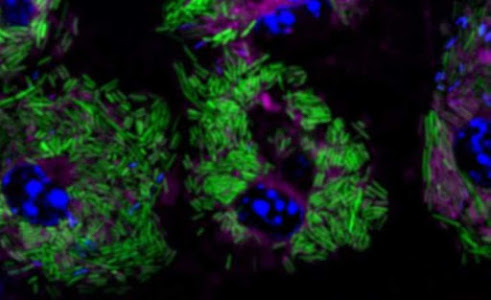
Image: Dr Carmen Mathmann

University of Queensland researchers have unlocked a way of fighting Listeria infections, which can cause severe illness in pregnant women and people with compromised immune systems.

During the study, researchers discovered a way to block Listeria from making the proteins that allow bacteria to survive and multiply in immune cells.

UQ Diamantina Institute’s Professor Antje Blumenthal said using a small, drug-like inhibitor has improved their understanding of the Achilles heel of Listeria.

“Listeria is found in the soil and sometimes in raw foods. Once ingested it can hide from the immune system and multiply inside immune cells,” Professor Blumenthal said.

“Instead of killing the bacteria, the immune cells are used by the bacteria to multiply and are often killed by Listeria growing inside them.

“Our study showed the bacteria could be cleared with a small drug-like inhibitor that targets the 'master regulator’ of the proteins that help Listeria grow in immune cells. The inhibitor helped the immune cells survive infection and kill the bacteria.”

CRISPR-Cas13 targets proteins causing ALS, Huntington's disease in the mouse nervous system

Spinal cord astrocytes, the cells seen in this fluorescent microscope image, are involved in the progression of ALS. A new CRISPR-Cas13 system targeting mutant protein production in these cells improved outcomes for mice with ALS. 
Image courtesy of Thomas Gaj and Colin Lim

A single genetic mutation can have profound consequences, as demonstrated in neurodegenerative diseases such as amyotrophic lateral sclerosis or Huntington’s disease. A new study by University of Illinois Urbana-Champaign researchers used a targeted CRISPR technique in the central nervous systems of mice to turn off production of mutant proteins that can cause ALS and Huntington’s disease.

Rather than the popular DNA-editing CRISPR-Cas9 technique, the new approach uses CRISPR-Cas13, which can target mRNA – the messenger molecule that carries protein blueprints transcribed from DNA. The Illinois team developed Cas13 systems to target and cut RNAs that code for mutant proteins that trigger ALS and Huntington’s disease, effectively silencing the mutant genes without disturbing the cell’s DNA, said study leader Thomas Gaj, an Illinois professor of bioengineering. The team published its results in the journal Science Advances.

“Targeting RNA rather than DNA has some unique advantages, including the fact that, in theory, its effects within a cell can be reversed since RNAs are transient molecules,” said Colin Lim, a graduate student who helped lead the study. “Because Cas13 enzymes just target RNA, they also carry minimal risk for introducing any permanent off-target mutations to DNA.”

Featured Article

What Is: Quorum Sensing

Scientific Frontline: Extended "At a Glance" Summary : Quorum Sensing The Core Concept : Quorum sensing is a sophisticated, popula...

Top Viewed Articles