
 |
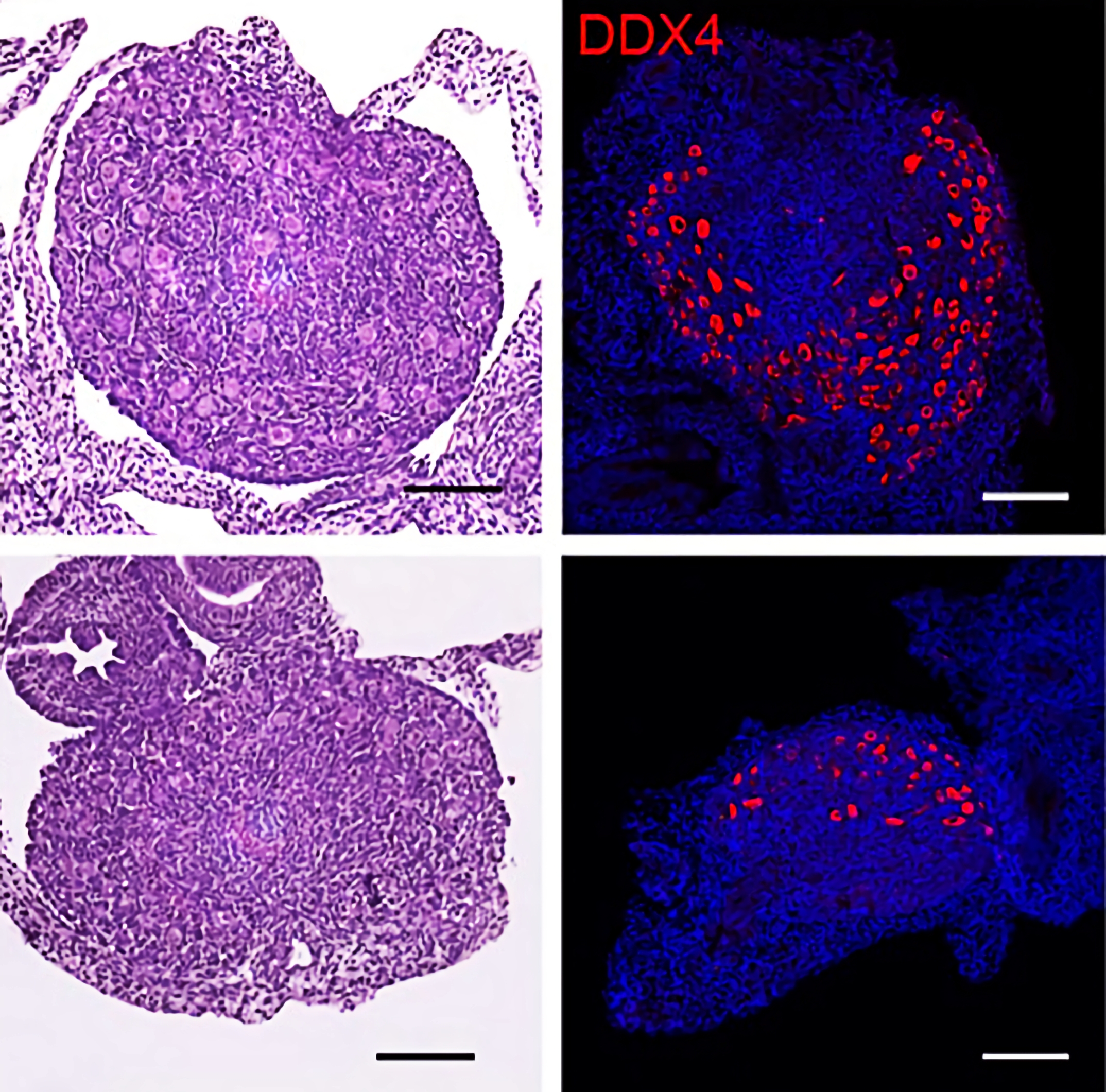
| Female mammals have a limited number of follicles that can form eggs, called the ovarian reserve. New work at UC Davis shows that the PRC1 gene complex is responsible for establishing the ovarian reserve and plays a role in fertility. Credit: Mengwen Hu, UC Davis |
Scientific Frontline: Extended "At a Glance" Summary: The Ovarian Reserve
The Core Concept: The ovarian reserve is the finite, non-renewable pool of primordial follicles present in mammalian females from birth, with each follicle containing an oocyte capable of eventually developing into an egg.
Key Distinction/Mechanism: The establishment and maintenance of the reserve rely on a group of proteins known as Polycomb Repressive Complex 1 (PRC1). PRC1 functions as an epigenetic mechanism that suppresses the cellular development process (meiosis), forcing the oocytes into a paused, quiescent state where they can survive for decades without dividing or proliferating.
Major Frameworks/Components:
- Epigenetic Regulation: The process of altering how genes function and express themselves without changing the underlying DNA sequence, crucial for maintaining cellular arrest.
- Polycomb Repressive Complex 1 (PRC1): The specific protein complex responsible for halting oocyte development; its depletion results in rapid follicle loss and sterility.
- Meiosis Suppression: The targeted inhibition of cell division prior to the establishment of the reserve, ensuring proper gene expression programs are maintained.
- Primordial Follicles: The fundamental, arrested cellular units that house the oocytes and collectively make up the reserve.
Branch of Science: Molecular Genetics, Epigenetics, Reproductive Biology, and Microbiology.
Future Application: Elucidating the PRC1 pathway provides a molecular foundation for developing targeted clinical interventions to treat premature ovarian failure, address unexplained infertility, and potentially remedy age-related fertility decline in humans.
Why It Matters: Because mammalian female fertility is fundamentally limited by the size and viability of the ovarian reserve, understanding the epigenetic mechanisms that govern it is critical for advancing female reproductive health and extending the functional lifespan of human fertility.
Fertility is finite for mammalian females. From birth, females possess a limited number of primordial follicles, collectively called the ovarian reserve. Within each follicle is an oocyte that eventually becomes an egg. But with age, the follicles in the ovarian reserve decrease.
“Despite its fundamental importance, our understanding of how the ovarian reserve is established and maintained remains poor,” said Professor Satoshi Namekawa, Department of Microbiology and Molecular Genetics at the University of California, Davis.
Researchers define the epigenetic machinery that governs the establishment and function of the mammalian ovarian reserve, providing molecular insights into female reproductive health and lifespan, in a new study published Aug. 10 in Nature Communications. Epigenetics refers to changes that influence how genes work without altering DNA itself. Lead scientists on the paper include Namekawa, project scientist Mengwen Hu and UC Davis Professors Richard Schultz and Neil Hunter.
“In human females over the age of 35, you see a decline in fertility,” said Namekawa. “Our study may give us the foundation to understand how female fertility is established and maintained at the molecular level and why it declines with age.”
Pausing primordial production
When the ovarian reserve is established, all the oocytes in primordial follicles pause their development and can remain in such an arrested state for decades.
“Fertility is supported by these arrested oocytes,” said Namekawa, noting that some hitherto unknown molecular machinery pauses development. “The main question is how can these cells be maintained for decades? It’s a big question. They cannot divide, they cannot proliferate, they just stay quiescent in the ovaries for decades. How is this possible?”
Using mouse mutants, the team found that the pausing of this oocyte transition phase was mediated by a group of proteins called the Polycomb Repressive Complex 1 (PRC1).
A molecular understanding of fertility
PRC1 suppresses the development process, called meiosis, that occurs prior to establishing the ovarian reserve, thereby ensuring a proper gene expression program in the ovarian reserve. When the team created mouse mutants with depleted PRC1 machinery, they found that the ovarian reserve could not be established, and the cells underwent cell death.
“We show that a conditional PRC1 deletion results in rapid depletion of follicles and sterility,” said Namekawa. “These results strongly implicate PRC1 in the critical process of maintaining the epigenome of primordial follicles throughout the protracted arrest that can last up to 50 years in humans.”
According to Namekawa and his colleagues, deficiencies in PRC1 functionality may help explain cases of premature ovarian failure and infertility in humans.
“Now that we found that this epigenetic process is key for establishment, the next question is can we uncover a more detailed mechanism of this process?” Namekawa said. “How can the ovarian reserve be maintained for decades?”
Namekawa and colleagues plan to investigate this question next, attempting to further elucidate the mechanistic events that govern the PRC1 machinery. By learning more about this process, they hope to remedy potential fertility issues that arise with age.
Funding: The work was supported by grants from the NIH.
Published in journal: Nature Communications
Title: PRC1-mediated epigenetic programming is required to generate the ovarian reserve
Authors: Mengwen Hu, Yu-Han Yeh, Yasuhisa Munakata, Hironori Abe, Akihiko Sakashita, So Maezawa, Miguel Vidal, Haruhiko Koseki, Neil Hunter, Richard M. Schultz, and Satoshi H. Namekawa
Source/Credit: University of California, Davis | Greg Watry
Reference Number: mcb081022_01


