
 |
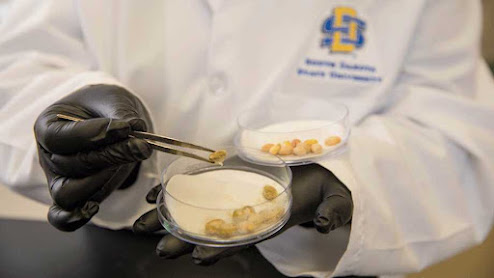
| The sprouting soybeans, in front, have been inoculated with a pathogen to trigger production of glyceollins, which have antimicrobial properties. Scaling up these lab experiments at the POET Bioproducts Institute may lead to soybeans that are rich in glyceollins being integrated into animal feed to help prevent disease and reduce the need for antibiotics. |
Antimicrobial compounds that soybean plants produce when threatened by insects, diseases and even drought may help animals stay healthy, thereby reducing the need for antibiotics.
“When a soybean is attacked by a pathogen, the plant produces phytochemicals called glyceollins as a defense mechanism,” explained assistant professor Bishnu Karki of South Dakota State University’s Department of Biology and Microbiology. Her research group has identified pathogens and lab-scale processes to trigger production of glyceollins and begun assessing soybean varieties to see which produce higher levels of the antimicrobial compounds.
“Animals, such as pigs and poultry, already consume diets high in soybeans and could benefit from the phytochemical’s antimicrobial properties,” Karki said, pointing out scientists are studying the impact of glyceollins on human health, specifically in relation to cancer, inflammation and cardiovascular diseases.
Karki’s research is supported by U.S. Department of Agriculture Hatch Act funding through the South Dakota Agricultural Experiment Station. Two master’s students and several undergraduates have also worked on the project.







.jpg)