. Scientific Frontline

Monday, November 7, 2022

Designing Next-Generation Metals, One Atom at a Time

Pacific Northwest National Laboratory researchers are visualizing how shear forces rearrange metal atoms in ways that translate to improved characteristics—like greater strength, ductility, and conductivity—to inform the custom design of next-generation metals with broad applications from batteries to vehicles.   
Composite Credit: image by Shannon Colson | Pacific Northwest National Laboratory

How can studying metals manufacturing lead to longer-lasting batteries and lighter vehicles? It all comes down to physics.

Researchers at Pacific Northwest National Laboratory (PNNL) are investigating the effects of physical forces on metals by taking a direct look at atomic-level changes in metals undergoing shear deformation.

The forces applied during shear deformation to change a metal’s shape also rearrange its atoms, but not in the same way for every metal or alloy. Atomic arrangement can affect metal properties like strength, formability, and conductivity—so better understanding how atoms move during shear is a key part of ongoing efforts to custom design next-generation metals with specific properties from the atom up.

Scientists discover exotic quantum state at room temperature

Researchers at Princeton discovered a material, made from the elements bismuth and bromine, that allows specialized quantum behaviors — usually seen only under high pressures and temperatures near absolute zero — to appear at room temperature. 
Photo Credit: Shafayat Hossain and M. Zahid Hasan, Princeton University

For the first time, physicists have observed novel quantum effects in a topological insulator at room temperature. This finding opens up a new range of possibilities for the development of efficient quantum technologies, such as spin-based electronics, which may potentially replace many current electronic systems for higher energy efficiency.

The breakthrough, published as the cover article of the October issue of Nature Materials, came when Princeton scientists explored a topological material based on the element bismuth.

The scientists have used topological insulators to demonstrate quantum effects for more than a decade, but this experiment is the first time these effects have been observed at room temperature. Typically, inducing and observing quantum states in topological insulators requires temperatures around absolute zero, which is equal to minus 459 degrees Fahrenheit (or -273 degrees Celsius).

In recent years, the study of topological states of matter has attracted considerable attention among physicists and engineers and is presently the focus of much international interest and research. This area of study combines quantum physics with topology — a branch of theoretical mathematics that explores geometric properties that can be deformed but not intrinsically changed.

“The novel topological properties of matter have emerged as one of the most sought-after treasures in modern physics, both from a fundamental physics point of view and for finding potential applications in next-generation quantum engineering and nanotechnologies,” said M. Zahid Hasan, the Eugene Higgins Professor of Physics at Princeton University, led the research. “This work was enabled by multiple innovative experimental advances in our lab at Princeton.”

New international study concludes digital media can fuel polarization and populism

Image Credit: Thomas Ulrich

The question of whether the rise in usage of digital media is contributing to the erosion of democracy is a source of popular debate, with tech companies arguing the findings are inconclusive.

But now a team of international researchers has carried out a comprehensive review of hundreds of studies globally, the biggest of its kind, exploring this claim and found that while social media is not exclusively bad, it can certainly stoke starkly conflicting views, populism, and political mistrust especially in established democracies.

The researchers, from the Max Planck Institute for Human Development and the Hertie School in Germany, and the University of Bristol in the UK, systematically assessed studies investigating whether and how digital media impacts people’s political behavior. Studies show that although some effects may be beneficial for democracy, for instance digital media can increase political knowledge and diversity of news exposure, they also have detrimental effects, such as fostering polarization and populism.

Furthermore, the way consequences such as increased political mobilization and decreasing trust in institutions play out depends largely on the political context. Such developments were found to be beneficial in emerging democracies but can have destabilizing effects in established democracies.

Researchers develop superfast new method to manufacture high-performance thermoelectric devices

high-performance thermoelectric devices for energy harvesting and cooling
Source: University of Notre Dame

Yanliang Zhang, associate professor of aerospace and mechanical engineering at the University of Notre Dame, and collaborators Alexander Dowling and Tengfei Luo have developed a machine-learning assisted superfast new way to create high-performance, energy-saving thermoelectric devices.

The novel process uses intense pulsed light to sinter thermoelectric material in less than a second (conventional sintering in thermal ovens can take hours). The team sped up this method of turning nanoparticle inks into flexible devices by using machine learning to determine the optimum conditions for the ultrafast but complex sintering process.

The achievement was just published in the journal Energy and Environmental Science.

Flexible thermoelectric devices offer great opportunities for direct conversion of waste heat into electricity as well as solid-state refrigeration, Zhang said. They have additional benefits such as power sources and cooling devices — they don’t emit greenhouse gases, and they are durable and quiet since they don’t have moving parts.

Early planetary migration can explain missing planets

An illustration of the variations among the more than 5,000 known exoplanets discovered since the 1990s.
Image Credit: of NASA/JPL-Caltech

A new model that accounts for the interplay of forces acting on newborn planets can explain two puzzling observations that have cropped up repeatedly among the more than 3,800 planetary systems cataloged to date.

One puzzle known as the “radius valley” refers to the rarity of exoplanets with a radius about 1.8 times that of Earth. NASA’s Kepler spacecraft observed planets of this size about 2-3 times less frequently than it observed super-Earths with radii about 1.4 times that of Earth and mini-Neptunes with radii about 2.5 times Earth’s. The second mystery, known as “peas in a pod,” refers to neighboring planets of similar size that have been found in hundreds of planetary systems. Those include TRAPPIST-1 and Kepler-223, which also feature planetary orbits of near-musical harmony.

“I believe we are the first to explain the radius valley using a model of planet formation and dynamical evolution that self-consistently accounts for multiple constraints of observations,” said Rice University’s AndrĂ© Izidoro, corresponding author of a study published this week in Astrophysical Journal Letters. “We’re also able to show that a planet-formation model incorporating giant impacts is consistent with the peas-in-a-pod feature of exoplanets.”

University of Oxford study provides important insights into TB correlates of protection

Drug-resistant, Mycobacterium tuberculosis bacteria, the pathogen responsible for causing the disease tuberculosis (TB). A 3D computer-generated image.
Image Credit: CDC

Researchers from the University of Oxford have today reported findings from a study that investigated whether previously identified correlates of protection associated with risk of full-blown tuberculosis (TB) disease could also be associated with risk of infection from the bacteria that causes TB - highlighting certain correlates in the process.

In their paper on the TB020 study, published in Nature Communications, researchers identified that certain correlates of protection – inflammation and activation of the immune system (where the body responds to invading pathogens such as viruses and harmful bacteria) – were associated with the likelihood of becoming infected with Mycobacterium tuberculosis (M.tb), the bacteria that causes TB disease.

However, their previously identified correlates of risk of TB disease were not associated with an increased risk of M.tb infection in infants who became infected with the bacteria but did not progress to active TB.

Most individuals infected with M.tb do not progress to full TB disease. Instead, infection is either eliminated or contained by the infected individual. This study improves understanding of the immune-related factors that drive infection and disease – necessary for an effective TB vaccine that is yet to be developed.

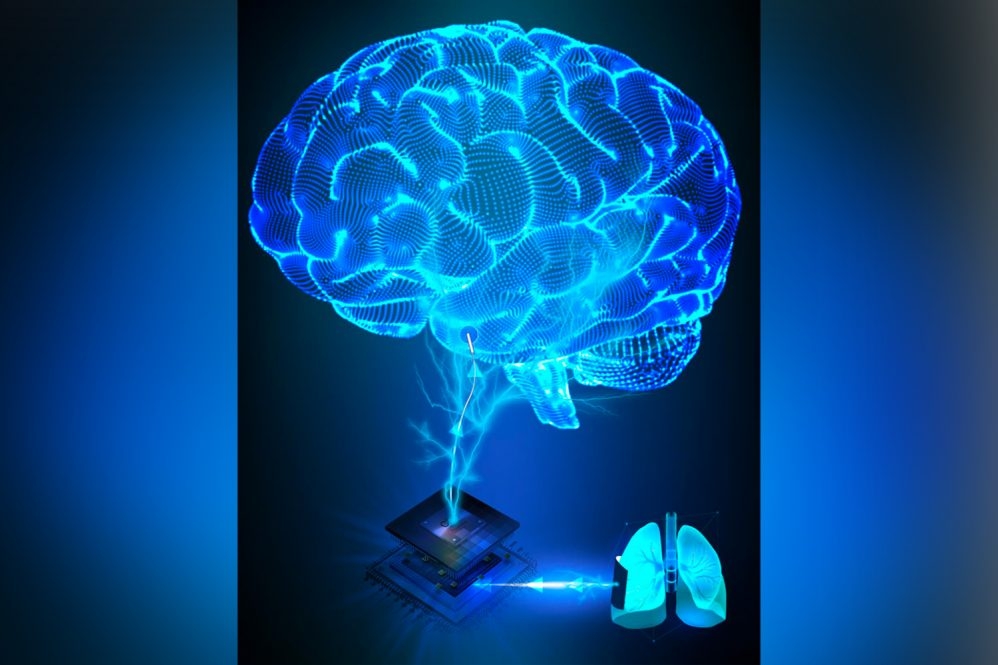
A Brain Stimulator That Powers with Breath Instead of Batteries

UConn researchers have developed a way of charging deep brain stimulators that don't require the battery power that's currently standard
Credit/Source: University of Connecticut Contributed Illustration

Implantable deep brain stimulators can help many people with neurological and psychiatric disease when traditional treatments fail. But surgery every time the batteries need to be changed is a major drawback. Now, UConn researchers report in Cell Reports Physical Sciences a new way to charge the devices using a person’s own breathing movements.

Deep brain stimulators are becoming more common, with about 150,000 new devices implanted each year. They are normally placed under the skin in the chest area and their electrodes implanted within the brain. The electrodes zap the brain with electrical pulses multiple times per second to regulate the brain’s abnormal electrical activity. Deep brain stimulators can help people with Parkinson’s disease and other movement disorders to regain control over their muscle motions. Research has also shown the technique can significantly reduce the symptoms for psychiatric conditions such as treatment-resistant depression and obsessive-compulsive disorder.

Just like a pacemaker, deep brain stimulators are battery powered. While most pacemaker batteries last from 7-10 years, deep brain stimulator batteries typically require changing every 2-3 years because of their high energy consumption. And each battery change requires surgery.

UConn chemists Esraa Elsanadidy, Islam Mosa, James Rusling, and their collaborators have developed a deep brain stimulator that never needs its batteries changed.

Summer camps promote altruism in children

After two weeks of camp, the participants’ level of altruism had increased significantly, while that of the other children had decreased.
Photo Credit: Anna Samoylova

Being able to control oneself, cooperate or help others: having socio-emotional abilities is essential for those who wish to interact positively with their peers. These skills are largely acquired during childhood and can be trained in different contexts, such as school, family or leisure. A team from the University of Geneva (UNIGE) has shown that holiday camps Favour their development. They found an increase in altruism among children returning from camps, unlike those who did not participate in this type of stay during their holidays. These results can be found in the journal PLOS ONE.

Knowing how to recognize and manage our own emotions, as well as those of others, and adapting our behavior accordingly: socio-emotional abilities play a key role in our daily lives. They enable us to make decisions that are beneficial to our own well-being and that of our peers, and to establish quality relationships with them. Fostering the development of children, from an early age, is therefore essential.

These skills can be acquired and trained directly or indirectly. They can also be learned in a variety of contexts, such as school, family or leisure. By stimulating prosocial acts such as altruistic behavior, they are a prime target for the prevention of antisocial behavior, i.e. behavior that is confrontational towards others and society. A team from the UNIGE has studied the development of these abilities in a specific context: holiday camps.

First ever clinical trial underway of laboratory grown red blood cells being transfused into another person

Microscope image Example of a RESTORE laboratory grown young red blood cell
Image Credit: NHS Blood and Transplant

The manufactured blood cells were grown from stem cells from donors. The red cells were then transfused into volunteers in the RESTORE randomized controlled clinical trial.

This is the first time in the world that red blood cells that have been grown in a laboratory have been given to another person as part of a trial into blood transfusion.

If proved safe and effective, manufactured blood cells could in time revolutionize treatments for people with blood disorders such as sickle cell and rare blood types. It can be difficult to find enough well-matched donated blood for some people with these disorders.

Chief Investigator Professor Cedric Ghevaert, Professor in Transfusion Medicine and Consultant Haematologist at the University of Cambridge and NHS Blood and Transplant, said: “We hope our lab grown red blood cells will last longer than those that come from blood donors. If our trial, the first such in the world, is successful, it will mean that patients who currently require regular long-term blood transfusions will need fewer transfusions in future, helping transform their care.”

The RESTORE trial is a joint research initiative by NHS Blood and Transplant and the University of Bristol, working with the University of Cambridge, Guy’s and St Thomas’ NHS Foundation Trust, NIHR Cambridge Clinical Research Facility, and Cambridge University Hospitals NHS Foundation Trust. It is part-funded by a National Institute for Health and Care Research (NIHR) grant.

Saturday, November 5, 2022

Limiting antibiotics for cows may create a new dairy market

Photo Credit: David Mark

Consumers would be willing to buy milk from cows only treated with antibiotics when medically necessary – as long as the price isn’t much higher than conventional milk, according to researchers at the College of Veterinary Medicine.

The findings suggest conventional farmers could tap a potentially large market for this type of milk if they can find the right price point – and that dairy consumers can help slow the rise of antimicrobial resistance.

“Most of the antibiotics produced throughout the world are used for animal agriculture. Therefore, reducing antibiotic use in animals, including dairy cattle, is necessary to tackle antibiotic resistance at a global scale,” said Dr. Renata Ivanek, professor in the Department of Population Medicine and Diagnostic Sciences. She is senior author on the study, which was published Nov. 4 in the Journal of Dairy Science.

In the paper, the researchers propose a new label for milk that indicates responsible antibiotic use (RAU), which would leverage consumer preferences to reduce the use of antibiotics on commercial dairy farms. The study showed that, although a consumer’s willingness to pay for the RAU-labeled milk was comparable to how much they would pay for the unlabeled milk, they strongly preferred the RAU-labeled milk over the unlabeled milk option. Therefore, the researchers hypothesize this new RAU label would entice farmers to minimize antibiotics more than they do for conventional, unlabeled milk.

Featured Article

What Is: The Psychology of Conspiracy Theories, Weaponization, and Societal Impact

Scientific Frontline: Extended "At a Glance" Summary The Core Concept : Conspiracy theories are alternative explanatory narratives...

Top Viewed Articles