. Scientific Frontline

Friday, November 25, 2022

NIST Finds a Sweet New Way to Print Microchip Patterns on Curvy Surfaces

Using sugar and corn syrup (i.e., candy), researcher Gary Zabow transferred the word "NIST" onto a human hair in gold letters, shown in false color in this grayscale microscope image. 
Image Credit: G. Zabow/NIST

NIST scientist Gary Zabow had never intended to use candy in his lab. It was only as a last resort that he had even tried burying microscopic magnetic dots in hardened chunks of sugar — hard candy, basically — and sending these sweet packages to colleagues in a biomedical lab. The sugar dissolves easily in water, freeing the magnetic dots for their studies without leaving any harmful plastics or chemicals behind.

By chance, Zabow had left one of these sugar pieces, embedded with arrays of micromagnetic dots, in a beaker, and it did what sugar does with time and heat — it melted, coating the bottom of the beaker in a gooey mess.

“No problem,” he thought. He would just dissolve away the sugar, as normal. Except this time when he rinsed out the beaker, the microdots were gone. But they weren’t really missing; instead of releasing into the water, they had been transferred onto the bottom of the glass where they were casting a rainbow reflection.

“It was those rainbow colors that really surprised me,” Zabow recalls. The colors indicated that the arrays of microdots had retained their unique pattern.
Protein Spheres Protect the Genome of Cancer Cells

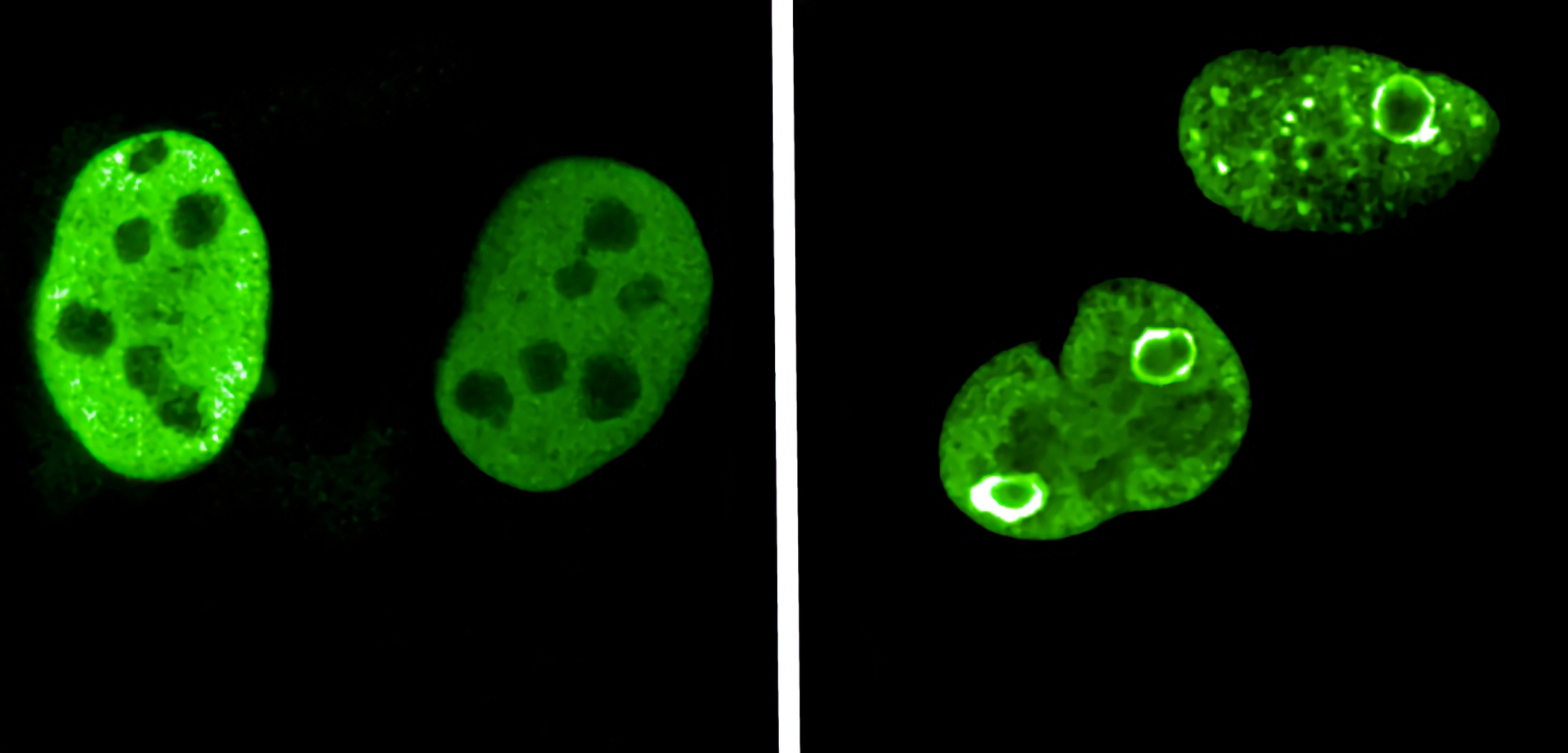
MYC proteins are colored green in this figure. In normally growing cells, they are homogeneously distributed in the cell nucleus (left). In diverse stress situations, as they occur in cancer cells, they rearrange themselves, form sphere-like structures and thus surround particularly vulnerable sections of the genome.
Image Credit: Team Martin Eilers / Universität Würzburg

Hollow spheres made of MYC proteins open new doors in cancer research. Würzburg scientists have discovered them and report about this breakthrough in the journal "Nature".

MYC genes and their proteins play a central role in the emergence and development of almost all cancers. They drive uncontrolled growth and altered metabolism of tumor cells. And they help tumors hide from the immune system.

MYC proteins also show an activity that was previously unknown – and which is now opening new doors for cancer research: They form hollow spheres that protect particularly sensitive parts of the genome. If these MYC spheres are destroyed, cancer cells will die.

This was reported by a research team led by Martin Eilers and Elmar Wolf from the Institute of Biochemistry and Molecular Biology at Julius-Maximilians-Universität Würzburg (JMU, Bavaria, Germany) in the journal Nature. The researchers are convinced that their discovery is a game changer for cancer research, an important breakthrough on the way to new therapeutic strategies.

New CRISPR-based tool inserts large DNA sequences at desired sites in cells

Building on the CRISPR gene-editing system, MIT researchers designed a new tool that can snip out faulty genes and replace them with new ones.
Image Credit: Sangharsh Lohakare

Building on the CRISPR gene-editing system, MIT researchers have designed a new tool that can snip out faulty genes and replace them with new ones, in a safer and more efficient way.

Using this system, the researchers showed that they could deliver genes as long as 36,000 DNA base pairs to several types of human cells, as well as to liver cells in mice. The new technique, known as PASTE, could hold promise for treating diseases that are caused by defective genes with a large number of mutations, such as cystic fibrosis.

“It’s a new genetic way of potentially targeting these really hard to treat diseases,” says Omar Abudayyeh, a McGovern Fellow at MIT’s McGovern Institute for Brain Research. “We wanted to work toward what gene therapy was supposed to do at its original inception, which is to replace genes, not just correct individual mutations.”

The new tool combines the precise targeting of CRISPR-Cas9, a set of molecules originally derived from bacterial defense systems, with enzymes called integrases, which viruses use to insert their own genetic material into a bacterial genome.

Synthetic fibers discovered in Antarctic samples show the ‘pristine’ continent is now a sink for plastic pollution


As nations prepare to meet in Uruguay to negotiate a new Global Plastics Treaty, a new study has revealed the discovery of synthetic plastic fibers in air, seawater, sediment and sea ice sampled in the Antarctic Weddell Sea. The field research was carried out by scientists from the University of Oxford and Nekton (a not-for-profit research institute) during an expedition to discover Sir Ernest Shackleton’s ship, the Endurance. The results are published in the journal Frontiers in Marine Science.

Fibrous polyesters, primarily from textiles, were found in all samples. The majority of microplastic fibers identified were found in the Antarctic air samples, revealing that Antarctic animals and seabirds could be breathing them.

‘The issue of microplastic fibers is also an airborne problem reaching even the last remaining pristine environments on our planet’, stated co-author Lucy Woodall, a Professor in the University of Oxford’s Department of Biology and Principal Scientist at Nekton. ‘Synthetic fibers are the most prevalent form of microplastic pollution globally and tackling this issue must be at the heart of the Plastic Treaty negotiations.’ Professor Woodall was the first to reveal the prevalence of plastic in the deep sea in 2014.

The whole in a part: Synchronizing chaos through a narrow slice of spectrum

Conceptual overview of the coupling scheme between a master and a slave chaotic oscillator via a band-pass filter, and the resulting complex interdependence between their activities.
Credit: Tokyo Institute of Technology

Engineers at the Tokyo Institute of Technology (Tokyo Tech) have uncovered some intricate effects arising when chaotic systems, which typically generate broad spectra, are coupled by conveying only a narrow range of frequencies from one to another. The synchronization of chaotic oscillators, such as electronic circuits, continues to attract considerable fascination due to the richness of the complex behaviors that can emerge. Recently, hypothetical applications in distributed sensing have been envisaged, however, wireless couplings are only practical over narrow frequency intervals. The proposed research shows that, even under such constraints, chaos synchronization can occur and give rise to phenomena that could one day be leveraged to realize useful operations over ensembles of distant nodes.

The abstract notion that the whole can be found in each part of something has for long fascinated thinkers engaged in all walks of philosophy and experimental science: from Immanuel Kant on the essence of time to David Bohm on the notion of order, and from the self-similarity of fractal structures to the defining properties of holograms. It has, however, remained understandably extraneous to electronic engineering, which strives to develop ever more specialized and efficient circuits exchanging signals that possess highly controlled characteristics. By contrast, across the most diverse complex systems in nature, such as the brain, the generation of activity having features that present themselves similarly over different temporal scales, or frequencies, is nearly a ubiquitous observation.

Thursday, November 24, 2022

Overgrazing is threatening global drylands

Sheep on Green Grass Field
Photo Credit: Gökçe Gök

The positive effects of grazing by livestock and wild herbivores can turn negative as temperatures become warmer.

Grazing is a trillion-dollar industry, and is particularly important in drylands, which cover about 40 percent of Earth's land surface and support half of the world’s livestock. Livestock are critical for food, shelter and a source of capital, but changing climates threaten livestock production and the livelihoods of billions of people worldwide.

An international team of scientists has published a study in the journal Science today with the first global estimates of how grazing will affect ecosystem services across the world’s drylands. The research, led by the Dryland Ecology and Global Change group in Spain with collaborators from UNSW Sydney, shows that grazing by livestock and wild herbivores in drylands can have positive effects on ecosystem services, but these effects can turn negative as Earth’s temperature becomes warmer.

Physicist strikes gold, solving 50-year lightning mystery

Photo Credit: Bogdan Radu

The chances of being struck by lightning are less than one in a million, but those odds shortened considerably this month when more than 4.2 million lightning strikes were recorded in every Australian state and territory over the weekend of 12-13 November.

When you consider that each lighting strike travels at more than 320,000 kilometers per hour, that’s a massive amount of electricity.

Ever wondered about lightning? For the past 50 years, scientists around the world have debated why lightning zig-zags and how it is connected to the thunder cloud above.

There hasn’t been a definitive explanation until now, with a University of South Australia plasma physicist publishing a landmark paper that solves both mysteries.

Dr John Lowke, former CSIRO scientist and now UniSA Adjunct Research Professor, says the physics of lightning has stumped the best scientific minds for decades.

“There are a few textbooks on lightning, but none have explained how the zig-zags (called steps) form, why the electrically conducting column connecting the steps with the cloud remains dark, and how lightning can travel over kilometers,” Dr Lowke says.

A brain circuit underpinning locomotor speed control

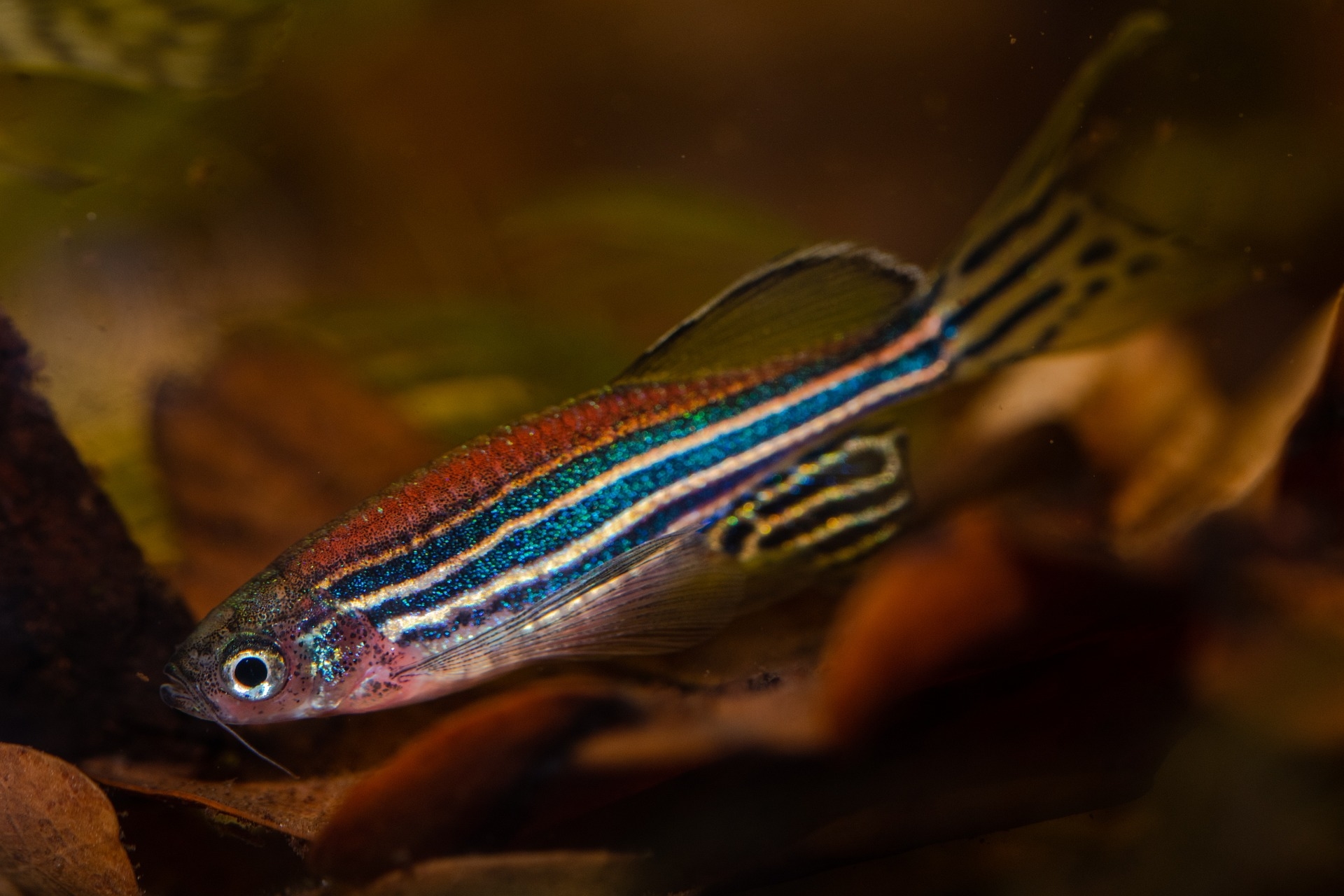
Zebrafish Photo Credit: Petr Kuznetsov

Researchers at Karolinska have uncovered how brain circuits encode the start, duration and sudden change of speed of locomotion. The study is published in the journal Neuron.

Important findings

By exploiting the relative accessibility of adult zebrafish, combined with a broad range of techniques, the researchers can now reveal two brain circuits that encode the start, duration and sudden change in locomotor speed.

The brain circuits represent the initial step in the sequence of commands coding for the onset, duration, speed and vigor of locomotion. The two command streams revealed here, with their direct access to the spinal circuits, allow the animal to navigate through their environment by grading the speed and strength of their locomotor movements, while at the same time controlling directionality. These mechanisms in adult zebrafish can be extrapolated to mammalian model systems.

Mapping connectivity

The next step will be to map the connectivity between these brain circuits and those in the spinal cord driving locomotion.

Hopefully, the circuit revealed in the study can guide designing novel therapeutic strategies aimed at restoring motor function after traumatic spinal cord injury.

The study was financed by The Swedish Research Council, Knut and Alice Wallenberg Foundation, The Swedish Brain Foundation.

Source/Credit: Karolinska Institutet | Charlotte Brandt

ns112422_01

Old World flycatchers’ family tree mapped

European robin in snow. A new study of Old World flycatcher family, to which these birds belong. The study comprises 92 per cent of the more than 300 species in this family. 
Photo Credit: Tomas Carlberg

The European robin’s closest relatives are found in tropical Africa. The European robin is therefore not closely related to the Japanese robin, despite their close similarity in appearance. This is confirmed by a new study of the Old World flycatcher family, to which these birds belong. The study comprises 92 per cent of the more than 300 species in this family.

“The fact that the European and Japanese robins are so similar-looking despite not being closely related is one of many examples of so-called convergent evolution in this group of birds. Similarities in appearance can evolve in distant relatives, e.g., as a result of similarities in lifestyle,” says Per Alström from Uppsala University, who is one of the researchers behind the study published in Molecular Phylogenetics and Evolution.

Engineers improve electrochemical sensing by incorporating machine learning

Aida Ebrahimi, Thomas and Sheila Roell Early Career Assistant Professor of Electrical Engineering and assistant professor of biomedical engineering, and Vinay Kammarchedu, 2022-23 Milton and Albertha Langdon Memorial Graduate Fellowship in Electrical Engineering, developed a new approach to improve the performance of electrochemical biosensors by combining machine learning with multimodal measurement.
Photo Credit: Kate Myers | Pennsylvania State University

Combining machine learning with multimodal electrochemical sensing can significantly improve the analytical performance of biosensors, according to new findings from a Penn State research team. These improvements may benefit noninvasive health monitoring, such as testing that involves saliva or sweat. The findings were published this month in Analytica Chimica Acta.

The researchers developed a novel analytical platform that enabled them to selectively measure multiple biomolecules using a single sensor, saving space and reducing complexity as compared to the usual route of using multi-sensor systems. In particular, they showed that their sensor can simultaneously detect small quantities of uric acid and tyrosine — two important biomarkers associated with kidney and cardiovascular diseases, diabetes, metabolic disorders, and neuropsychiatric and eating disorders — in sweat and saliva, making the developed method suitable for personalized health monitoring and intervention.

Many biomarkers have similar molecular structures or overlapping electrochemical signatures, making it difficult to detect them simultaneously. Leveraging machine learning for measuring multiple biomarkers can improve the accuracy and reliability of diagnostics and as a result improve patient outcomes, according to the researchers. Further, sensing using the same device saves resources and biological sample volumes needed for tests, which is critical with clinical samples with scarce amounts.

Featured Article

What Is: Biological Plasticity

Image Credit: Scientific Frontline The Paradigm of the Reactive Genome  The history of biological thought has long been dominated by a tensi...

Top Viewed Articles