. Scientific Frontline

Friday, May 12, 2023

New Research Unveils Mechanisms for Removal of Strong Replication-Blocking Lesions Generated by the Human HMCES Protein

Image Credit: ANIRUDH

Researchers at Nagoya University and Osaka University in Japan have found novel repair pathways of apurinic/apyrimidinic (AP) sites of DNA. Repair of the base excision, which repairs AP sites, is an essential mechanism for cell survival. Its dysfunction causes genome instability disorders, including various cranial nerve diseases. The findings of this study should lead to a better understanding of the molecular mechanisms to repair AP sites that are the causes of unexplained and intractable genomic instability diseases.

Recently, it was discovered that the HMCES protein prevents DNA cleavage by forming the DNA-protein crosslink with the AP site and that the DNA-HMCES crosslink protects cells from the toxicity of the AP sites. However, the mechanism by which the DNA-HMCES crosslinks when secondary DNA damage is repaired remains to be elucidated. In this study, the research team determined the repair mechanisms of DNA-HMCES crosslink damage.

This research is important because endogenous DNA damage induced by intracellular metabolites causes aging and carcinogenesis. One of the most frequently generated endogenous DNA damages is the AP site. Although AP sites in double-stranded DNA are repaired by base excision repair, human tissues accumulate between 50,000 and 200,000 AP sites per single cell. The AP site is a site in which genetic information is lost and is susceptible to DNA strand breakage through a chemically unstable structure. During DNA replication, the exposed AP site on the single strand of the template DNA impedes the progress of DNA polymerases because of the loss of genetic information. It also causes serious DNA double-strand break due to AP site breakage, which would induce cell death.


Resistant mushroom species spreads

Candida auris infections are difficult to treat and potentially life-threatening. The picture shows yeast cells from C. auris on the left and a fluconazole-resistant C. auris strain on the right.
Image Credit: Alexander Aldejohann

In Germany, too, the number of infections with the Candida auris fungus is increasing. This is shown by a new study by research teams from Würzburg, Jena and Berlin. Despite the low numbers, those involved advise precautionary measures.

Among the yeasts from the genus Candida, that cause infections in humans is the type Candida auris still relatively new: this species was only described in 2009, and no evidence is known before the 1990s. It is unclear which ecological niche C. auris populated and why human infections have increased since the turn of the millennium.

The treatment of C. auris infections are made considerably more difficult by the potential of the pathogen to develop resistance to all available antifungals classes. In addition, C. auris unlike others Candida- Types, are efficiently transmitted from patient to patient via direct and indirect contact, thus leading to hospital outbreaks that are difficult to control.

Zinnia Elegans will Help Strengthen Plants

Zinnia is one of the most common flower crops.
Photo Credit: Jeana Bala

Biologists at Ural Federal University and Inner Mongolia University (Hohhot, China) have identified a group of genes that are responsible for the strength of the stem in dicotyledonous plants. The results of the study are described in the journal Horticulturae, and will be useful for agriculture. 

"During plant development, specific changes occur at the level of cells, tissues, whole organs, as well as in metabolism and physiological processes. All these changes are controlled at the genetic level and by environmental conditions. These changes lead to the formation of anatomo-morphological structures that ensure the effective fulfillment of the main functions of the stem - water, mineral and photosynthetic transport, and maintenance of the shoot in an upright position. These processes are connected with deposition of lingin in cell walls of vessels and fibers. There is no lingin in the cells of the bark or in the center of the stem", - explains Anastasia Tugbaeva, co-author of the study, Junior Researcher at the UrFU Research Laboratory "Biotechnology of Components Maintenance and Restoration of Natural and Transformed Biosystems".

Thursday, May 11, 2023

Brain-Belly Connection: Gut Health May Influence Likelihood of Developing Alzheimer’s

UNLV study pinpoints 10 bacterial groups associated with Alzheimer’s disease, provides new insights into the relationship between gut makeup and dementia.
Illustration Credit: Julien Tromeur

Could changing your diet play a role in slowing or even preventing the development of dementia? We’re one step closer to finding out, thanks to a new UNLV study that bolsters the long-suspected link between gut health and Alzheimer’s disease.

The analysis — led by a team of researchers with the Nevada Institute of Personalized Medicine (NIPM) at UNLV and published this spring in the Nature journal Scientific Reports — examined data from dozens of past studies into the belly-brain connection. The results? There’s a strong link between particular kinds of gut bacteria and Alzheimer’s disease.

Between 500 and 1,000 species of bacteria exist in the human gut at any one time, and the amount and diversity of these microorganisms can be influenced by genetics and diet.

The UNLV team’s analysis found a significant correlation between 10 specific types of gut bacteria and the likelihood of developing Alzheimer’s disease. Six categories of bacteria — Adlercreutzia, Eubacterium nodatum group, Eisenbergiella, Eubacterium fissicatena group, Gordonibacter, and Prevotella9 — were identified as protective, and four types of bacteria — Collinsella, Bacteroides, Lachnospira, and Veillonella — were identified as a risk factor for Alzheimer’s disease.

Australian fruit holds the key to citrus disease resistance

Upuli Nakandala and Prof Robert Henry with a native Finger lime.
Photo Credit: Megan Pope

A comprehensive map of the genome of a native lime species that is resistant to a devastating citrus disease could be the key to preventing that disease entering Australia.

Researchers from The University of Queensland have sequenced the genome of the Australian round lime, also known as the Gympie lime, and are now looking at five other native citrus species including the finger lime.

PhD candidate Upuli Nakandala said the work aimed to identify a gene which provides resistance to Huanglongbing (HLB), also known as 'citrus greening', that could be incorporated into commercial citrus varieties.

“The species citrus australis is recognized as HLB-resistant so we put it first on our list,” Ms. Nakandala said.

With new experimental method, researchers probe spin structure in 2D materials for first time

In the study, researchers describe what they believe to be the first measurement showing direct interaction between electrons spinning in a 2D material and photons coming from microwave radiation.
 Graphic Credit: Jia Li, an assistant professor of physics at Brown.

For two decades, physicists have tried to directly manipulate the spin of electrons in 2D materials like graphene. Doing so could spark key advances in the burgeoning world of 2D electronics, a field where super-fast, small and flexible electronic devices carry out computations based on quantum mechanics.

Standing in the way is that the typical way in which scientists measure the spin of electrons — an essential behavior that gives everything in the physical universe its structure — usually doesn’t work in 2D materials. This makes it incredibly difficult to fully understand the materials and propel forward technological advances based on them. But a team of scientists led by Brown University researchers believe they now have a way around this longstanding challenge. They describe their solution in a new study published in Nature Physics.

In the study, the team — which also include scientists from the Center for Integrated Nanotechnologies at Sandia National Laboratories, and the University of Innsbruck — describe what they believe to be the first measurement showing direct interaction between electrons spinning in a 2D material and photons coming from microwave radiation. Called a coupling, the absorption of microwave photons by electrons establishes a novel experimental technique for directly studying the properties of how electrons spin in these 2D quantum materials — one that could serve as a foundation for developing computational and communicational technologies based on those materials, according to the researchers.

First-of-its-kind measurement of Universe’s expansion rate weighs in on longstanding astronomy debate

Image Credit: Patrick Kelly, University of Minnesota

Thanks to data from a magnified supernova, a team led by University of Minnesota researchers has successfully used a first-of-its-kind technique to measure the expansion rate of the Universe. Their data provide insight into a longstanding debate in the field of astronomy and could help scientists more accurately determine the Universe’s age and better understand the cosmos.

The work is divided into two papers, published in Science, one of the world’s top peer-reviewed academic journals, and The Astrophysical Journal, a peer-reviewed scientific journal of astrophysics and astronomy.

In astronomy, there are two precise measurements of the expansion of the Universe, also called the “Hubble constant.” One is calculated from nearby observations of supernovae, and the second uses the “cosmic microwave background,” or radiation that began to stream freely through the Universe shortly after the Big Bang. 

However, these two measurements differ by about 10%, which has caused widespread debate among physicists and astronomers. If both measurements are accurate, that means scientists’ current theory about the make-up of the universe is incomplete.

12 Months of Treatment with EPIT Superior to Placebo in Desensitizing Children to Peanuts

Wesley Burks, MD, and Edwin Kim, MD
Photo Credit: Courtesy UNC School of Medicine

The study, called EPITOPE, led by senior author A. Wesley Burks, MD, CEO of UNC Health and dean of the UNC School of Medicine, and contributing author Edwin Kim, MD, MS, associate professor of pediatrics in the Division of Pediatric Allergy and Immunology at the UNC School of Medicine, shows superior results in desensitizing children to peanuts. Results were recently published in the New England Journal of Medicine.

Peanut allergy affects approximately two percent of children in the United States, Canada, and other westernized countries, with a rapidly rising prevalence over the past 20 years. Currently there are no FDA approved treatment options for peanut-allergic children under the age of 4 years, but further research into the safety, efficacy, and tolerability of epicutaneous immunotherapy (EPIT) could play a significant role in novel options for immunotherapy. The EPITOPE trial, led by senior author A. Wesley Burks, MD, CEO of UNC Health and dean of the UNC School of Medicine, evaluating the safety profile of Viaskin, a novel form of EPIT, among peanut-allergic toddlers shows that after 12 months of treatment in children aged 1-3 years, the treatment was found to be statistically superior to placebo in desensitizing participants to peanuts, increasing the peanut dose triggering allergic symptoms. Edwin Kim, MD, MS, associate professor of pediatrics in the Division of Pediatric Allergy and Immunology at the UNC School of Medicine is also a contributing author to the paper.

Study could help solve mystery of the disappearing twins

An image of the binary stars Alpha Centauri A (left) and Alpha Centauri B, taken by the Hubble Space Telescope.
Image Credit: NASA

When supermassive stars are born, they’re almost always paired with a twin, and the two stars normally orbit one another.

But astronomers at UCLA’s Galactic Center Group and the Keck Observatory have analyzed over a decade’s worth of data about 16 young supermassive stars orbiting the supermassive black hole at the center of the Milky Way galaxy. Their findings, published today in the Astrophysical Journal, reveal a startling conclusion: All of them are singletons.

But why? Are the stars, which are about 10 times larger than our sun, being formed alone in the hostile environment around the black hole? Have their “twins” been kicked out by the black hole? Or have pairs of stars merged to form single stars?

The findings support a scenario in which the central supermassive black hole drives nearby stellar binaries to merge or be disrupted, with one of the pair being ejected from the system.

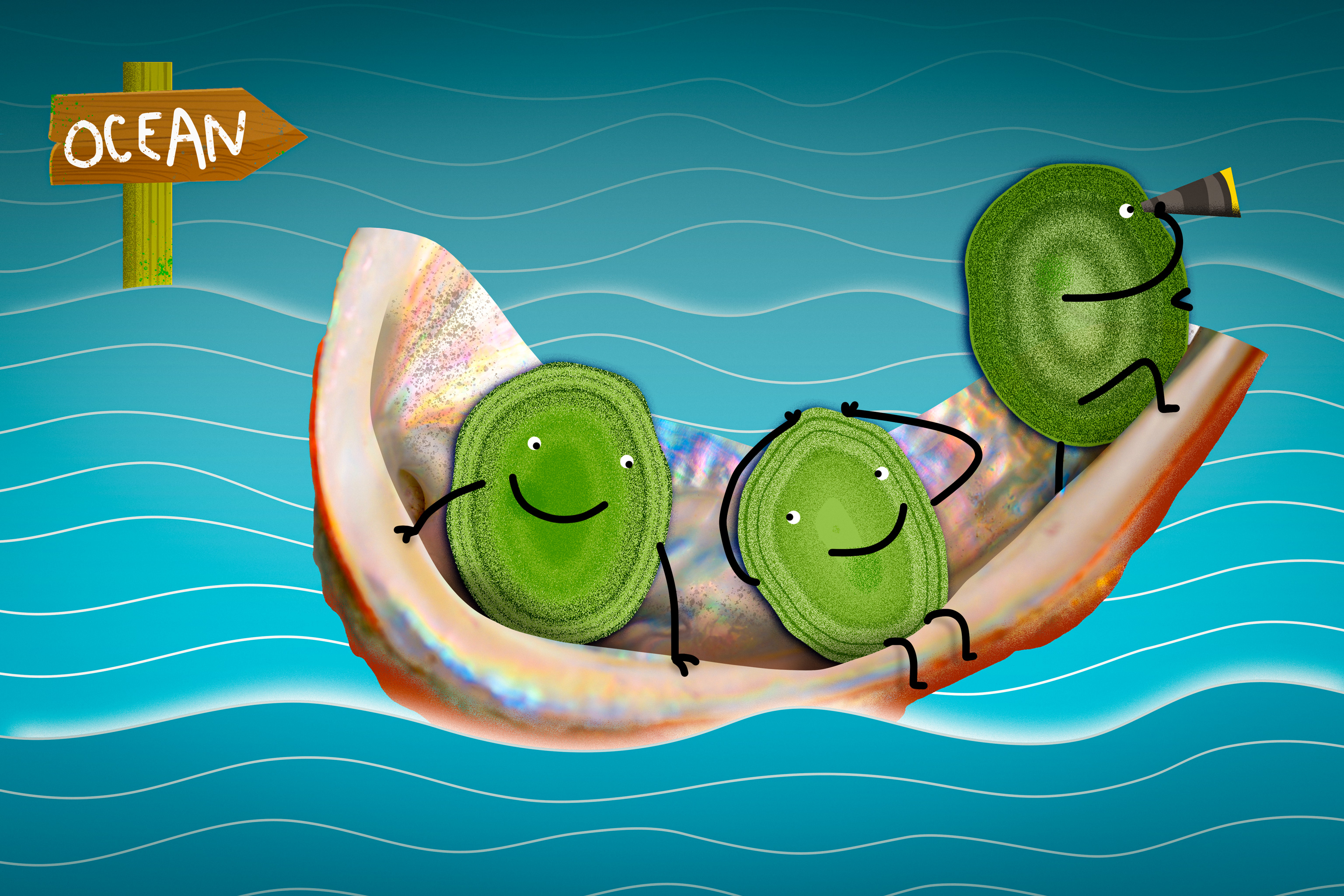
Like ancient mariners, ancestors of Prochlorococcus microbes rode out to sea on exoskeleton particles

New research suggests the Prochlorococcus microbe’s ancient coastal ancestors colonized the ocean by rafting out on chitin particles.
Illustration Credit: Jose-Luis Olivares/MIT
(CC BY-NC-ND 3.0)

Throughout the ocean, billions upon billions of plant-like microbes make up an invisible floating forest. As they drift, the tiny organisms use sunlight to suck up carbon dioxide from the atmosphere. Collectively, these photosynthesizing plankton, or phytoplankton, absorb almost as much CO2 as the world’s terrestrial forests. A measurable fraction of their carbon-capturing muscle comes from Prochlorococcus — an emerald-tinged free-floater that is the most abundant phytoplankton in the oceans today.

But Prochlorococcus didn’t always inhabit open waters. Ancestors of the microbe likely stuck closer to the coasts, where nutrients were plentiful and organisms survived in communal microbial mats on the seafloor. How then did descendants of these coastal dwellers end up as the photosynthesizing powerhouses of the open oceans today?

MIT scientists believe that rafting was the key. In a new study they propose that ancestors of Prochlorococcus acquired an ability to latch onto chitin — the degraded particles of ancient exoskeletons. The microbes hitched a ride on passing flakes, using the particles as rafts to venture further out to sea. These chitin rafts may have also provided essential nutrients, fueling and sustaining the microbes along their journey.

Featured Article

Hidden heartache of losing an animal companion

Chimmi April 09, 2010 -February 23, 2025 My best friend. Photo Credit: Heidi-Ann Fourkiller The emotional toll of losing a beloved pet durin...

Top Viewed Articles