. Scientific Frontline

Thursday, August 11, 2022

Do you keep secrets from your loved ones, family, or friends?

Ninety percent of people have kept an everyday consumer decision a secret from a spouse or other close relationship 
Photo Credit: Noelle Otto

It turns out that many people do. Whether ordering something online and hiding the package when it arrives, hiring a cleaning service and not telling your roommate, or eating a pizza instead of dieting, we often have secret purchases that we just prefer not to divulge.

UConn marketing professor Danielle Brick is investigating this behavior and discovering the little “errors of omissions” that go on in many households.

“I think what makes this research important, and fun, is how relatable it is,’ says Brick, a new member of the UConn School of Business faculty.

Her research, titled “Secret Consumer Behaviors in Close Relationships,” has just been published in the Journal of Consumer Psychology.

She and her colleagues found that this clandestine behavior not only impacts relationships in an unexpected and significant way, but also has considerable marketing implications.

Nearly a hundred genes have been lost during the woolly mammoth’s evolution

Tusk from woolly mammoth emerging from the permafrost on Wrangel Island.
Photo Credit: Love Dalén/Stockholm University.

A new study shows that 87 genes have been affected by deletions or short insertions during the course of the mammoth’s evolution. The researchers note that their findings have implications for international efforts to resurrect extinct species, including the woolly mammoth. The study was published in the journal iScience by researchers at the Centre for Palaeogenetics in Stockholm, a collaboration between Stockholm University and the Swedish Museum of Natural History.

One of the most widely discussed methods to resurrect extinct species is to use genome editing techniques such as Crispr-Cas9 to insert key gene variants from an extinct species into a genome from its living relative. However, the results in this new study indicate that one might also need to remove certain genes to preserve important biological traits while reconstructing extinct genomes.

“Editing the genome of a living species to mimic that from an extinct relative was never going to be easy, and these new findings certainly illustrate the complexity and difficulties that lie ahead”, says Love Dalén, a professor of evolutionary genomics at the Centre for Palaeogenetics.

New research "UNCOVERS" hidden objects in high resolution

Target objects and the images of them created with UNCOVER NLOS technology.
Credit: Caltech

Imagine driving home after a long day at work. Suddenly, a car careens out of an obscured side street and turns right in front of you. Luckily, your autonomous car saw this vehicle long before it came within your line of sight and slowed to avoid a crash. This might seem like magic, but a novel technique developed at Caltech could bring it closer to a reality.

With the advent of autonomous vehicles, advanced spacecraft, and other technologies that rely on sensors for navigation, there is an ever-increasing need for advanced technologies that can scan for obstacles, pedestrians, or other objects. But what if something is hidden behind another object?

In a paper recently published in the journal Nature Photonics, Caltech researchers and their colleagues describe a new method that essentially transforms nearby surfaces into lenses that can be used to indirectly image previously obscured objects.

The technology, developed in the laboratory of Changhuei Yang, Thomas G. Myers Professor of Electrical Engineering, Bioengineering, and Medical Engineering; and Heritage Medical Research Institute investigator, is a form of non-line-of-sight (NLOS) sensing—or sensing that detects an object of interest outside of the viewer's line of sight. The new method, dubbed UNCOVER, does this by using nearby flat surfaces, such as walls, like a lens to clearly view the hidden object.

Genetic mapping of tumors reveals how cancers grow


Understanding which cells give rise to which areas of cancer can improve our understanding of how a tumor has grown and developed, including how it has changed genetically, over time. This has been made possible using a new technique called spatial transcriptomics, which allows scientists to see what genetic changes take place without breaking up the tissue they’re looking at. This adds a new dimension which researchers have now used to reveal which cells have mutated and where within the ecosystem of an organ.

Current techniques for studying the genetics of cells within tumors involve taking a sample from the cancerous area and analyzing the DNA of those cells. The problem is that many cancers, such as prostate cancer, are three dimensional, which means that any one sample would only give a small snapshot of the tumor.

In a new study published in Nature, the researchers used spatial transcriptomics to create a cross-sectional map of a whole prostate, including areas of healthy and cancerous cells. By grouping cells according to similar genetic identity, they were surprised to see areas of supposedly healthy tissue that already had many of the genetic characteristics of cancer. This finding was surprising because of both the genetic variability within the tissue as well as the large number of cells that would be considered healthy, but which contained mutations usually identified with cancerous cells.

Alastair Lamb of Oxford’s Nuffield Department of Surgical Sciences, who jointly led the study, said: 'Prostate tissue is three-dimensional, and like most organs that can develop cancer we still have much to learn about what cellular changes cause cancer and where it starts. One thing we are fairly confident of is that it starts with genetic mutations.

World first chronic fatigue syndrome findings could fast track response to Long COVID

Professor Sonya Marshall-Gradisnik from the National Centre for Neuroimmunology and Emerging Diseases (NCNED) at Griffith University.
Credit: Griffith University

Griffith University researchers are hoping to find a treatment for Long COVID after proving the illness shares the same biological impairment as patients with Chronic Fatigue Syndrome (known internationally as Myalgic Encephalomyelitis (ME/CFS)).

In a world first, their study suggests COVID-19 could be a potential trigger for ME/CFS and their 10 years of research on ME/CFS could help fast track understanding and treatment of Long Covid.

Griffith University’s National Centre for Neuroimmunology and Emerging Diseases Director, Professor Sonya Marshall-Gradisnik, said the breakthrough findings will assist with investigations into therapeutic strategies to help both Long COVID and ME/CFS patients.

“Patients with Long COVID report neurocognitive, immunological, gastrointestinal, and cardiovascular manifestations, which are also symptoms of ME/CFS,” Professor Marshall-Gradisnik said.

“Our researchers have pioneered a specialized technique known as electrophysiology or ‘patch-clamp’ in immune cells.”

“This technique previously led the team to report on the pathology of ME/CFS and to examine specific ion channels in cells.

Wednesday, August 10, 2022

How dinos carried their enormous weight

 3D paleoreconstruction of a sauropod dinosaur
Credit: Dr. Andreas Jannel

Scientists have cracked an enduring mystery, discovering how sauropod dinosaurs – like Brontosaurus and Diplodocus – supported their gigantic bodies on land.

A University of Queensland and Monash University-led team used 3D modeling and engineering methods to digitally reconstruct and test the function of foot bones of different sauropods.

Dr. Andréas Jannel conducted the research during his PhD studies at UQ’s Dinosaur Lab and said the team found that the hind feet of sauropod had a soft tissue pad beneath the ‘heel’, cushioning the foot to absorb their immense weight.

“We’ve finally confirmed a long-suspected idea and we provide, for the first time, biomechanical evidence that a soft tissue pad – particularly in their back feet – would have played a crucial role in reducing locomotor pressures and bone stresses,” Dr. Jannel said.

“It is mind-blowing to imagine that these giant creatures could have been able to support their own weight on land.”

Sauropods were the largest terrestrial animals that roamed the Earth for more than 100 million years.

They were first thought to have been semi-aquatic with water buoyancy supporting their massive weight, a theory disproved by the discovery of sauropod tracks in terrestrial deposits in the mid-twentieth century.

Monash University’s Dr. Olga Panagiotopoulou said it had also been thought sauropods had feet similar to a modern-day elephant.

Ageing neutralizes sex differences in the brain

When male and female fruit flies age, their brains become desexualized.
Credit: Erik Karits on Unsplash

When male and female fruit flies age, their brains become desexualized. Age-related changes take place in both sexes, but the male brain becomes feminized to a larger extent than the female brain becomes masculinized. This is the conclusion of a study performed by a research group at Linköping University.

It is a well-known fact that weaker individuals cannot afford to “invest” in sexual behaviors to the same extent as their healthier conspecifics. However, it is not clear if ageing, which weakens individuals, also leads to a reduced investment in sexual activities. You might think that for individuals close to the end of their lives, going “all in” on reproduction, in order to pass on their genes before it is too late, would be best. Sexual behaviors are directed from the brain, and to find out what happens to sex differences in this tissue when fruit flies age the researchers have investigated how genes expressed to different degrees in young males and females change over time.

“Our results show that gene expression in male and female brains become more similar with age, and that both sexes contribute to this pattern”, says Dr Antonino Malacrinò, one of the study’s main authors who now works at the University of Reggio Calabria in Italy.

What the study shows is that if the expression of a certain gene is higher in the brains of young females than in young males, the gene’s expressions is reduced in older females and increased in old males – and vice versa for genes with higher expression in young males.

“The results also show that the changes are larger in males than in females”, says Antonino Malacrinò.

Study Reveals How the Ovarian Reserve Is Established

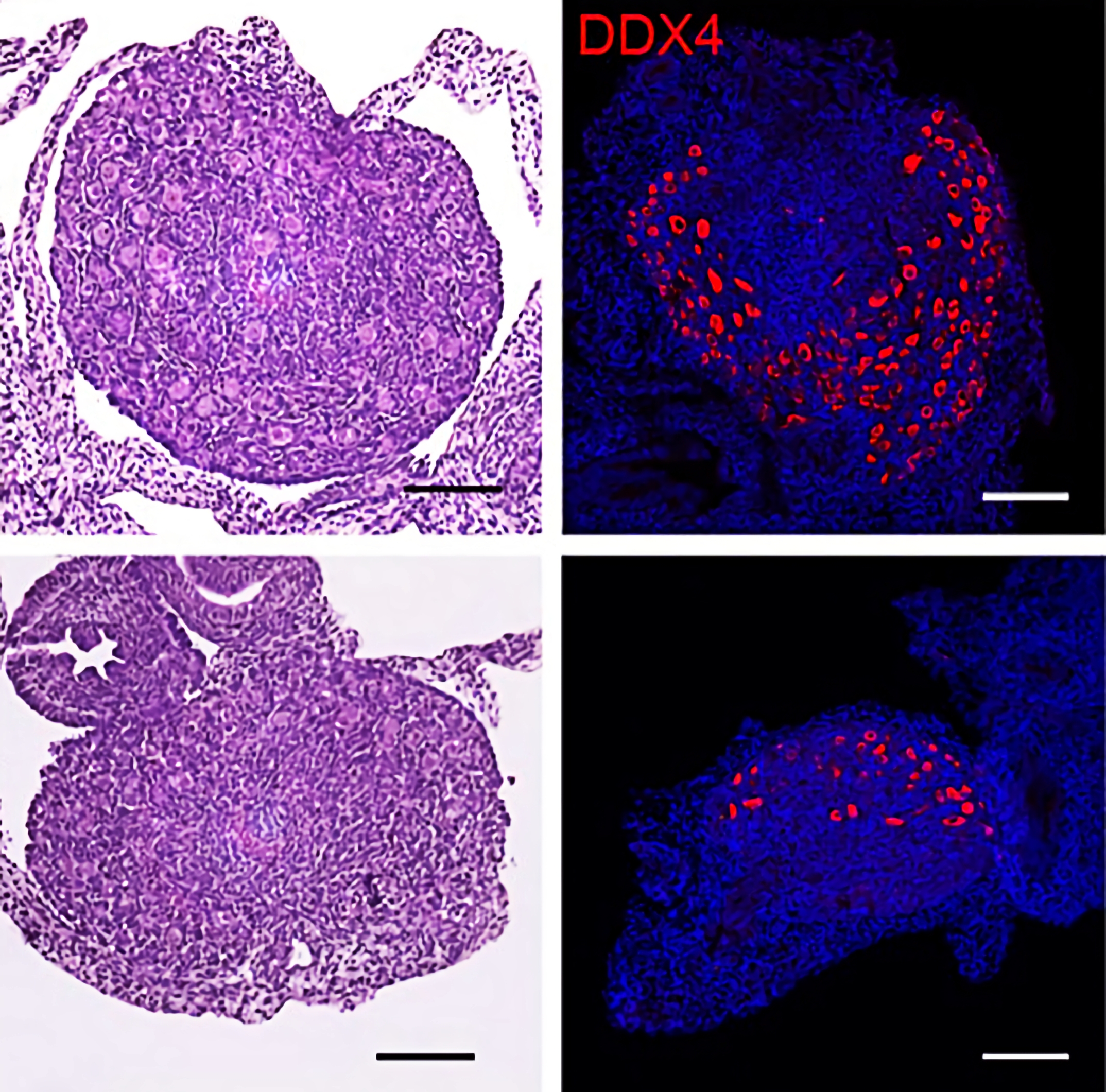
Female mammals have a limited number of follicles that can form eggs, called the ovarian reserve. New work at UC Davis shows that the PRC1 gene complex is responsible for establishing the ovarian reserve and plays a role in fertility.
Credit: Mengwen Hu, UC Davis

Scientific Frontline: Extended "At a Glance" Summary: The Ovarian Reserve

The Core Concept: The ovarian reserve is the finite, non-renewable pool of primordial follicles present in mammalian females from birth, with each follicle containing an oocyte capable of eventually developing into an egg.

Key Distinction/Mechanism: The establishment and maintenance of the reserve rely on a group of proteins known as Polycomb Repressive Complex 1 (PRC1). PRC1 functions as an epigenetic mechanism that suppresses the cellular development process (meiosis), forcing the oocytes into a paused, quiescent state where they can survive for decades without dividing or proliferating.

Major Frameworks/Components:

  • Epigenetic Regulation: The process of altering how genes function and express themselves without changing the underlying DNA sequence, crucial for maintaining cellular arrest.
  • Polycomb Repressive Complex 1 (PRC1): The specific protein complex responsible for halting oocyte development; its depletion results in rapid follicle loss and sterility.
  • Meiosis Suppression: The targeted inhibition of cell division prior to the establishment of the reserve, ensuring proper gene expression programs are maintained.
  • Primordial Follicles: The fundamental, arrested cellular units that house the oocytes and collectively make up the reserve.

AI May Come to the Rescue of Future Firefighters

A view from NIST's Burn Observation Bubble (BOB) of a burning structure during an experiment, one minute before flashover. 
Credit: NIST

In firefighting, the worst flames are the ones you don’t see coming. Amid the chaos of a burning building, it is difficult to notice the signs of impending flashover — a deadly fire phenomenon wherein nearly all combustible items in a room ignite suddenly. Flashover is one of the leading causes of firefighter deaths, but new research suggests that artificial intelligence (AI) could provide first responders with a much-needed heads-up.

Researchers at the National Institute of Standards and Technology (NIST), the Hong Kong Polytechnic University and other institutions have developed a Flashover Prediction Neural Network (FlashNet) model to forecast the lethal events precious seconds before they erupt. In a new study published in Engineering Applications of Artificial Intelligence, FlashNet boasted an accuracy of up to 92.1% across more than a dozen common residential floorplans in the U.S. and came out on top when going head-to-head with other AI-based flashover predicting programs.

Flashovers tend to suddenly flare up at approximately 600 degrees Celsius (1,100 degrees Fahrenheit) and can then cause temperatures to shoot up further. To anticipate these events, existing research tools either rely on constant streams of temperature data from burning buildings or use machine learning to fill in the missing data in the likely event that heat detectors succumb to high temperatures.

Until now, most machine learning-based prediction tools, including one the authors previously developed, have been trained to operate in a single, familiar environment. In reality, firefighters are not afforded such luxury. As they charge into hostile territory, they may know little to nothing about the floorplan, the location of fire or whether doors are open or closed.

Secret behind ‘nic-sickness’ could help break tobacco addiction

Nicotine is addictive because it activates the brain’s dopamine network, which makes us feel good. UC Berkeley researchers now show in experiments on mice that nicotine in high doses also activates a recently discovered dopamine network that responds to unpleasant stimuli. This aversive dopamine network could be leveraged to create a therapy that boosts the negative effects and lessens the rewards of nicotine.
Image credit: Christine Liu, UC Berkeley

If you remember your first hit on a cigarette, you know how sickening nicotine can be. Yet, for many people, the rewards of nicotine outweigh the negative effects of high doses.

University of California, Berkeley, researchers have now mapped out part of the brain network responsible for the negative consequences of nicotine, opening the door to interventions that could boost the aversive effects to help people quit smoking.

Though most addictive drugs at high doses can cause physiological symptoms that lead to unconsciousness or even death, nicotine is unique in making people physically ill when inhaled or ingested in large quantities. As a result, nicotine overdoses are rare, though the advent of e-cigarettes has made “nic-sick” symptoms like nausea and vomiting, dizziness, rapid heartbeat and headaches more common.

New research, conducted in mice, suggests that this aversive network could be manipulated to treat nicotine dependence.

“Decades of research have focused on understanding how nicotine reward leads to drug addiction and what are the underlying brain circuits. In contrast, the brain circuits that mediate the aversive effects of nicotine are largely understudied,” said Stephan Lammel, UC Berkeley associate professor of molecular and cell biology. “What we found is that the brain circuits that are activated after a high aversive dose are actually different from those that are activated when nicotine is delivered at a low dose. Now that we have an understanding of the different brain circuits, we think we can maybe develop a drug so that, when nicotine is taken at a low dose, these brain circuits can be coactivated to induce an acute aversive effect. This could actually be a very effective treatment for nicotine addiction in the future, which we currently do not have.”

A new study overturns 100-year-old understanding of color perception

. This visualization captures the 3D mathematical space used to map human color perception. A new mathematical representation has found that the line segments representing the distance between widely separated colors don't add up correctly using the previously accepted geometry. The research contradicts long-held assumptions and will improve a variety of practical applications of color theory.
Credit: Los Alamos National Laboratory

A new study corrects an important error in the 3D mathematical space developed by the Nobel Prize–winning physicist Erwin Schrödinger and others and used by scientists and industry for more than 100 years to describe how your eye distinguishes one color from another. The research has the potential to boost scientific data visualizations, improve TVs and recalibrate the textile and paint industries.

“The assumed shape of color space requires a paradigm shift,” said Roxana Bujack, a computer scientist with a background in mathematics who creates scientific visualizations at Los Alamos National Laboratory. Bujack is lead author of the paper by a Los Alamos team in the Proceedings of the National Academy of Science on the mathematics of color perception. "Our research shows that the current mathematical model of how the eye perceives color differences is incorrect. That model was suggested by Bernhard Riemann and developed by Hermann von Helmholtz and Erwin Schrödinger — all giants in mathematics and physics — and proving one of them wrong is pretty much the dream of a scientist.”

Modeling human color perception enables automation of image processing, computer graphics and visualization tasks.

First demonstration of a new particle beam technology at Fermilab

The optical stochastic cooling apparatus occupies the entire six-meter length of IOTA’s long experimental straight. Designed and built by the IOTA/FAST team and industry partners, the system was recently used to achieve the world’s first demonstration of OSC.
Photo Credit: Ryan Postel, Fermilab

Physicists love to smash particles together and study the resulting chaos. Therein lies the discovery of new particles and strange physics, generated for tiny fractions of a second and recreating conditions often not seen in our universe for billions of years. But for the magic to happen, two beams of particles must first collide.

Researchers at the U.S. Department of Energy’s Fermi National Accelerator Laboratory has announced the first successful demonstration of a new technique that improves particle beams. Future particle accelerators could potentially use the method to create better, denser particle beams, increasing the number of collisions and giving researchers a better chance to explore rare physics phenomena that help us understand our universe. The team published its findings in a recent edition of Nature.

Particle beams are made of billions of particles traveling together in groups called bunches. Condensing the particles in each beam so they are packed closely together makes it more likely that particles in colliding bunches will interact—the same way multiple people trying to get through a doorway at the same time are more likely to jostle one another than when walking through a wide-open room.

New long-necked dinosaur helps rewrite evolutionary history of sauropods in South America

Panoramic view of the Serranía del Perijá in Colombia, where a vertebra was found in 1943. The vertebra has allowed scientists to identify a new species of sauropod, the Perijasaurus lapaz.
Image Credit: Jeff Wilson Mantilla, University of Michigan

A medium-sized sauropod dinosaur inhabited the tropical lowland forested area of the Serranía del Perijá in northern Colombia approximately 175 million years ago, according to a new study by an international team of researchers published in the Journal of Vertebrate Paleontology.

The new species is a long-necked, plant-eating dinosaur known from a single trunk vertebra that is about a half meter tall and wide. The vertebra bears a distinct pattern of bony struts that identify it as the new dinosaur species Perijasaurus lapaz (pear-EE-hah-SOW-roos la-PAHZ)—named in recognition of the mountainous region where it was found and for the 2016 peace treaty that allowed scientists to pursue their research decades after the fossil remains were found in 1943.

Perijasaurus is the northernmost occurrence of a sauropod in South America and represents an early phase in their evolutionary history.

“This new genus and species in the paleotropics allow us to understand a little more about the origin of the sauropods in the Jurassic, as well as how they set the stage for later sauropods from the Cretaceous,” said study lead author Aldo Rincón Burbano, professor of physics and geosciences at the Universidad del Norte in Colombia.

Eco-glue can replace harmful adhesives in wood construction

Plywood with eco-glue produced in Aalto University.
Photo Credit: Aalto University

A fast and energy-efficient manufacturing process results in a strong, non-toxic and fire-resistant adhesive—and a great opportunity for the Finnish bioeconomy.

Researchers at Aalto University have developed a bio-based adhesive that can replace formaldehyde-containing adhesives in wood construction. The main raw material in the new adhesive is lignin, a structural component of wood and a by-product of the pulp industry that is usually burned after wood is processed. As an alternative to formaldehyde, lignin offers a healthier and more carbon-friendly way to use wood in construction.

The carbon footprint of timber construction is significantly lower than concrete construction, and timber construction has often been viewed as better for the health of human occupants as well. However, wood panels still use adhesives made from fossil raw materials. They contain formaldehyde, which can be harmful to health, especially for those working in the adhesive manufacturing process. People living in or visiting buildings can also be exposed to toxic formaldehyde from wood panels.

Lignin, on the other hand, comes from wood itself. It binds cellulose and hemicellulose together and gives wood its tough, strong structure. Lignin accounts for about a quarter of the weight of wood and is produced in huge quantities in the pulp and bioprocessing industry. Only two to five percent of the lignin produced is used, and the rest is burned in factories for energy.

Rice models moving ‘washers’ that help DNA replicate

A simulation shows how a six-sided helicase protein moves along a strand of DNA as it separates double strands into single strands during replication. Rice University theorists found that ATP hydrolysis is key to the proteins' stair-step motion. One complete step is seen here. 
Credit: Yang Gao/Shikai Jin/Rice University

Knowing the structure of a complex biological system isn’t nearly enough to understand how it works. It helps to know how the system moves.

In that light, Rice University researchers have modelled a key mechanism by which DNA replicates.

Combining structural experiments and computer simulations, bioscientist Yang Gao, theoretical physicist Peter Wolynes, graduate student Shikai Jin and their colleagues have uncovered details about how helicases, a family of ringlike motor proteins, wrangle DNA during replication. Their work could reveal new targets for disease-fighting drugs.

The synergy between the experiments and large-scale simulations they describe in the Proceedings of the National Academy of Sciences could become a paradigm for modeling of the mechanisms of many complex biological systems.

“These are dynamic processes that cannot be captured well with experimental methods alone,” said Gao, an assistant professor of biosciences and a CPRIT Scholar in Cancer Research. “But it’s important to show the mechanisms of these helicases, because they’re essential for DNA replication, and also possible drug targets.”

Featured Article

What Is: Quantum Biology

Scientific Frontline: Extended "At a Glance" Summary : Quantum Biology The Core Concept : Quantum biology is the study of non-triv...

Top Viewed Articles