. Scientific Frontline: Search results for Mutualism
Showing posts sorted by relevance for query Mutualism. Sort by date Show all posts

Friday, February 13, 2026

What Is: Mutualism


The Core Concept: Mutualism is a fundamental ecological interaction between two or more species in which each party derives a net benefit, functioning as a biological positive-sum game. It represents a cooperative strategy where organisms exchange resources or services to overcome physiological limitations or environmental deficits.

Key Distinction/Mechanism: Unlike parasitism (where one benefits at the other's expense) or commensalism (where one benefits while the other is unaffected), mutualism is defined by reciprocal advantage. It operates on "Biological Market Theory," where species trade commodities—such as nutrients, protection, or transport—based on supply, demand, and the ability to sanction "cheaters" who fail to reciprocate.

Origin/History: The term was introduced to the scientific lexicon in 1876 by Belgian zoologist Pierre-Joseph van Beneden in his seminal work Animal Parasites and Messmates to describe "mutual aid among species."

Major Frameworks/Components:

  • Biological Market Theory (BMT): An economic framework analyzing interactions as markets with "traders" (species) and "commodities" (resources/services), governed by partner choice and market dynamics.
  • Trophic Mutualism: The exchange of energy and nutrients, such as the relationship between leguminous plants and nitrogen-fixing rhizobia bacteria.
  • Virulence Theory: An evolutionary pathway suggesting many mutualisms originated as parasitic relationships that became less virulent and more cooperative over time.
  • Facultative vs. Obligate Mutualism: A spectrum of dependency ranging from flexible, non-essential partnerships (facultative) to co-evolved relationships where species cannot survive alone (obligate).
  • Sanctioning Mechanisms: Biological controls used to punish uncooperative partners, such as plants cutting off carbon supplies to underperforming bacterial nodules.

Branch of Science: Evolutionary Biology, Ecology, and Behavioral Economics.

Future Application: Understanding these mechanisms is critical for advancing sustainable agriculture (developing bio-fertilizers to replace synthetic nitrogen) and climate change mitigation strategies, specifically leveraging mycorrhizal fungi which help sequester approximately 13 gigatons of \(\mathrm{CO_2}\) annually.

Why It Matters: Mutualism challenges the traditional view of nature as purely competitive ("red in tooth and claw"), revealing that cooperation is equally ubiquitous and essential for life's complexity. It underpins critical global systems, from the digestive efficiency of ruminants to the carbon cycles that stabilize the Earth's climate.

Thursday, October 19, 2023

Understanding mutualism can help control the spread of invasive species

The subalpine fir has a mutualistic relationship with belowground fungi.
Photo Credit: Khilav Majmudar, University of Minnesota

Scientific Frontline: Extended "At a Glance" Summary

The Core Concept: Mutualism is a cooperative interaction where species exchange benefits to aid each other's survival, such as nutrient exchange between plants and fungi. Recent research analyzes how this dependence influences the ability of non-native species to invade new environments.

Key Distinction/Mechanism: Unlike general competition or predation models, this research utilizes integro-difference equations (IDEs) to simulate how "mutualism dependence"—the degree to which a species relies on a partner—impacts range expansion. The findings indicate that while moderate dependence can accelerate invasiveness, supporting too many partners creates a high metabolic cost that can actually halt an invasion.

Major Frameworks/Components:

  • Mutualism Dependence: A metric defining the extent to which a species relies on a partner for growth.
  • Obligate vs. Facultative Mutualists: A classification distinguishing between species that are highly dependent (obligate) versus those with lower dependence (facultative) on their partners.
  • Integro-difference Equations (IDEs): Mathematical models used to project spatial growth and dispersal patterns over long periods.
  • Invasional Meltdown: A theoretical feedback loop where mutualists accelerate one another's invasion, hastening native extinctions.

Friday, July 29, 2022

Orchid helps insect get a grip

Figure 1: The white egret orchid (Habenaria radiata) resembles a dancing white egret.
Credit: Suetsugu Kenji / Kobe University

Scientific Frontline: "At a Glance" Summary

  • Main Discovery: The elaborate, feather-like fringe of the white egret orchid (Habenaria radiata) functions primarily as a physical supportive platform that stabilizes hawkmoth pollinators during nectar feeding, rather than acting solely as a visual attractant.
  • Methodology: Researchers conducted field experiments by surgically removing the petal fringes from specific plants in their natural habitat and performing detailed behavioral observations of hawkmoth interactions to measure visitation rates and subsequent seed viability.
  • Key Data: Specimens with the fringe removed produced a significantly lower number of healthy seeds per fruit compared to intact plants, despite showing no decrease in the overall fruit production rate or pollinator visitation frequency.
  • Significance: This study overturns the conventional evolutionary assumption that dramatic floral geometries are selected mainly for visual appeal, highlighting the critical role of physical flower-insect mechanics in driving floral diversity.
  • Future Application: These findings provide essential data for biological conservation strategies, emphasizing the need to preserve specific functional morphological traits that facilitate mutualism in endangered wetland plant species.
  • Branch of Science: Evolutionary Biology and Ecology
  • Additional Detail: Contrary to the prior belief that hawkmoths hover continuously while feeding, behavioral analysis confirmed they actively grasp the orchid's fringe with their mid-legs to anchor themselves for effective pollen transfer.

Friday, September 19, 2025

Clownfish and Anemones Are Disappearing Because of Climate Change

A Red Sea clownfish (Amphiprion bicinctus) peers out of a bleached sea anemone (Radianthus magnifica) during a record-breaking heat wave in 2023.
Photo Credit: © Morgan Bennett-Smith

Scientific Frontline: "At a Glance" Summary

  • Main Discovery: Extreme marine heat waves in the Red Sea have disrupted the mutualistic bond between clownfish and sea anemones, resulting in a near-total collapse of local clownfish populations.
  • Methodology: Scientists monitored specific reef sites in the central Saudi Arabian Red Sea from 2022 to 2024, tracking the health and survival of Amphiprion bicinctus and Radianthus magnifica during a record-breaking 2023 heat wave, while conducting complementary laboratory experiments to analyze behavioral changes and biological mechanisms post-bleaching.
  • Key Data: During the study period, researchers documented a mortality rate of 94 to 100 percent for clownfish and 66 to 94 percent for anemones, with the bleaching event persisting for approximately six months.
  • Significance: This collapse challenges the long-held hypothesis that the Red Sea functions as a "thermal refuge" for marine life, demonstrating that even organisms adapted to high temperatures are exceeding their thermal thresholds due to accelerating climate change.
  • Future Application: These findings will guide global conservation assessments and restoration strategies for coral reef mutualisms, with ongoing comparative research extending to populations in Papua New Guinea to understand broader evolutionary impacts.
  • Branch of Science: Marine Biology and Evolutionary Ecology
  • Additional Detail: Laboratory analysis suggests the high mortality stems from bleached anemones providing inadequate camouflage and reduced defense capabilities, leaving clownfish vulnerable to predation and increased intraspecific conflict.

Sunday, November 16, 2025

Ecology: In-Depth Description

Photo Credit: Глеб Коровко

Ecology is the scientific study of the interactions between living organisms and their environment, including both living (biotic) and non-living (abiotic) components. Its primary goals are to understand the principles governing the distribution, abundance, and relationships of organisms, as well as the flow of energy and materials within ecosystems.

Saturday, January 17, 2026

What Is: Invasive Species

Image Credit: Scientific Frontline / stock image

Scientific Frontline: Extended "At a Glance" Summary

The Core Concept: Invasive species are non-native organisms that, upon introduction to a new environment, escape the evolutionary checks of their native ranges to cause significant ecological, economic, or human health harm. This phenomenon represents a systemic disruption of biophysical systems rather than merely the presence of an unwanted plant or animal.

Key Distinction/Mechanism: The defining characteristic separating "invasive" from "non-native" is impact; while many non-native species (like agricultural crops) are beneficial, invasive species actively dismantle native ecosystems. They often succeed via the Enemy Release Hypothesis, flourishing because they have left behind natural predators and diseases, or through Priority Effects, such as leafing out earlier than native flora to monopolize resources.

Origin/History: While natural translocation has occurred for eons, the current crisis is driven by the "relentless engine of human globalization" in the Anthropocene. The concept is underscored by the "Ten Percent Rule," a statistical filter noting that roughly 10% of transported species survive, 10% of those establish, and 10% of those become destructive invaders.

Wednesday, November 17, 2021

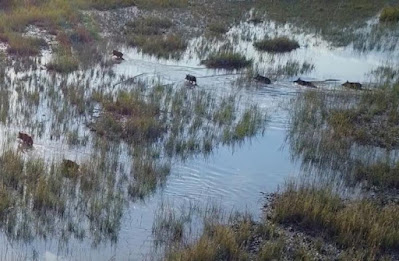
Feral Hog Invasions Leave Coastal Marshes More Susceptible to Climate Change

Coastal marshes that have been invaded by feral hogs recover from disturbances up to three times slower than non-invaded marshes and are far less resilient to sea-level rise, extreme drought and other impacts of climate change, a new study led by scientists at Duke University and the University of Massachusetts Boston (UMB) finds.

“Under normal circumstances, marshes can handle and recover from drought or sea level rise, given time, but there is no safety net in place for hog invasions,” said Brian Silliman, Rachel Carson Distinguished Professor of Marine Conservation Biology at Duke, who co-authored the study.

“Marshes that are invaded by hogs recover slower from drought, are less resilient to erosion, and hemorrhage carbon dioxide back into the air as hogs turn vast areas of the marsh into mud pits,” Silliman said.

“Based on data from our experiments, our disturbance-recovery model suggests full marsh recovery could take an extra 80 to 100 years,” he said.

Feral hogs are ravenous predators with an insatiable hunger for ribbed mussels, a shellfish species that is one of the most common – and ecologically important – inhabitants of southeastern salt marshes.

Saturday, December 20, 2025

What Is: The Phanerozoic Eon

Defining the Eon of Complex Life
Image Credit: Scientific Frontline / AI generated

The Phanerozoic Eon constitutes the current and most biologically dynamic division of the geological time scale. Spanning the interval from approximately 538.8 million years ago (Ma) to the present day, it represents roughly the last 12% of Earth's 4.54-billion-year history. Despite its relatively short duration compared to the preceding Precambrian supereon—which encompasses the Hadean, Archean, and Proterozoic eons—the Phanerozoic contains the overwhelming majority of the known fossil record and the entirety of the history of complex, macroscopic animal life.  

Featured Article

Building Immunity Against Avian Flu Risks

Plate test used to quantify infectious viral particles or neutralizing antibodies. Each hole corresponds to one viral particle. Photo Credit...

Top Viewed Articles