
 |
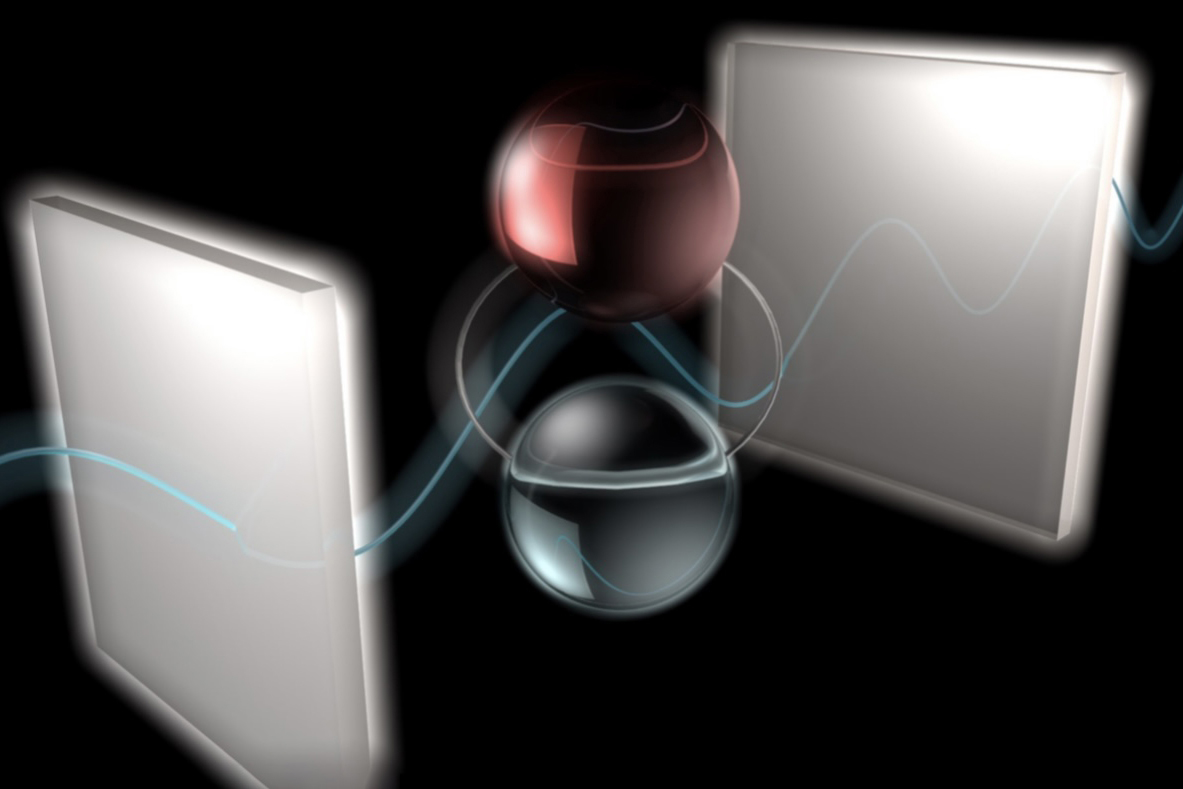
| By sandwiching bits of perovskite between two mirrors and stimulating them with laser beams, researchers were able to directly control the spin state of quasiparticles known as exciton-polariton pairs, which are hybrids of light and matter. Illustration Credit: Courtesy of the researchers (CC BY-NC-ND 3.0) |
New findings from a team of researchers at MIT and elsewhere could help pave the way for new kinds of devices that efficiently bridge the gap between matter and light. These might include computer chips that eliminate inefficiencies inherent in today’s versions, and qubits, the basic building blocks for quantum computers, that could operate at room temperature instead of the ultracold conditions needed by most such devices.
The new work, based on sandwiching tiny flakes of a material called perovskite in between two precisely spaced reflective surfaces, is detailed in the journal Nature Communications, in a paper by MIT recent graduate Madeleine Laitz PhD ’22, postdoc Dane deQuilettes, MIT professors Vladimir Bulovic, Moungi Bawendi and Keith Nelson, and seven others.
By creating these perovskite sandwiches and stimulating them with laser beams, the researchers were able to directly control the momentum of certain “quasiparticles” within the system. Known as exciton-polariton pairs, these quasiparticles are hybrids of light and matter. Being able to control this property could ultimately make it possible to read and write data to devices based on this phenomenon.




.jpg)


.jpg)