
 |
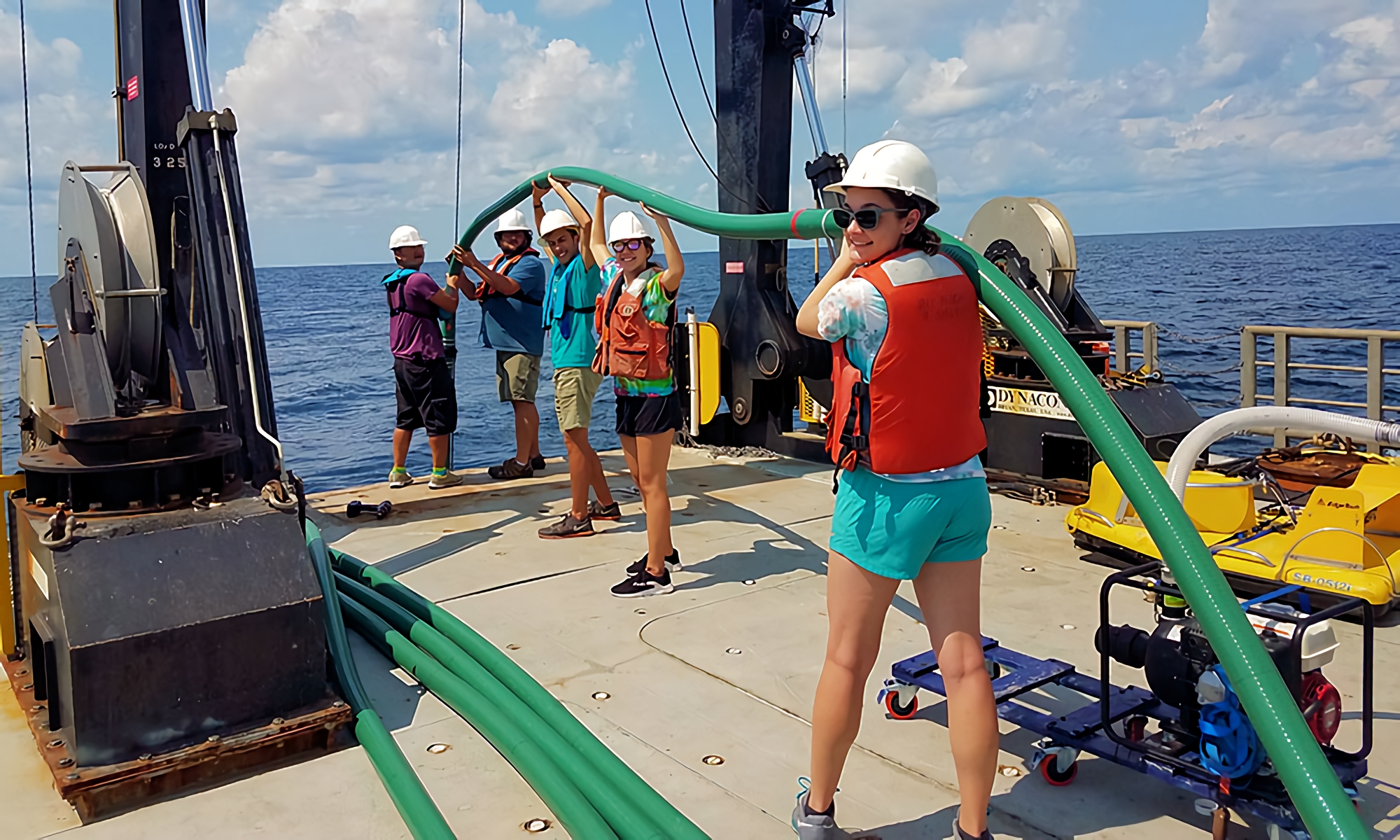
| Researchers used a giant suction hose to collect thousands of gallons of ocean water, while on the research ship R/V Hugh Sharp. The researchers extract methane from each sample, compress the methane into cylinders, and bring the cylinders back to the lab of John Kessler, a professor of earth and environmental sciences at Rochester. From left: DongJoo Joung, a former research scientist in Kessler's lab; Kenneth Fairbarn, a research technician on the ship; Ben Riddell-Young '18; Lillian Henderson '19; and Allison Laubach '18, '19 (MS). Credit: University of Rochester / John Kessler |
New research shows reservoirs of ocean methane in mid-latitude regions will not be released to the atmosphere under warming conditions.
Deep below the ocean’s surface, the seafloor contains large quantities of naturally occurring, ice-like deposits made up of water and concentrated methane gas. For decades, climate scientists have wondered if this methane hydrate reservoir might “melt” and release massive amounts of methane to the ocean and the atmosphere as ocean temperatures warm.
New research from scientists at the University of Rochester, the US Geological Survey, and the University of California Irvine is the first to directly show that methane released from decomposing hydrates is not reaching the atmosphere.
The researchers, including John Kessler, a professor in the Department of Earth and Environmental Sciences, and DongJoo Joung, a former research scientist in Kessler’s lab and now an assistant professor in the Department of Oceanography at Pusan National University in Korea, carried out the study in mid-latitude regions—Earth’s subtropical and temperate zones.
While the stability of the methane hydrate reservoir is sensitive to changes in temperature, “in the mid-latitude regions where this study was conducted, we see no signatures of hydrate methane being emitted to the atmosphere,” says Joung, the first author of the study, published in Nature Geoscience.
.jpg)


.jpg)