. Scientific Frontline

Saturday, May 13, 2023

More research is needed to spread the benefits of electric vehicles equitably

Researchers should focus on equity issues surrounding the spread of electrical vehicles, according to a study by Penn State researchers
Photo Credit: Michael Fousert

Electric vehicles, or EVs, promise to reduce carbon emissions and serve as a tool to help mitigate climate change, but a team of Penn State researchers report there has been little research to determine how equitable the benefits of EVs are and, in fact, whether the technology may unfairly harm some areas and populations.

In a study, the researchers only found 48 papers out of a pool of 9,838 studies that explicitly addressed equity issues of EVs, said Wei Peng, assistant professor of international affairs and civil and environmental engineering, Peng added that the small percentage of papers that addressed equity was telling in itself.

“During that screening process, we began to learn what is over-studied and what is understudied,” said Peng, who is also an associate of the Institute for Computational and Data Sciences. “We highlighted in our paper what we saw as the most understudied: making equity more explicit as research and, second, we saw a need to focus on those emerging markets and parts of the developing world where EVs are going to be more important.”

Unlike vehicles powered by gasoline or diesel fuel, which produce carbon and other chemicals during the combustion process, the electric motors that drive the wheels of an EV do not produce tailpipe emissions. EV owners charge the batteries that are stored on board the EV, rather than add fuel.

New Sensors with the HOTS for Extreme Missions

High Operational Temperature Sensors (HOTS)
Graphic Credit: Defense Advanced Research Projects Agency

Modern technologies are laden with sensors – a now-customary fact of life in much of the world. On smart watches and phones, and in cars and homes, sensors help monitor health, adjust various settings for comfort, and warn of potential dangers. More widely, sensors are deployed across countless commercial and defense systems, including in the oil and gas sector, the automotive industry, alternative energy sources, geothermal applications, and aviation and aerospace.

In these broader industrial contexts, the capabilities of sensors can be inhibited by thermal limitations. A sensor may theoretically be able to process inputs such as speed, pressure, or the integrity of a mechanical component, but inside a turbine engine, temperatures far exceed what any existing sensor can withstand.

DARPA’s new High Operational Temperature Sensors (HOTS) program will work toward developing microelectronic sensor technologies capable of high-bandwidth, high-dynamic-range sensing at extreme temperatures.

Study reveals set of brain regions that control complex sequences of movement

The findings in mice have the potential to advance treatment of some brain injuries and illnesses
Photo Credit: Kanashi

In a novel set of experiments with mice trained to do a sequence of movements and "change course" at the spur of the moment, Johns Hopkins scientists report they have identified areas of the animals' brains that interact to control the ability to perform complex, sequential movements, as well as to help the mice rebound when their movements are interrupted without warning.

The research, they say, could one day help scientists find ways to target those regions in people and restore motor function caused by injury or illness.

Based on brain activity measurements of the specially trained rodents, the investigators found that three main areas of the cortex have distinct roles in how the mice navigate through a sequence of movements: the premotor, primary motor, and primary somatosensory areas. All are on the top layers of the mammals' brains and arranged in a fundamentally similar fashion in people.

The team concluded that the primary motor and primary somatosensory areas are involved in controlling the immediate movements of the mice in real time, while the premotor area appears to control an entire planned sequence of movements, as well as how the mice react and adjust when the sequence is unexpectedly disrupted.

Friday, May 12, 2023

Scientists Discover Fire Records Embedded Within Sand Dunes

An illustration showing how charcoal layers accumulate in dune foot-slope deposits.
Full size image
Image Credit: Nicholas Patton / Desert Research Institute

Knowing how the frequency and intensity of wildfires has changed over time offers scientists a glimpse into Earth’s past landscapes, as well as an understanding of future climate change impacts. To reconstruct fire records, researchers rely heavily on sediment records from lake beds, but this means that fire histories from arid regions are often overlooked. Now, a new study shows that sand dunes can serve as repositories of fire history and aid in expanding scientific understanding of fire regimes around the world.

Published May 11 in Quaternary Research, the study is the first to examine sedimentary records preserved in foot-slope deposits of sand dunes. The research team, led by Nicholas Patton, Ph.D., a postdoctoral researcher now at DRI, studied four sand dunes at the Cooloola Sand Mass in Australia. Australia is one of the world’s most fire-prone landscapes, with a long history of both natural and cultural burning, and vast expanses without lakes or ponds to gather sedimentary records from. The researchers aimed to prove that these sand dune deposits could be used to reconstruct reliable, multi-millennial fire histories. These previously unrecognized archives could potentially be used in arid regions around the world to fill knowledge gaps in places where fire shapes the landscape.

New therapy helps immune system eradicate brain tumors

Professor Anna Dimberg.
Photo Credit: Mikael Wallerstedt

Researchers from Uppsala University have developed a method that helps immune cells exit from blood vessels into the tumor and kill cancer cells. The aim is to improve the treatment of aggressive brain tumors. The study has been published in the journal Cancer Cell.

Glioblastoma is an aggressive brain tumor that lacks efficient treatment. This is in part due to the ability of the tumor to suppress or evade the body´s natural anti-cancer immune response. Immunotherapy, using checkpoint inhibitors, aims to reactivate our immune system against cancer. However, for this type of treatment to be effective, specific immune cells known as killer T cells are required to be present within the tumor.

Unfortunately, blood vessels in brain cancer are dysfunctional and act as a barrier, preventing killer T cells from reaching the tumor. As a result, this form of immunotherapy, which is effective against many forms of cancer, is ineffective against brain cancers.

Help the killer T cells

In the new study, the Uppsala researchers have developed a method to help the killer T cells reach the tumors and fight cancer cells. They used a viral vector that specifically infected the blood vessels in the brain and enabled them to produce a factor called LIGHT. This altered the function of the tumor vessels, increasing their ability to transport T cells from the blood into the tumor tissue.

Ultralow temperature terahertz microscope capabilities enable better quantum technology

Terahertz microscope with cryogenic insert.
Image Credit: Courtesy of Ames National Laboratory

A team of scientists from the Department of Energy’s Ames National Laboratory have developed a way to collect terahertz imaging data on materials under extreme magnetic and cryogenic conditions. They accomplished their work with a new scanning probe microscope. 

This microscope was recently developed at Ames Lab. The team used the ultralow temperature terahertz microscope to take measurements on superconductors and topological semimetals. These materials were exposed to high magnetic fields and temperatures below liquid helium (below 4.2 Kelvins or -452 degrees Fahrenheit).

According to Jigang Wang, a scientist at Ames Lab, professor of Physics and Astronomy at Iowa State University, and the team leader, the team has been improving their terahertz microscope since it was first completed in 2019. “We have improved the resolution in terms of the space, time and energy,” said Wang. “We have also simultaneously improved operation to very low temperatures and high magnetic fields.”

Study reveals new ways for exotic quasiparticles to “relax”

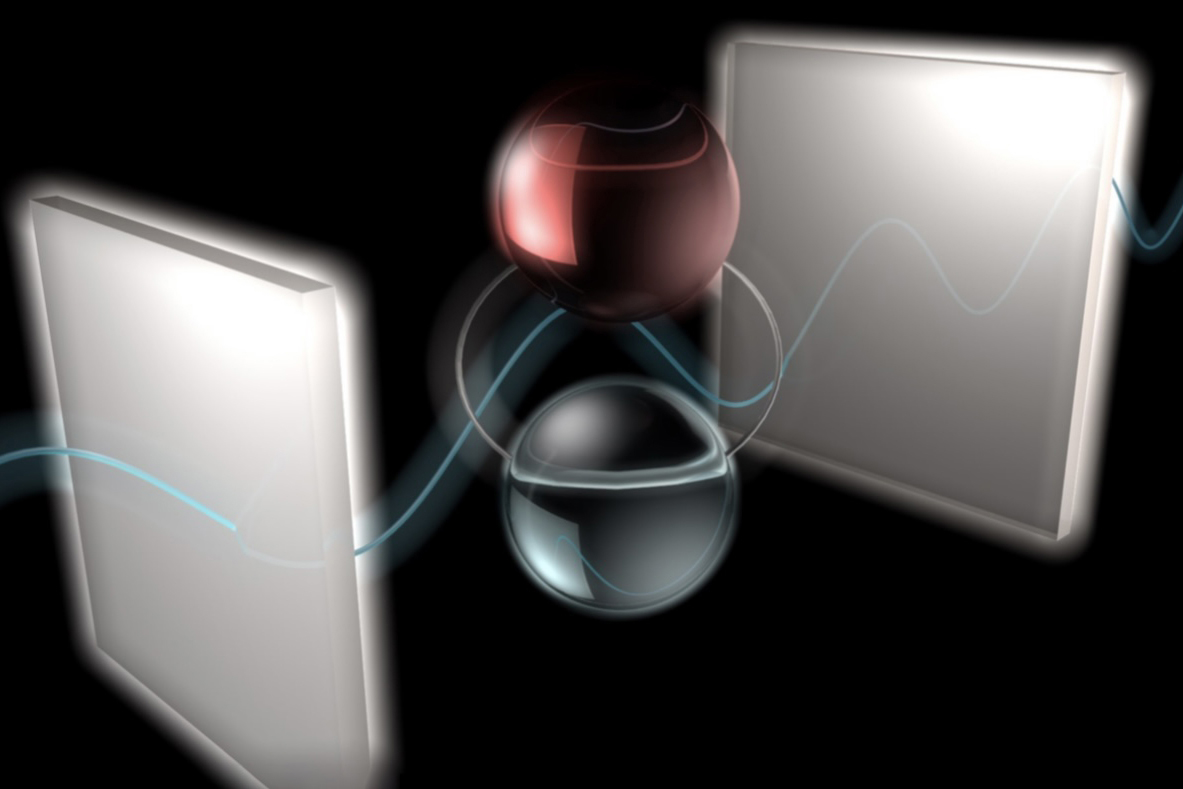
By sandwiching bits of perovskite between two mirrors and stimulating them with laser beams, researchers were able to directly control the spin state of quasiparticles known as exciton-polariton pairs, which are hybrids of light and matter.
Illustration Credit: Courtesy of the researchers
(CC BY-NC-ND 3.0)

New findings from a team of researchers at MIT and elsewhere could help pave the way for new kinds of devices that efficiently bridge the gap between matter and light. These might include computer chips that eliminate inefficiencies inherent in today’s versions, and qubits, the basic building blocks for quantum computers, that could operate at room temperature instead of the ultracold conditions needed by most such devices.

The new work, based on sandwiching tiny flakes of a material called perovskite in between two precisely spaced reflective surfaces, is detailed in the journal Nature Communications, in a paper by MIT recent graduate Madeleine Laitz PhD ’22, postdoc Dane deQuilettes, MIT professors Vladimir Bulovic, Moungi Bawendi and Keith Nelson, and seven others.

By creating these perovskite sandwiches and stimulating them with laser beams, the researchers were able to directly control the momentum of certain “quasiparticles” within the system. Known as exciton-polariton pairs, these quasiparticles are hybrids of light and matter. Being able to control this property could ultimately make it possible to read and write data to devices based on this phenomenon.

Tidal Shocks Can Light up the Remains of a Star Being Pulled Apart by a Black Hole

In a Tidal Disruption Event, a star moves close enough to a supermassive black hole so that the gravitational pull of the black hole bends the star until it is destroyed (image 1). The stellar matter from the destroyed star forms an elliptical stream around the black hole (image 2). Tidal shocks are formed around the black hole as the gas hits itself on its way back after circling the black hole (image 3). The tidal shocks create bright outbursts of polarized light that can be observed in optical and ultraviolet wavelengths. Over time, the gas from the destroyed star forms an accretion disk around the black hole (image 4) from where it is slowly pulled into the black hole. The scale of the image is not accurate.
Full size image
 Image Credit: Jenni Jormanainen

The Universe is a violent place where even the life of a star can be cut short. This occurs when a star finds itself in a "bad" neighborhood, specifically near a supermassive black hole. 

These black holes weigh millions or even billions of times the mass of the Sun and typically reside in the centers of quiet galaxies. As a star moves closer to the black hole, it experiences the ever-increasing gravitational pull of the supermassive black hole until it becomes more powerful than the forces that keep the star together. This results in the star being disrupted or destroyed, an event known as a Tidal Disruption Event (TDE).

“After the star has been ripped apart, its gas forms an accretion disk around the black hole. The bright outbursts from the disk can be observed in nearly every wavelength, especially with optical telescopes and satellites that detect X-rays,” says Postdoctoral Researcher Yannis Liodakis from the University of Turku and the Finnish Centre for Astronomy with ESO (FINCA).

New Research Unveils Mechanisms for Removal of Strong Replication-Blocking Lesions Generated by the Human HMCES Protein

Image Credit: ANIRUDH

Researchers at Nagoya University and Osaka University in Japan have found novel repair pathways of apurinic/apyrimidinic (AP) sites of DNA. Repair of the base excision, which repairs AP sites, is an essential mechanism for cell survival. Its dysfunction causes genome instability disorders, including various cranial nerve diseases. The findings of this study should lead to a better understanding of the molecular mechanisms to repair AP sites that are the causes of unexplained and intractable genomic instability diseases.

Recently, it was discovered that the HMCES protein prevents DNA cleavage by forming the DNA-protein crosslink with the AP site and that the DNA-HMCES crosslink protects cells from the toxicity of the AP sites. However, the mechanism by which the DNA-HMCES crosslinks when secondary DNA damage is repaired remains to be elucidated. In this study, the research team determined the repair mechanisms of DNA-HMCES crosslink damage.

This research is important because endogenous DNA damage induced by intracellular metabolites causes aging and carcinogenesis. One of the most frequently generated endogenous DNA damages is the AP site. Although AP sites in double-stranded DNA are repaired by base excision repair, human tissues accumulate between 50,000 and 200,000 AP sites per single cell. The AP site is a site in which genetic information is lost and is susceptible to DNA strand breakage through a chemically unstable structure. During DNA replication, the exposed AP site on the single strand of the template DNA impedes the progress of DNA polymerases because of the loss of genetic information. It also causes serious DNA double-strand break due to AP site breakage, which would induce cell death.

Resistant mushroom species spreads

Candida auris infections are difficult to treat and potentially life-threatening. The picture shows yeast cells from C. auris on the left and a fluconazole-resistant C. auris strain on the right.
Image Credit: Alexander Aldejohann

In Germany, too, the number of infections with the Candida auris fungus is increasing. This is shown by a new study by research teams from Würzburg, Jena and Berlin. Despite the low numbers, those involved advise precautionary measures.

Among the yeasts from the genus Candida, that cause infections in humans is the type Candida auris still relatively new: this species was only described in 2009, and no evidence is known before the 1990s. It is unclear which ecological niche C. auris populated and why human infections have increased since the turn of the millennium.

The treatment of C. auris infections are made considerably more difficult by the potential of the pathogen to develop resistance to all available antifungals classes. In addition, C. auris unlike others Candida- Types, are efficiently transmitted from patient to patient via direct and indirect contact, thus leading to hospital outbreaks that are difficult to control.

Featured Article

What Is: Endogenous Retroviruses (ERVs)

Ghost in the Machine Image Credit: Scientific Frontline Scientific Frontline: Extended "At a Glance" Summary : Endogenous Retrovir...

Top Viewed Articles