
 |
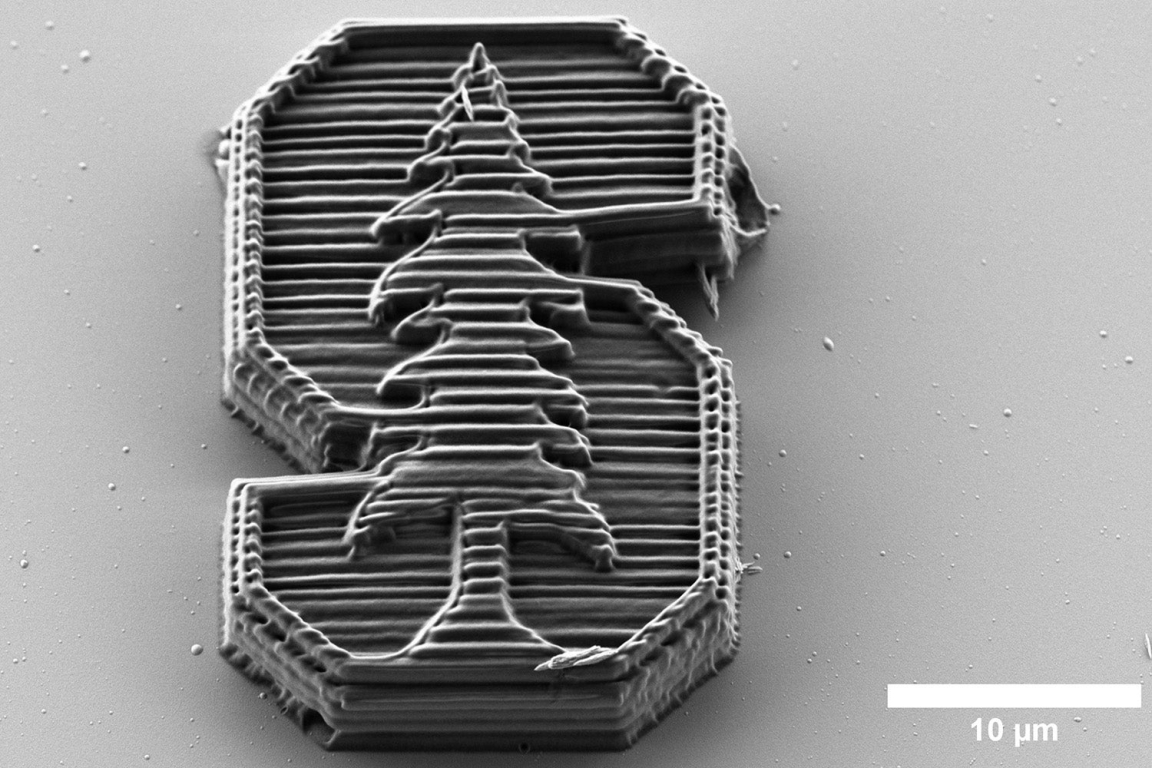
| A tiny but strong Stanford logo was made using nanoscale 3D printing. Image credit: John Kulikowski |
Engineers have designed a new material for nanoscale 3D printing that is able to absorb twice as much energy as other similarly dense materials and could be used to create better lightweight protective lattices.
Science fiction envisions rapid 3D printing processes that can quickly create new objects out of any number of materials. But in reality, 3D printing is still limited in the properties and types of materials that are available for use, especially when printing at very small scales.
Researchers at Stanford have developed a new material for printing at the nanoscale – creating structures that are a fraction of the width of a human hair – and used it to print minuscule lattices that are both strong and light. In a paper published in Science, the researchers demonstrated that the new material is able to absorb twice as much energy than other 3D-printed materials of a comparable density. In the future, their invention could be used to create better lightweight protection for fragile pieces of satellites, drones, and microelectronics.


.jpg)



.jpg)
.jpg)

.jpg)


.jpg)