. Scientific Frontline

Tuesday, February 8, 2022

Dog feces and urine could be harming nature reserves

Sign prohibiting dogs at one of the nature reserves.
Credit: Pieter De Frenne

New research finds that dogs being walked in nature reserves contribute a significant amount of nutrients to the environment through their feces and urine, which researchers warn could negatively impact local biodiversity. The research is published in the British Ecological Society journal, Ecological Solutions and Evidence.

Significant levels of fertilization

Researchers at Ghent University have estimated that each year dog feces and urine add an average of 11kg of nitrogen and 5kg of phosphorous per hectare to nature reserves near the Belgian city of Ghent. The researchers say that the nutrients added through this neglected form of fertilizations are substantial and could be detrimental to biodiversity and ecosystem functioning.

The estimates for the amount of nitrogen being added by this previously unrecorded source are particularly significant when compared to the total levels of nitrogen being added across most of Europe through fossil fuel emissions and agriculture, which range from 5 to 25kg of nitrogen per hectare.

Professor Pieter De Frenne of Ghent University and lead author of the research said: “We were surprised by how high nutrient inputs from dogs could be. Atmospheric nitrogen inputs from agriculture, industry and traffic rightfully receive a lot of policy attention, but dogs are entirely neglected in this respect.”

Five tips for nature-based solutions to combat climate change consequences

The recreational value of a landscape is also taken
 into account in nature-based solutions.
Credit: RUB, Marquard
What works in pilot projects does not have to work in real life.

In order to stop climate change and reduce its consequences, nature-based solutions are well suited: Inspired or supported by nature, they can preserve biodiversity and prevent flooding from flooding. Their implementation works in pilot projects - but how can they be implemented on a large scale under normal conditions? A team from Müncheberg, Hanover, Leipzig, Potsdam and Bochum proposes five principles - among other things, to take advantage of the opportunities of the Corona crisis. The suggestions are on 8. February 2022 published in the magazine npj Urban Sustainability.

Inspired by nature

Nature-based solutions master ecological, social and economic challenges in a way that is inspired or supported by nature. This includes green infrastructure that cushions the effects of climate change in cities, the restoration of meadows and wetlands, the effects of flooding rivers, and measures in agriculture to preserve biodiversity. Many countries see nature-based solutions as a central contribution to reducing and adapting to climate change. They can help achieve global sustainability goals, such as health and well-being, sustainable cities and towns, and sustainable land use.

Mineral dating reveals new clues about important tectonic process

Mantle Peridotite in the Samail Ophiolite, Oman

Ancient rocks on the coast of Oman that were once driven deep down toward Earth’s mantle may reveal new insights into subduction, an important tectonic process that fuels volcanoes and creates continents, according to an international team of scientists.

“In a broad sense this work gives us a better understanding of why some subduction zones fail while others set up as long-term, steady-state systems,” said Joshua Garber, assistant research professor of geosciences at Penn State.

Subduction occurs when two tectonic plates collide, and one is forced under the other. Where oceanic and continental plates meet, the denser oceanic plates normally subduct and descend into the mantle, the scientists said.

Occasionally, oceanic plates move on top, or obduct, forcing continental plates down toward the mantle instead. But the buoyancy of the continental crust can cause the subduction to fail, carrying the material back toward the surface along with slabs of oceanic crust and upper mantle called ophiolites, the scientists said.

“The Samail Ophiolite on the Arabian Peninsula is one of the largest and best exposed examples on the surface of the Earth,” Garber said. “It’s one of the best studied, but there have been disagreements about how and when the subduction occurred.”

Phosphate nutrition of plants through symbiosis with fungi

Prof. Dr. Caroline Gutjahr Professorship for Plant Genetics at the TUM School of Life Sciences, Prof. Dr. Caroline Gutjahr looks at Lotus japonicus seedlings that grow on a petri dish. It stands in front of a climate chamber, in the plant breeding room; The seedlings were subjected to a hairy root transformation with Agrobacterium rhizogenes. This gives transgenic roots for the investigation of molecular processes during the arbusculative mycorrhizal symbiosis. If the plants have grown even more, they are converted into pots and inoculated (stained) with the symbiotic mushroom.
Credit: Uli Benz / TUM

Phosphorus is one of the most important nutrients for plants. Among other functions, it is needed to create substances for the plant’s immune system, for the healthy development of seeds and for root growth. A team of researchers led by the Technical University of Munich (TUM) and the Chinese University of Hong Kong have now demonstrated how a root symbiosis with fungi is driven at the molecular level by the plant’s phosphate status.

Study in mice shows potential for gene-editing to tackle mitochondrial disorders

Mitochondria - 3D illustration 
Credit: wir0man/Getty Images
Our cells contain mitochondria, which provide the energy for our cells to function. Each of these mitochondria contains a tiny amount of mitochondrial DNA. Mitochondrial DNA makes up only 0.1% of the overall human genome and is passed down exclusively from mother to child.

Faults in our mitochondrial DNA can affect how well the mitochondria operate, leading to mitochondrial diseases, serious and often fatal conditions that affect around 1 in 5,000 people. The diseases are incurable and largely untreatable.

There are typically around 1,000 copies of mitochondrial DNA in each cell, and the percentage of these that are damaged, or mutated, will determine whether a person will suffer from mitochondrial disease or not. Usually, more than 60% of the mitochondria in a cell need to be faulty for the disease to emerge, and the more defective mitochondria a person has, the more severe their disease will be. If the percentage of defective DNA could be reduced, the disease could potentially be treated.

A cell that contains a mixture of healthy and faulty mitochondrial DNA is described as ‘heteroplasmic’. If a cell contains no healthy mitochondrial DNA, it is ‘homoplasmic’.

In 2018, a team from the MRC Mitochondrial Biology Unit at the University of Cambridge applied an experimental gene therapy treatment in mice and were able to successfully target and eliminate the damaged mitochondrial DNA in heteroplasmic cells, allowing mitochondria with healthy DNA to take their place.

Sunday, February 6, 2022

Study finds large new source of greenhouse gas emissions

An international team has discovered hundreds of large bursts of methane from oil and gas production activities across the globe. The bursts account for 10% of global oil and gas methane emissions and are missing from most greenhouse gas emissions inventories.

Carbon Mapper, a nonprofit organization that partners with the University of Arizona to mitigate methane and carbon emissions and accelerate climate conservation, contributed to the study, which is published in the journal Science.

The team performed a systematic analysis of thousands of images produced daily by the European Space Agency satellite mission Sentinel-5P to estimate the amount of methane released into the atmosphere by oil and gas production activities.

Over a two-year period, they detected 1,200 "ultra-emitters" attributed to oil and gas facilities and long major transmission pipelines that sporadically release greater than 25 tons of methane per hour over most of the largest oil and gas basins worldwide.

Together, these facilities represent more than 50% of the total onshore natural gas production. Most of these ultra-emitters were short-lived, and many are likely due to planned maintenance activities.

The study revealed that in total, these unreported ultra-emitters contribute to approximately 10% of all methane emissions from the oil and gas sector across the six major oil and gas producing countries – an incredibly large contribution for such a limited number of events.

New highly virulent and damaging HIV variant discovered in the Netherlands

A new HIV variant with higher virulence and more damaging health impacts has been discovered in a study led by the University of Oxford.

As the ongoing coronavirus pandemic has demonstrated, new mutations in viral genetic sequences can have significant impacts on the virus’s transmissibility and the damage it causes. For many years, there have been concerns that this could arise in the HIV-1 virus, which already affects 38 million people worldwide, and has caused 33 million deaths to date (www.unaids.org). This has now been confirmed with the discovery of a new, highly virulent HIV strain in the Netherlands, in an international collaborative study with key contributions from the Dutch HIV Monitoring Foundation and led by researchers from the University of Oxford’s Big Data Institute. The results are published today in Science.

Individuals infected with the new “VB variant” (for virulent subtype B) showed significant differences before antiretroviral treatment compared with individuals infected with other HIV variants:

Widely-used hormone drug associated with increased risk of benign brain tumor at high doses

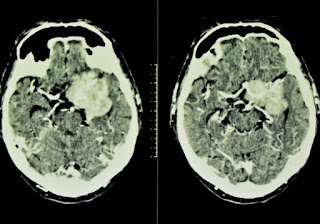
A generic image of a CT scan showing a
meningioma, brain tumor.
High doses of a widely-used drug used in the hormonal treatment of conditions such as excessive hair growth, early puberty, prostate cancer is linked to an increased risk of meningioma — the most common type of benign brain tumor, finds a University of Bristol-led study of over 8-million patients. The study is published in Scientific Reports.

Typically slow-growing, meningiomas are benign tumors, which are often revealed incidentally by imaging but can cause significant disability due to compressing or squeezing the adjacent brain, nerves and vessels and pressure effects within a fixed cranial vault.

Recent studies have reported an association between the growth of meningiomas and hormonal treatments, particularly prolonged and high dose use of the drug, cyproterone acetate (CPA).

High doses of cyproterone acetate (> 50 mg/day) is usually prescribed to male patients with inoperable prostate cancer, a condition which leads to excessive hair growth known as hirsutism, or male-to-female transsexual hormonal therapy. Lower doses (2-10 mg/day) of the drug are typically used in combination with estradiol to treat androgen-associated alopecia or female seborrhea.

Given the drug’s widespread use, researchers at the Universities of Bristol, Cambridge and the National University of Singapore, conducted a systematic review and meta-analysis study using four studies comprising a sample of 8,132,348 patients, to assess the evidence of the association between cyproterone acetate and incidence of meningiomas.

Researchers capture first snapshot of dissolved chemicals from coral reefs

Reefscapes of the Moorea backreef.
Photo credit: Shayle Matsuda/ UH SOEST

Coral reefs are hotspots of biodiversity and are amazingly productive with a vast number of organisms interacting simultaneously. Hundreds of molecules that are made by important members of the coral reef community were recently discovered by a team of scientists. Together, the compounds—modified amino acids, vitamins and steroids—comprise the “smell” or “taste” of corals and algae in a tropical reef, and will help scientists understand both the food web dynamics and the chemical ecology of these ecosystems.

The study, led by researchers at Scripps Institution of Oceanography at UC San Diego, University of Hawaiʻi at Mānoa and the NIOZ Royal Netherlands Institute for Sea Research was published in the Proceedings of the National Academy of Sciences. It provides the first snapshot of the diversity of dissolved chemicals floating among coral reefs and a window into the interactions among organisms that scientists are just beginning to understand.

Although coral and seaweed (limu) are fixed to the seafloor, these organisms interact via chemicals dissolved in the water. Despite knowing the importance of these molecules built during photosynthesis and released into the seawater environment, their quantity, energy content and structural diversity have always been a mystery to biologists.

Gone forever – two-thirds of Australia has lost its unique birdlife

Vulnerable Goshawk.
Credit: James Watson

Researchers have revealed that threatened birds have disappeared from almost 70 per cent of Australia since European colonization.

The study – led by The University of Queensland, Charles Darwin University, WWF Australia and Australian Wildlife Conservancy – mapped the pre-European (1750) habitats of Australia’s most threatened birds, comparing those with current habitats.

Dr Michelle Ward, from UQ’s School of Earth and Environmental Sciences and WWF Australia, said Australians should be extremely alarmed by the findings.

Tuesday, February 1, 2022

Mission to find lunar ice

Artistic concept of CoRaLS mission.
Photo credit: A. Romero-Wolf, JPL

A University of Hawaiʻi at Mānoa project to detect ice deposits below the surface of the Moon received a major boost from NASA. Five scientists in the Department of Physics and Astronomy and Hawaiʻi Institute of Geophysics and Planetology (HIGP) have been awarded a three-year, $2,945,704 grant to develop technology for the NASA Cosmic Ray Lunar Sounder (CoRaLS) mission, which was initiated by UH Mānoa and NASA’s Jet Propulsion Lab.

CoRaLS hopes to be the first mission to detect subsurface ice below the first meter, therefore having a unique opportunity to further lunar science and identify crucial resources for future manned and unmanned missions to the Moon.

History of ice deposits

Extensive ice deposits have been found in the permanently shadowed regions (PSRs) of Mercury, but so far only traces of ice have been found on the surface of lunar PSRs, and active radar measurements sensitive to the top meter or so of the regolith (5–10 meter layer of debris on the Moon’s surface) show no clear signal yet from extensive ice deposits.

Global elimination of meat production could save the planet

Photo by Kat Smith from Pexels

A new study of the climate impacts of raising animals for food concludes that phasing out all animal agriculture has the potential to substantially alter the trajectory of global warming.

The work is a collaboration between Michael Eisen, professor of molecular and cell biology at the University of California, Berkeley, and Patrick Brown, professor emeritus of biochemistry at Stanford University and the CEO of Impossible Foods Inc., a company that sells plant-based meat substitutes.

Eisen, who consults for Impossible Foods, and Brown used a simple climate model to look at the combined impact of eliminating emissions linked to animal agriculture and of restoring native vegetation on the 30% of Earth’s land surface currently used to house and feed livestock.

They found that the resulting drop in methane and nitrous oxide levels, and the conversion of 800 gigatons (800 billion tons) of carbon dioxide to forest, grassland and soil biomass, would have the same beneficial impact on global warming as cutting annual global CO2 emissions by 68%.

“Our work shows that ending animal agriculture has the unique potential to significantly reduce atmospheric levels of all three major greenhouse gases, which, because we have dithered in responding to the climate crisis, is now necessary to avert climate catastrophe,” said Eisen, who is also a Howard Hughes Medical Institute (HHMI) investigator at UC Berkeley.

Novel Nanoparticle SARS-CoV-2 Vaccine Combines Immune Focusing and Self-assembling Nanoparticles to Elicit More Potent Protection

Dr. Dan Kulp, associate professor in Wistar's Vaccine & Immunotherapy Center
Credit: The Wistar Institute

The first generation of COVID-19 vaccines have been highly effective, but also have limitations: their efficacy can wane without a booster shot, and they may be less effective against some variants. Now scientists at The Wistar Institute have developed a more targeted vaccine that, in animal studies, shows stronger, broader, and more durable protection in a single, low dose.

The vaccine combines three technologies – immune focusing, self-assembling nanoparticles, and DNA delivery – into a single platform for the first time. In addition to its other advantages, the vaccine could be stored at room temperature, making it potentially easier to transport to remote or developing locations than existing mRNA vaccines, which require specialized cold storage.

“This is among the first next-generation vaccines that will have more advanced features and broader protection,” said Daniel Kulp, Ph.D., associate professor in the Vaccine & Immunotherapy Center at The Wistar Institute and corresponding author of the study.

The paper, “Nucleic acid delivery of immune-focused SARS-CoV-2 nanoparticles drive rapid and potent immunogenicity capable of single-dose protection,” was published in the journal Cell Reports.

How Omicron escapes from antibodies

Image: CDC; Christine Daniloff, MIT
A new study from MIT suggests that the dozens of mutations in the spike protein of the Omicron variant help it to evade all four of the classes of antibodies that can target the SARS-CoV-2 virus that causes Covid-19.

This includes antibodies generated by vaccinated or previously infected people, as well as most of the monoclonal antibody treatments that have been developed, says Ram Sasisekharan, the Alfred H. Caspary Professor of Biological Engineering and Health Sciences and Technology (HST) at MIT.

Using a computational approach that allowed them to determine how mutated amino acids of the viral spike protein influence nearby amino acids, the researchers were able to get a multidimensional view of how the virus evades antibodies. According to Sasisekharan, the traditional approach of only examining changes in the virus’ genetic sequence reduces the complexity of the spike protein’s three-dimensional surface and doesn’t describe the multidimensional complexity of the protein surfaces that antibodies are attempting to bind to.

“It is important to get a more comprehensive picture of the many mutations seen in Omicron, especially in the context of the spike protein, given that the spike protein is vital for the virus’s function, and all the major vaccines are based on that protein,” he says. “There is a need for tools or approaches that can rapidly determine the impact of mutations in new virus variants of concern, especially for SARS-CoV-2.”

Sasisekharan is the senior author of the study, which appears this week in Cell Reports Medicine. The lead author of the paper is MIT HST graduate student Nathaniel Miller. Technical associate Thomas Clark and research scientist Rahul Raman are also authors of the paper.

Even though Omicron is able to evade most antibodies to some degree, vaccines still offer protection, Sasisekharan says.

World-record lightning “megaflashes” detected using space-based technology

Satellite image of the record lightning flash over Uruguay and Argentina on June 18, 2020, which lasted 17.102 seconds.

A researcher at Los Alamos National Laboratory has detected two world-record lightning “megaflashes.” The longest-distance flash was detected in the southern United States on April 29, 2020 and spanned more than 477 miles from Mississippi to Texas. The longest-duration lightning strike was detected over Uruguay on June 18, 2020 and lasted 17.1 seconds.

“We are now at a place where we have excellent lightning measurements, which allows us to discover surprising new aspects of its behavior,” said lead author Michael Peterson, of the Space and Remote Sensing group at Los Alamos. “Now that we have a robust record of these massive flashes, we can better understand how they occur and the impact that they have.”

These megaflashes are incredibly rare events. In order to record one from the ground, or from an aircraft or satellite in a low orbit, the sensor has to be exactly in the right place at the right time, which is very unlikely.

Featured Article

Quantum computers go high-dimensional

Marcus Huber (left) and Nicolai Friis Photo Credit: © Alexander Rommel / TU Wien Scientific Frontline: Extended "At a Glance" Summ...

Top Viewed Articles