. Scientific Frontline

Friday, April 29, 2022

Fermilab engineers develop new control electronics for quantum computers that improve performance and cut costs

Gustavo Cancelo led a team of Fermilab engineers to create a new compact electronics board: It has the capabilities of an entire rack of equipment that is compatible with many designs of superconducting qubits at a fraction of the cost.
Photo: Ryan Postel, Fermilab

When designing a next-generation quantum computer, a surprisingly large problem is bridging the communication gap between the classical and quantum worlds. Such computers need specialized control and readout electronics to translate back and forth between the human operator and the quantum computer’s languages — but existing systems are cumbersome and expensive.

However, a new system of control and readout electronics, known as Quantum Instrumentation Control Kit, or QICK, developed by engineers at the U.S. Department of Energy’s Fermi National Accelerator Laboratory, has proved to drastically improve quantum computer performance while cutting the cost of control equipment.

“The development of the Quantum Instrumentation Control Kit is an excellent example of U.S. investment in joint quantum technology research with partnerships between industry, academia and government to accelerate pre-competitive quantum research and development technologies,” said Harriet Kung, DOE deputy director for science programs for the Office of Science and acting associate director of science for high-energy physics.

Engineers at UBC get under the skin of ionic skin

Dr. John Madden and Yuta Dobashi with one of the hydrogel sensors.
Photo by Kai Jacobson/UBC Faculty of Applied Science

In the quest to build smart skin that mimics the sensing capabilities of natural skin, ionic skins have shown significant advantages. They’re made of flexible, biocompatible hydrogels that use ions to carry an electrical charge. In contrast to smart skins made of plastics and metals, the hydrogels have the softness of natural skin. This offers a more natural feel to the prosthetic arm or robot hand they are mounted on, and makes them comfortable to wear.

These hydrogels can generate voltages when touched, but scientists did not clearly understand how — until a team of researchers at UBC devised a unique experiment, published in Science.

“How hydrogel sensors work is they produce voltages and currents in reaction to stimuli, such as pressure or touch – what we are calling a piezoionic effect. But we didn’t know exactly how these voltages are produced,” said the study’s lead author Yuta Dobashi, who started the work as part of his master’s in biomedical engineering at UBC.

Working under the supervision of UBC researcher Dr. John Madden, Dobashi devised hydrogel sensors containing salts with positive and negative ions of different sizes. He and collaborators in UBC’s physics and chemistry departments applied magnetic fields to track precisely how the ions moved when pressure was applied to the sensor.

Experts predict this hurricane season will only be slightly above average

Hurricane Ida, Tropical Storm Julian and Tropical Depression Ten - which intensified into Tropical Storm Kate on August 30 - as shown from NOAA's GOES-16 satellite on August 29, 2021.
Credit: NOAA

For the seventh year in a row, University of Arizona hurricane forecasters say to prepare for an above-average hurricane season, which runs from June 1 through Nov. 30. However, this year isn't expected to be as active as recent years.

The experts' forecast, released this month, shows 14 named storms and seven hurricanes developing over the Atlantic Ocean. Three of those seven hurricanes are expected to develop into major hurricanes – which are classified as category 3 or above. The UArizona experts also predict an accumulated cyclone energy, or ACE, index of 129 units. The ACE index provides a value for the combined strength and duration of a storm.

These predictions are only slightly higher than the seasonal median since 1980, which is 13 named storms and seven hurricanes, two of which are major hurricanes, and an ACE index of 107 units.

Professor of atmospheric sciences Xubin Zeng and former graduate student Kyle Davis developed their predictive model in 2014. It has since become one of the most accurate in the world for seasonal hurricane forecasting. It combines seasonal forecasts of sea surface temperature from the European Centre for Medium-Range Weather Forecasts with machine learning and the researchers' own understanding of hurricanes.

Thursday, April 28, 2022

Higher COVID-19 Death Rates in the Southern U.S. Due to Behavior Differences

During the pre-Omicron phases of the COVID-19 pandemic, regions of the U.S. had markedly different mortality rates, primarily due to differences in mask use, school attendance, social distancing and other behaviors. Had the entire country reacted to the pandemic as the Northeast region, more than 316,000 deaths might have been avoided, 62% of those avoidable deaths being in the South.

The study, by Georgetown University’s School of Nursing & Health Studies researchers, appeared April 28, 2022, in PLOS ONE.

Excess mortality, which helps account for avoidable deaths from a new disease or situation, is defined by the difference between total current deaths and deaths expected based on earlier time period, usually the previous decade or so. The U.S. Centers for Disease Control and Prevention (CDC) calculate these numbers weekly. For this study, the CDC excess mortality data were analyzed for the period between January 3, 2020, to September 26, 2021. For regional comparison purposes, areas of the country were broken down into the Northeast, Midwest, South and West.

“Our goal was to carefully examine regional differences in COVID-19 death rates based on reliable statistical data,” says Michael Stoto, PhD, professor of Health Systems Administration and Population Health at the School of Nursing & Health Studies and corresponding author of the study. “Our study is the first to quantify avoidable deaths and confirm that both COVID-19 deaths and avoidable deaths disproportionately occurred in the South.”

Diminishing Arctic Sea Ice Has Lasting Impacts on Global Climate

Source: University at Albany, State University of New York

As the impacts of climate change are felt around the world, no area is experiencing more drastic changes than the northern polar region. Studies have shown the Arctic is warming at two to three times as fast as the rest of the planet, resulting in a rapid loss of its sea ice volume.

The loss of sea ice, declining at an average rate of about 13 percent per decade, is having a long-lasting climatic impact in the Arctic and beyond, according to a new study published this month in Nature Communications.

The research team, led by University at Albany atmospheric scientist Aiguo Dai, analyzed observational data and climate model simulations to show how fluctuations in Arctic Sea ice cover are able to amplify multi-decadal variations in surface temperatures not only in the Arctic but also in the North Atlantic Ocean.

Their results indicate that recent – and future – decreases in sea ice cover have a significant influence on global climate.

“Through our study, we demonstrated for the first time that fluctuations in sea ice-air interactions can greatly enlarge or amplify multi-decadal climate variations not only in the Arctic, but also the North Atlantic,” said Dai, a distinguished professor in the Department of Atmospheric and Environmental Sciences.

Researchers Discover New Function Performed by Nearly Half of Brain Cells

Scientists say the discovery of a new function by cells known as astrocytes opens a whole new direction for neuroscience research.
Illustration Credit: Siena Fried

Researchers at Tufts University School of Medicine have discovered a previously unknown function performed by a type of cell that comprises nearly half of all cells in the brain.

The scientists say this discovery in mice of a new function by cells known as astrocytes opens a whole new direction for neuroscience research that might one day lead to treatments for many disorders ranging from epilepsy to Alzheimer’s to traumatic brain injury.

It comes down to how astrocytes interact with neurons, which are fundamental cells of the brain and nervous system that receive input from the outside world. Through a complex set of electrical and chemical signaling, neurons transmit information between different areas of the brain and between the brain and the rest of the nervous system.

Until now, scientists believed astrocytes were important, but lesser cast members in this activity. Astrocytes guide the growth of axons, the long, slender projection of a neuron that conducts electrical impulses. They also control neurotransmitters, chemicals that enable the transfer of electrical signals throughout the brain and nervous system. In addition, astrocytes build the blood-brain barrier and react to injury.

But they did not seem to be electrically active like the all-important neurons—until now.

Bird populations in eastern Canada declining due to forest ‘degradation,’ research shows

Mixed forest at left, spruce plantation at right.
Credit: by Debora Carr

Bird species that live in wooded areas are under stress from human-caused changes to forest composition, according to new research led by Oregon State University that quantifies the effects of forest “degradation” on bird habitat.

“Reducing forest loss has been the main focus of conservation policy to date, which is well justified because it has a strong negative effect on biodiversity,” said Matt Betts of the OSU College of Forestry. “But the effects of changing the composition and age of forest via timber management have traditionally been very difficult to measure at large scales and thus have been largely ignored. Our work shows population declines in many bird species in eastern Canada are due to habitat loss caused by forestry activities.”

Findings by the international collaboration led by Betts were published today in Nature Ecology and Evolution.

The scientists looked at the degree to which forest degradation – the reduction or loss of biological complexity – in the form of clearcutting and then thinning or replanting single tree species affected bird habitat and long-term trends in bird populations.

The study area was the Acadian Forest in Canada’s maritime provinces. Breeding habitat loss occurred for 66% of the forest’s 54 most common bird species from 1985 to 2020 and was strongly associated with the loss of older forests.

Unchecked global emissions on track to initiate mass extinction of marine life

Princeton University researchers report that unless greenhouse gas emissions are curbed, marine biodiversity could be on track to plummet to levels not seen since the extinction of the dinosaurs. The study authors modeled future marine biodiversity under projected climate scenarios and found that species such as dolphinfish (shown) would be imperiled as warming oceans decrease the ocean’s oxygen supply while increasing marine life’s metabolic demand for it. 
Credit: Evan Davis

As greenhouse gas emissions continue to warm the world’s oceans, marine biodiversity could be on track to plummet within the next few centuries to levels not seen since the extinction of the dinosaurs, according to a recent study in the journal Science by Princeton University researchers.

Princeton University researchers report that unless greenhouse gas emissions are curbed, marine biodiversity could be on track to plummet to levels not seen since the extinction of the dinosaurs. The study authors modeled future marine biodiversity under projected climate scenarios and found that species such as dolphinfish (shown) would be imperiled as warming oceans decrease the ocean’s oxygen supply while increasing marine life’s metabolic demand for it.

The paper’s authors modeled future marine biodiversity under different projected climate scenarios. They found that if emissions are not curbed, species losses from warming and oxygen depletion alone could come to mirror the substantial impact humans already have on marine biodiversity by around 2100. Tropical waters would experience the greatest loss of biodiversity, while polar species are at the highest risk of extinction, the authors reported.

Large bodies helped extinct marine reptiles with long necks swim, study finds

3D models of aquatic tetrapods
Credit: S. Gutarra Díaz

Scientists at the University of Bristol have discovered that body size is more important than body shape in determining the energy economy of swimming for aquatic animals.

This study, published today in Communications Biology, shows that big bodies help overcome the excess drag produced by extreme morphology, debunking a long-standing idea that there is an optimal body shape for low drag.

One important finding of this research is that the large necks of extinct elasmosaurs did add extra drag, but this was compensated for by the evolution of large bodies.

Tetrapods or ‘four-limbed vertebrates’, have repeatedly returned to the oceans over the last 250 million years, and they come in many shapes and sizes, ranging from streamlined modern whales over 25 meters in length, to extinct plesiosaurs, with four flippers and extraordinarily long necks, and even extinct fish-shaped ichthyosaurs.

Dolphins and ichthyosaurs have similar body shapes, adapted for moving fast through water producing low resistance or drag. On the other hand, plesiosaurs, who lived side by side with the ichthyosaurs in the Mesozoic Era, had entirely different bodies. Their enormous four flippers which they used to fly underwater, and variable neck lengths, have no parallel amongst living animals. Some elasmosaurs had really extreme proportions, with necks up to 20 feet (6 meters) long. These necks likely helped them to snap up quick-moving fish, but were also believed to make them slower.

Boeing Unveils First T-7A Red Hawk Advanced Trainer Jet to be Delivered to the U.S. Air Force

The first T-7A Red Hawk advanced trainer has rolled out of the production facility in St. Louis, Missouri. Ushering in a new era of training for U.S. Air Force fighter and bomber pilots. The jets have red tails to honor the legendary Tuskegee Airmen who flew their aircraft with red tails during World War II. First jets scheduled to arrive at Joint Base San Antonio- Randolph next year.
Photo Credit- Eric Shindelbower

Boeing [NYSE: BA] has unveiled the first T-7A Red Hawk advanced trainer jet to be delivered to the U.S. Air Force. The jet, one of 351 the U.S. Air Force plans to order, was unveiled prior to official delivery.

The fully digitally designed aircraft was built and tested using advanced manufacturing, agile software development and digital engineering technology significantly reducing the time from design to first flight. The aircraft also features open architecture software, providing growth and flexibility to meet future mission needs.

“We’re excited and honored to deliver this digitally advanced, next-generation trainer to the U.S. Air Force,” said Ted Colbert, president and CEO, Boeing Defense, Space & Security. “This aircraft is a tangible example of how Boeing, its suppliers and partners are leading the digital engineering revolution. T-7A will prepare pilots for future missions for decades to come.”

Childhood obesity increases risk of Type 1 diabetes

Being overweight in childhood increases the risk of developing type 1 diabetes in later life, according to the findings of a new study that analyzed genetic data on over 400,000 individuals. The study, co-led by researchers from the Universities of Bristol and Oxford and published today in Nature Communications, also provides evidence that being overweight over many years from childhood influences the risk of other diseases including asthma, eczema and hypothyroidism.

The number of individuals being diagnosed with type 1 diabetes has increased drastically in the last 20 years. One possible explanation is the rising prevalence of childhood obesity in an increasingly obesogenic environment. Poor diets with high fat, salt and carbohydrate may compromise early life health-promoting effects of the bacteria in the gut and pancreatic beta-cell fragility in childhood and subsequently increase type 1 diabetes risk.

In contrast to type 1 diabetes, there is irrefutable evidence that children who are overweight are more likely to develop type 2 diabetes and that weight loss can lead to its sustained remission. However, detecting reliable evidence for the factors that contribute to type 1 has been challenging, particularly given that individuals are typically diagnosed early in life before reaching adulthood.

New Study Could Help Reduce Agricultural Greenhouse Gas Emissions

Researchers developed a first-of-its-kind knowledge-guided machine learning model for agroecosystem, called KGML-ag that includes less obvious variables such as soil water content, oxygen level, and soil nitrate content related to nitrous oxide production and emission.
Credit: University of Minnesota College of Science and Engineering

A team of researchers led by the University of Minnesota has significantly improved the performance of numerical predictions for agricultural nitrous oxide emissions. The first-of-its-kind knowledge-guided machine learning model is 1,000 times faster than current systems and could significantly reduce greenhouse gas emissions from agriculture.

The research was recently published in Geoscientific Model Development, a not-for-profit international scientific journal focused on numerical models of the Earth. Researchers involved were from the University of Minnesota, the University of Illinois at Urbana-Champaign, Lawrence Berkeley National Laboratory, and the University of Pittsburgh.

Compared to greenhouse gases such as carbon dioxide and methane, nitrous oxide is not as well-known. In reality, nitrous oxide is about 300 times more powerful than carbon dioxide in trapping heat in the atmosphere. Human-induced nitrous oxide emissions (mainly from agricultural synthetic fertilizer and cattle manure) have also grown by at least 30 percent over the past four decades.

Origin of complex cells started without oxygen

Since the 1960s, many experts have argued that the emergence of eukaryotes (cells containing a clearly defined nucleus) happened in response to the oxygenation of Earth’s surface environment.

But a team led by the universities of Stanford and Exeter say recent advances in the Earth and life sciences challenge this view.

Their review says these breakthroughs "decouple" the emergence of eukaryotes (known as eukaryogenesis) from rising oxygen levels, and suggest eukaryotes in fact emerged in an anoxic (no-oxygen) environment in the ocean.

"We can now independently date eukaryogenesis and key oxygenation transitions in Earth history," said Dr Daniel Mills, of Stanford University.

"Based on fossil and biological records, the timing of eukaryogenesis does not correlate with these oxygen transitions in the atmosphere (2.22 billion years ago) or the deep ocean (0.5 billion years ago).

"Instead, mitochondria-bearing eukaryotes are consistently dated to between these two oxygenation events, during an interval of deep-sea anoxia and variable surface-water oxygenation."

The emergence of mitochondria – the energy-producing "powerhouses" of eukaryote cells – is now thought to be the defining step in eukaryogenesis.

Mitochondria have different DNA to the cells in which they live, and the new paper addresses the possible origin of this symbiotic relationship, famously championed by the biologist Lynn Margulis.

Wednesday, April 27, 2022

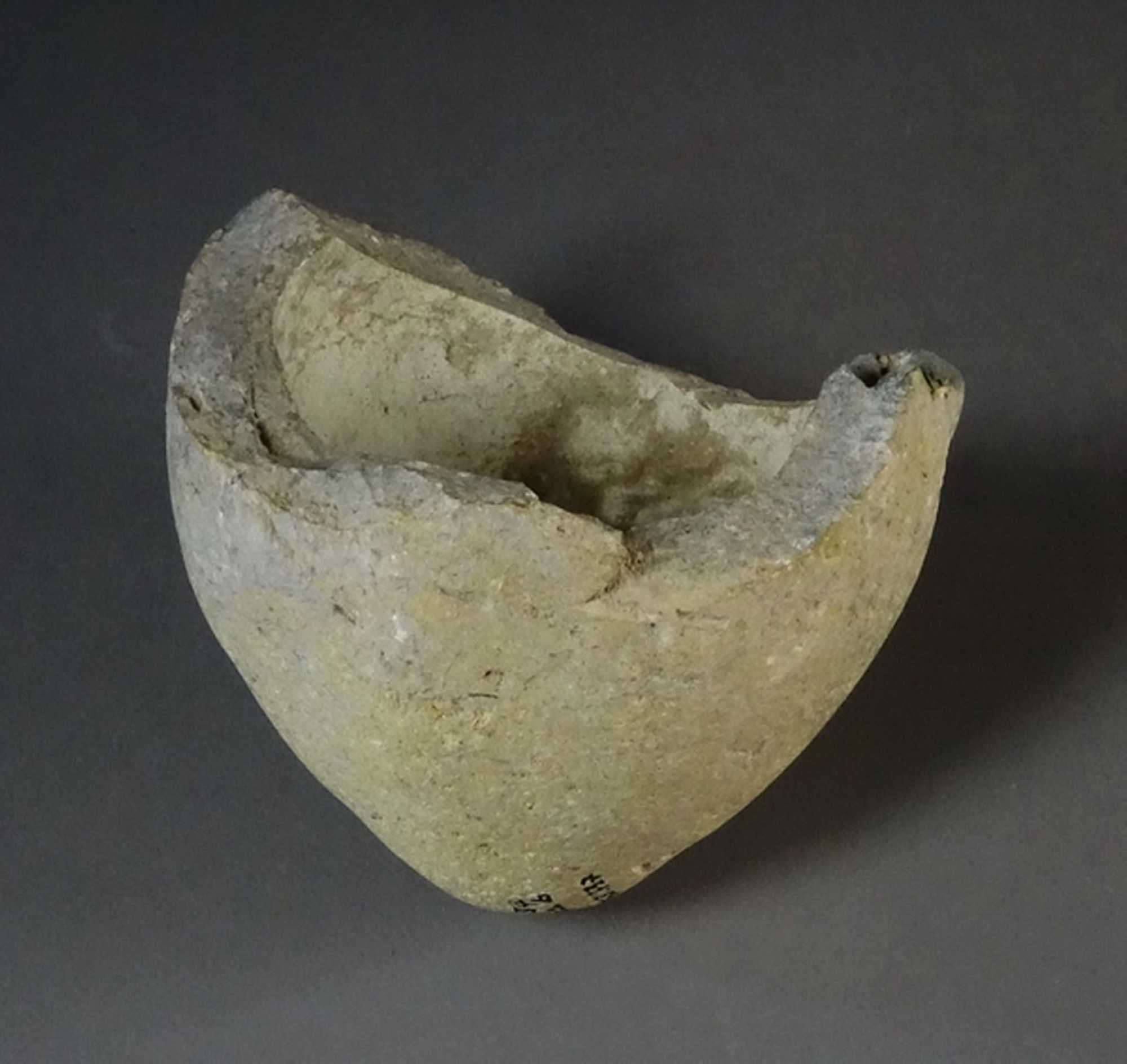
Ancient hand grenades: explosive weapons in medieval Jerusalem during Crusades

A fragment of the sphero-conical vessel that was identified as containing a possibly explosive material from Jerusalem.
Credit: Robert Mason, Royal Ontario Museum.

New analysis into the residue inside ancient ceramic vessels from 11th-12th century Jerusalem has found that they were potentially used as hand grenades.

Previous research into the diverse sphero-conical containers, which are within museums around the world, had identified that they were used for a variety of purposes, including beer drinking vessels, mercury containers, containers for oil and containers for medicines.

This latest research, led by Griffith University’s Associate Professor Carney Matheson, confirmed that some vessels did indeed contain oils and medicines, and some contained scented oils, consistent with other recent research into the use of the vessels.

However, his findings also revealed that some of the vessels contained a flammable and probably explosive material that indicated they may have been used as ancient hand grenades.

Associate Professor Matheson, from Griffith’s Australian Research Centre for Human Evolution, said the explosive material he analyzed within the vessels suggested that there may have been a locally developed ancient explosive.

New research finds the risk of psychotic-like experiences can start in childhood


It has long been understood that environmental and socio-economic factors – including income disparity, family poverty, and air pollution – increase a person’s risk of developing psychotic-like experiences, such as subtle hallucinations and delusions that can become precursors to a schizophrenia diagnosis later in life. Research has long focused on young adults but now, thanks to data from the Adolescent Brain Cognitive Development (ABCD) Study, researchers at the University of Rochester have found these risk factors can be observed in pre-adolescent children.

“These findings could have a major impact on public health initiatives to reduce the risk of psychotic-like experiences,” said Abhishek Saxena, a graduate student in the department of Psychology at the University of Rochester and first author of the study recently published in Frontiers in Psychiatry. “Past research has largely focused on the biological factors that lead to development of schizophrenia spectrum disorders, but we now know that social and environmental factors can also play a large role in the risk and development of schizophrenia. And this research shows these factors impact people starting at a very young age.”

Researchers looked at data collected from 8,000 kids enrolled in the ABCD study. They found that the more urban of an environment a child lived in – proximity to roads, houses with lead paint risks, families in poverty, and income disparity – the greater number of psychotic-like experiences they had over a year’s time. These findings are in line with past research conducted in young adults, but have not been found like this in pre-adolescences.

Featured Article

Quantum computers go high-dimensional

Marcus Huber (left) and Nicolai Friis Photo Credit: © Alexander Rommel / TU Wien Scientific Frontline: Extended "At a Glance" Summ...

Top Viewed Articles