. Scientific Frontline

Thursday, June 30, 2022

The hawk has landed: braking mid-air to prioritize safety over energy or speed

A Harris hawk braking in mid-air before perching.
Resized image using AI by SFLORG
Credit: Rob Bullingham

New research from the Oxford Flight Group using computer simulations and Hollywood-style motion capture shows how birds optimize their landing maneuvers for an accurate descent.

Researchers at the University of Oxford have found that hawks control their flight to ensure the safest landing conditions when perching, even if it takes longer and more energy to do so. Understanding how birds optimize their landing maneuvers through learning may help in developing small aircraft capable of perching like birds.

In new research published in Nature, four Harris’ hawks wearing tiny retroreflective markers were tracked flying back and forth between two perches. Their precise movements were recorded by 20 motion capture cameras positioned around the room, allowing the research team to reconstruct their flight paths on over 1,500 flights. The research team then used computer simulations to understand why the birds chose their particular path to the perch.

Aircraft have the luxury of using a runway for braking after landing to reduce speed. In contrast, birds must brake before they arrive at the perch – however slowing down to a safe speed while in flight risks stall, leading to a sudden loss of flight control. The researchers discovered that the hawks follow a flight path that slows them down to a safe speed but minimizes the distance from the perch at which they stall.

Wednesday, June 29, 2022

Shrimps and worms among first animals to recover after largest mass extinction

Reconstructed sea bed scenes (A) Pre-extinction, (B-D) Induan (early Early Triassic), (E) Smithian, (F) Spathian
Credit: Yaqi Jiang

Researchers studying ancient sea bed burrows and trails have discovered that bottom burrowing animals were among the first to bounce back after the end-Permian mass extinction.

In a new study, published today in the journal Science Advances, researchers from China, the USA and the UK, reveal how life in the sea recovered from the event, which killed over 90 percent of species on Earth, from their observations of trace fossils.

Life was devastated by the end-Permian mass extinction 252 million years ago, and recovery of life on Earth took millions of years for biodiversity to return to pre-extinction levels. But by examining trails and burrows on the South China sea bed, the international team were able to piece together sea life’s revival by pinpointing what animal activity was happening when.

Professor Michael Benton from the University of Bristol’s School of Earth Sciences, a collaborator on the new paper, said: “The end-Permian mass extinction and the recovery of life in the Early Triassic are very well documented throughout South China.

“We were able to look at trace fossils from 26 sections through the entire series of events, representing seven million crucial years of time, and showing details at 400 sampling points, we finally reconstructed the recovery stages of all animals including benthos, nekton, as well as these soft-bodied burrowing animals in the ocean.”

Falling stardust, wobbly jets explain blinking gamma ray bursts

A close-up view of the disk (in orange) tilting, causing the jets (in purple) to wobble.
Credit: Ore Gottlieb/Northwestern University

A Northwestern University-led team of astrophysicists has developed the first-ever full 3D simulation of an entire evolution of a jet formed by a collapsing star, or a “collapsar.”

Because these jets generate gamma ray bursts (GRBs) — the most energetic and luminous events in the universe since the Big Bang — the simulations have shed light on these peculiar, intense bursts of light. Their new findings include an explanation for the longstanding question of why GRBs are mysteriously punctuated by quiet moments — blinking between powerful emissions and an eerily quiet stillness. The new simulation also shows that GRBs are even rarer than previously thought.

The new study was published today (June 29) in Astrophysical Journal Letters. It marks the first full 3D simulation of the entire evolution of a jet — from its birth near the black hole to its emission after escaping from the collapsing star. The new model also is the highest-ever resolution simulation of a large-scale jet.

“These jets are the most powerful events in the universe,” said Northwestern’s Ore Gottlieb, who led the study. “Previous studies have tried to understand how they work, but those studies were limited by computational power and had to include many assumptions. We were able to model the entire evolution of the jet from the very beginning — from its birth by a black hole — without assuming anything about the jet’s structure. We followed the jet from the black hole all the way to the emission site and found processes that have been overlooked in previous studies.”

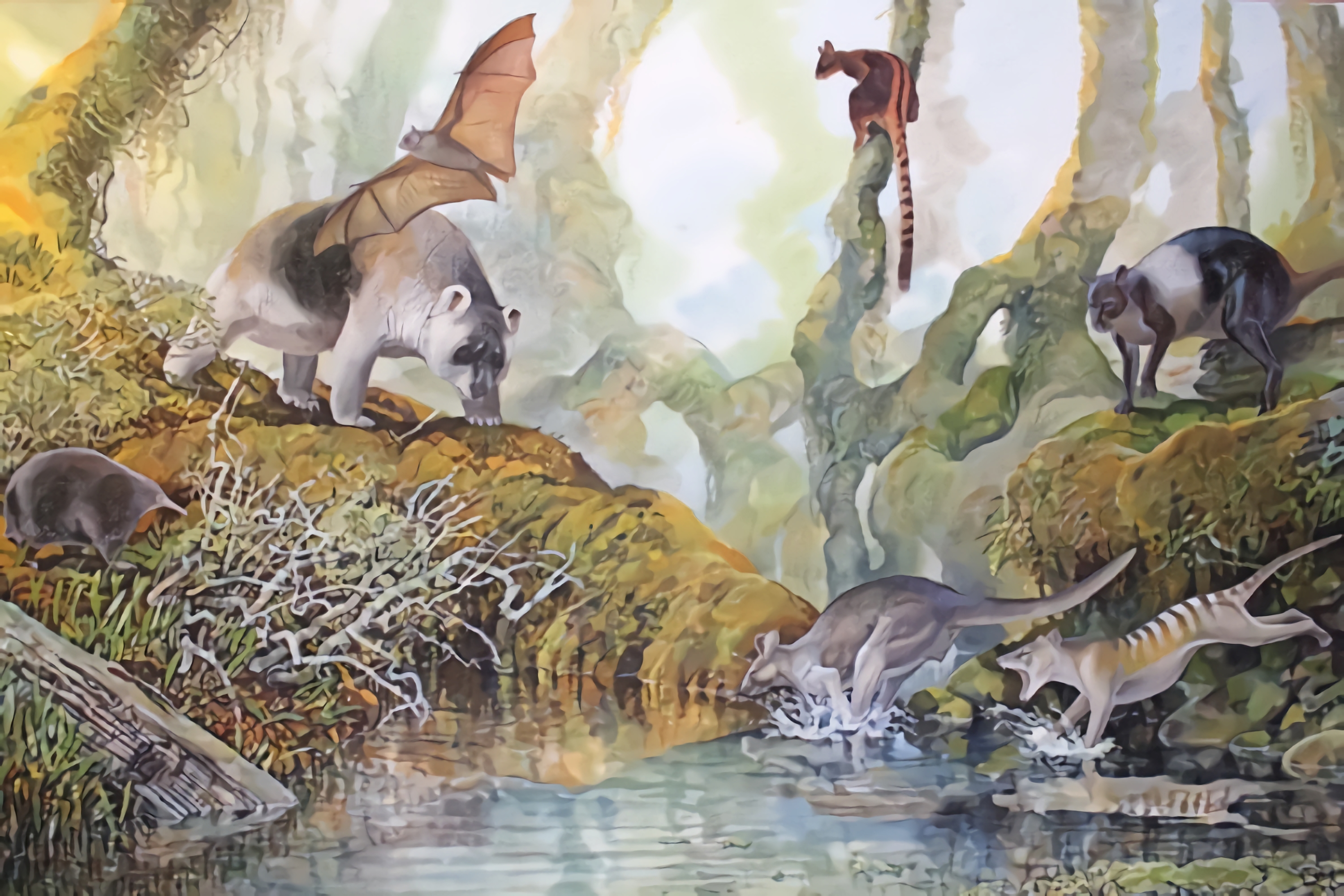
New Kangaroo Described from Papua New Guinea

Artist's impression of Nombe Rockshelter Megafauna, showing the Nombe kangaroo on the Right.
Image resized using AI by SFLORG
 Credit: Artwork Courtesy Peter Schouten

Australian paleontologists from Flinders University have described a new genus of giant fossil kangaroo from the mountains of central Papua New Guinea.

The new description of the fossil kangaroo has found that, rather than being closely related to Australian kangaroos, it most likely belongs to a unique genus of more primitive kangaroo found only in PNG.

The kangaroo, first described in 1983 by Professor Tim Flannery, is known from fossils around 20,000-50,000 years old. They come from the Nombe Rockshelter, an archaeological and paleontological site in Chimbu Province, Papua New Guinea.

Nombe is already known for multiple extinct species of kangaroo and giant four-legged marsupials called diprotodontids.

Flinders University researchers have renamed the animal Nombe nombe, after the location of its discovery – and plan to return to PNG for further excavations and research next year.

The squat, muscular Nombe lived in a diverse montane rainforest with thick undergrowth and a closed canopy. Here, it evolved to eat the tough leaves from trees and shrubs, with a thick jaw bone and strong chewing muscles.

Cancer drug shows potential as treatment for muscular dystrophy

Dr. Farshad Babaeijandaghi
Source UBC
Researchers at UBC’s School of Biomedical Engineering have discovered that an existing cancer drug could have potential as a treatment for muscular dystrophy.

The researchers found that the drug — known as a colony-stimulating factor 1 receptor (CSF1R) inhibitor — helped slow the progress of Duchenne muscular dystrophy in mice by increasing the resiliency of muscle fibers.

The findings were published today in Science Translational Medicine.

“This is a class of drug that is already being used in clinical trials to treat rare forms of cancer,” says Dr. Farshad Babaeijandaghi, a postdoctoral fellow at UBC and first author on the study. “To find that it could potentially serve a double purpose as a treatment for muscular dystrophy is incredibly exciting. It shows a lot of promise, and with further testing, could help extend and improve quality of life for patients.”

Duchenne muscular dystrophy (DMD) is a severe genetic disorder that leads to progressive muscle weakness and degeneration due to disruptions to the protein dystrophin, which helps keep muscle cells intact. It is the most common congenital disease in Canada, affecting about one out of every 3,500 males, and in rarer cases, females.

DMD symptoms typically appear in early childhood, with patients facing increased loss of muscle function as they age. As the disease progresses, many patients are forced to rely on mobility aids, such as a wheelchair, with the disease eventually impacting heart and lung function. While improvements in cardiac and respiratory care have increased life expectancy in recent decades, there is currently no cure.

New Organomineral Fertilizers Created in the Urals

A new type of fertilizer was created in the Ural.
Credit: Anastasia Mavrenkova

New organomineral fertilizers have been developed in the Ural. They are based on magnesium, sulfur, silicon, calcium and poultry manure. The manure contains organics (carbon), nitrogen, potassium, and phosphorus. These fertilizers are more effective than organic fertilizers and safer than mineral fertilizers. They can be used for growing plants and for soil regeneration. This is a new kind of fertilizer (analogues consist of peat and other mineral components), registered under the trademark "Organomin". With favorable developments, the production of fertilizers on an industrial scale will begin this year. Now the developer, the company Nika PetroTech, a member of the Ural Interregional Research and Education Center, is in the process of registering a patent, which they expect to receive in the fall.

"Often chicken droppings are used as organic fertilizer by the poultry farms themselves. They grow plants for birds and animals in the fields. However, there are two difficulties. Firstly, often manure is put in excessive amounts - 20-30 tons per hectare, which adversely affects the soil and groundwater. Secondly, since manure contains a large amount of pathogenic microflora, it takes up to six months to decompose. In our case, after adding the mineral component, the manure can be used in a day. Moreover, according to preliminary calculations, our fertilizer is not much needed for productive plant growth - no more than one ton per hectare," explains Sergey Yakovlev, Head of the Engineering and Technological Department of Nika PetroTech.

Physicists confront the neutron lifetime puzzle


To solve a long-standing puzzle about how long a neutron can “live” outside an atomic nucleus, physicists entertained a wild but testable theory positing the existence of a right-handed version of our left-handed universe. They designed a mind-bending experiment at the Department of Energy’s Oak Ridge National Laboratory to try to detect a particle that has been speculated but not spotted. If found, the theorized “mirror neutron” — a dark-matter twin to the neutron — could explain a discrepancy between answers from two types of neutron lifetime experiments and provide the first observation of dark matter.

“Dark matter remains one of the most important and puzzling questions in science — clear evidence we don’t understand all matter in nature,” said ORNL’s Leah Broussard, who led the study published in Physical Review Letters.

Neutrons and protons make up an atom’s nucleus. However, they also can exist outside nuclei. Last year, using the Los Alamos Neutron Science Center, co-author Frank Gonzalez, now at ORNL, led the most precise measurement ever of how long free neutrons live before they decay, or turn into protons, electrons and anti-neutrinos. The answer — 877.8 seconds, give or take 0.3 seconds, or a little under 15 minutes — hinted at a crack in the Standard Model of particle physics. That model describes the behavior of subatomic particles, such as the three quarks that make up a neutron. The flipping of quarks initiates neutron decay into protons.

Proteomics Reveals HDAC Inhibitor Off-Targets

Group Leader in Chemical Proteomics, Dr. Guillaume Médard, and his research group in the lab.
 Credit: Uli Benz / TUM

Scientific Frontline: Extended "At a Glance" Summary: Chemical Proteomics and HDAC Inhibitor Profiling

The Core Concept: Mass-spectrometry based chemical proteomics is a big-data analytical approach used to simultaneously monitor thousands of proteins, allowing researchers to discover the precise protein targets and unintended off-targets of small molecules like histone deacetylase (HDAC) inhibitors.

Key Distinction/Mechanism: Unlike conventional targeted assays that monitor single protein-drug interactions, chemical proteomics utilizes target deconvolution and customized affinity matrices to systematically profile a drug's binding activity across the entire proteome at once.

Major Frameworks/Components

  • Mass-Spectrometry Based Proteomics: The big-data science utilized to monitor the abundances of thousands of proteins simultaneously within a sample.
  • Target Deconvolution: A method using newly developed affinity matrices to systematically profile drug interactions and identify the actual proteins engaged by small molecules.
  • Epidrugs (HDAC Inhibitors): A specific class of oncology drugs designed to target and inhibit histone deacetylases.
  • MBLAC2: A previously obscure protein identified as an unintended off-target for approximately half of the profiled HDAC inhibitors.
  • Extracellular Vesicles (Exosomes): Small, membrane-bounded particles responsible for transmitting biomolecules between cells, which accumulate in the extracellular space when MBLAC2 is inhibited.

Research brings new light to unsolved genetic diseases in children

Asst Prof Xue and her team in NUS study the effects of maternal SMCHD1 gene mutations on offspring.
Source: National University of Singapore

The study highlights the role of genes inherited from mothers in genetic diseases in children, and improves the understanding of such diseases

The development of an embryo is a well-orchestrated string of processes, ensuring correct formation and positioning of vital organs of the growing organism. At the molecular level, these processes are controlled in a precise manner by switching on or off specific factors such as genes or proteins. Any errors in these processes could result in physical defects or disease in the newborn organism.

A team of scientists from the National University of Singapore (NUS) led by Assistant Professor Xue Shifeng from the Department of Biological Sciences has discovered a new way to interpret unsolved Mendelian diseases – diseases inherited from either parent due to gene mutations in the developing egg or sperm – through studying the inheritance of a protein known as SMCHD1 which is coded by the SMCHD1 gene. Mutations in the SMCHD1 gene can cause diseases such as facioscapulohumeral muscular dystrophy (FSHD) which is a muscle degenerative disorder, and Bosma arhinia microphthalmia syndrome (BAMS) which causes abnormalities of the nose and eyes.

The researchers found that SMCHD1 from mothers controls the expression of a group of genes in offspring, known as the HOX genes, which determines the position of body parts in an embryo along the axis from its head to tail. The researchers also found that the inactivation of SMCHD1 in female zebrafish results in alterations to HOX gene expression leading to skeletal defects in their offspring.

The study led by NUS researchers, in collaboration with A*STAR, Yale-NUS and Aix-Marseille University, was published in Nature Communications.

Student helps find world’s largest frog in Equatorial Guinea for first time in almost two decades

Left: Student Sam Hurley (left) with local guide Edu. Right: A goliath frog found in Monte Alén National Park, Equatorial Guinea
Source: University of Bristol

Field researchers from the University of Bristol and Bristol Zoological Society have found the world’s largest frog in Equatorial Guinea for the first time in almost two decades.

The most recent amphibian survey in the country’s Monte Alén National Park, which is one of the goliath frog's few known habitats, recorded no sign of it.

Goliath frogs can be as big as some housecats, measuring up to 34cm in length and weighing more than 3kg.

Concerned by the lack of recent evidence of the species in the national park, conservationists travelled to Equatorial Guinea to find evidence that the giant amphibian was not lost to the region.

Working in partnership with INDEFOR-AP, the national park service of Equatorial Guinea, the researchers conducted a survey along the Benito River.

Over 10 days in the forest, the researchers spotted the amphibian in a small waterfall. They had hoped to collect vocal recordings of the frog, however, the animal was not heard calling, perhaps confirming previous accounts that it is indeed a quiet, if not silent, amphibian. More study is needed.

Bernese researchers simulate defense of the earth

Info graphic which shows what effects the collision of DART could have on the orbit of Didymos B.
Credit: NASA / Johns Hopkins APL

NASA’s Double Asteroid Redirection Test (DART) mission is the world’s first full-scale planetary defense test against potential asteroid impacts on Earth. Researchers of the University of Bern and the National Centre of Competence in Research (NCCR) PlanetS now show that instead of leaving behind a relatively small crater, the impact of the DART spacecraft on its target could leave the asteroid near unrecognizable.

66 million years ago, a giant asteroid impact on the Earth likely caused the extinction of the dinosaurs. Currently no known asteroid poses an immediate threat. But if one day a large asteroid were to be discovered on a collision course with Earth, it might have to be deflected from its trajectory to prevent catastrophic consequences.

Last November, the DART space probe of the US space agency NASA was launched as a first full-scale experiment of such a manoeuvre: Its mission is to collide with an asteroid and to deflect it from its orbit, in order to provide valuable information for the development of such a planetary defense system.

In a new study published in The Planetary Science Journal, researchers of the University of Bern and the National Centre of Competence in Research (NCCR) PlanetS have simulated this impact with a new method. Their results indicate that it may deform its target far more severely than previously thought.

COVID-19 Fattens Up Our Body’s Cells to Fuel Its Viral Takeover

Illustration of a SARS-CoV-2 viral particle entering a cell. The particle pierces through a cell’s membrane, made of two layers of lipids.  A PNNL-OHSU team has shown how lipids are key to the ability of the virus to replicate.
Credit: Illustration by Michael Perkins | Pacific Northwest National Laboratory

The virus that causes COVID-19 undertakes a massive takeover of the body’s fat-processing system, creating cellular storehouses of fat that empower the virus to hijack the body’s molecular machinery and cause disease.

After scientists discovered the important role of fat for SARS-CoV-2, they used weight-loss drugs and other fat-targeting compounds to try to stop the virus in cell culture. Cut off from its fatty fuel, the virus stopped replicating within 48 hours.

The authors of the recent paper in Nature Communications caution that the results are in cell culture, not in people; much more research remains to see if such compounds hold promise for people diagnosed with COVID. But the scientists, from Oregon Health & Science University and the Department of Energy’s Pacific Northwest National Laboratory, call the work a significant step toward understanding the virus.

“This is exciting work, but it’s the start of a very long journey,” said Fikadu Tafesse, the corresponding author of the study and assistant professor of molecular microbiology and immunology at OHSU. “We have an interesting observation, but we have a lot more to learn about the mechanisms of this disease.”

Tuesday, June 28, 2022

How did vertebrates first evolve jaws?

A zebrafish showing the skeleton and jaw (magenta), the eye (green circle on the left), and gill-like pseudobranch and gills (green structures on the right).
Image resized using AI by SFLORG
Credit: Mathi Thiruppathy/Crump Lab

Five-hundred million years ago, it was relatively safe to go back in the water. That’s because creatures of the deep had not yet evolved jaws. In a new pair of studies in the journals eLife and Development, scientists reveal clues about the origin of this thrilling evolutionary innovation in vertebrates.

In the studies, Mathi Thiruppathy from Gage Crump’s laboratory at USC, and collaborator J. Andrew Gillis from the University of Cambridge and the Marine Biological Laboratory, looked to embryonic development as way to gain insight into evolution—an approach known as “evo-devo.”

In fishes, jaws share a common developmental origin with gills. During development, jaws and gills both arise from embryonic structures called “pharyngeal arches.” The first of these arches is called the mandibular arch because it gives rise to jaws, while additional arches develop into gills. There are also anatomical similarities: the gills are supported by upper and lower bones, which could be thought of as analogous to the upper and lower jaws.

“These developmental and anatomical observations led to the theory that the jaw evolved by modification of an ancestral gill,” said Thiruppathy, who is the eLife study’s first author and a PhD student in the Crump Lab. “While this theory has been around since the late 1800s, it remains controversial to this day.”

Highly antibiotic-resistant strain of MRSA that arose in pigs can jump to humans

Pig farm 
Credit: Mark Holmes

The strain, called CC398, has become the dominant type of MRSA in European livestock in the past fifty years. It is also a growing cause of human MRSA infections.

The study found that CC398 has maintained its antibiotic resistance over decades in pigs and other livestock. And it is capable of rapidly adapting to human hosts while maintaining this antibiotic resistance.

The results highlight the potential threat that this strain of MRSA poses to public health. It has been associated with increasing numbers of human infections, in people who have and have not had direct contact with livestock.

“Historically high levels of antibiotic use may have led to the evolution of this highly antibiotic resistant strain of MRSA on pig farms,” said Dr Gemma Murray, a lead author of the study, previously in the University of Cambridge’s Department of Veterinary Medicine and now at the Wellcome Sanger Institute.

She added: “We found that the antibiotic resistance in this livestock-associated MRSA is extremely stable – it has persisted over several decades, and also as the bacteria has spread across different livestock species.”

Rock art detection via machine learning model a breakthrough

A hypothetical example of possible rock art image detection on an image from Kakadu National Park.
 Source: Griffith University

Researchers have developed a way to detect the presence of rock art in remote, hard-to-reach areas in Australia’s rugged landscapes using Machine Learning (ML) methods.

Co-led by Dr Andrea Jalandoni, a digital archaeologist from Griffith University’s Centre for Social and Cultural Research, the study used hundreds of images of rock art found within Kakadu National Park to train a ML model to detect whether painted rock art was present within the image.

The model achieved an 89% success rate, meaning it determined which images contained rock art the vast majority of times.

“Some of these sites are not easily accessible, so alleviating some of the time, effort and expense to mount some explorative missions is of huge value to this type of archaeological research in some of the most remote areas of Australia,” Dr Jalandoni said.

“Once our ML model picks up whether an area photographed potentially contains previously undiscovered rock art, scientists can then go in and ground-truth the site to verify if there is rock art present and report on it further.”

Featured Article

What Is: Enteric Nervous System: The Second Brain

Scientific Frontline: Extended "At a Glance" Summary: The Enteric Nervous System (ENS) The Core Concept : The Enteric Nervous Syst...

Top Viewed Articles