. Scientific Frontline

Friday, July 1, 2022

Slow spin of early galaxy observed for the first time

The Atacama Large Millimeter/submillimeter Array (ALMA) by night
Credit: ALMA (ESO/NAOJ/NRAO)/B. Tafreshi (twanight.org)

One of the most distant known galaxies, observed in the very earliest years of the Universe, appears to be rotating at less than a quarter of the speed of the Milky Way today, according to a new study involving University of Cambridge researchers.

For the study, published in The Astrophysical Journal Letters, an international team of researchers analyzed data from a galaxy known as MACS1149-JD1 (JD1), obtained from observations by the Atacama Large Millimeter/submillimeter Array (ALMA), an assembly of radio telescopes in Chile.

The galaxy is so far away that its light comes to us from a time when the Universe was only 550 million years old – 4% of its present age.

The researchers, led by Tsuyoshi Tokuoka of Waseda University, found subtle variations in the wavelengths of the light indicating that parts of the galaxy were moving away from us while other parts were moving towards us. From these variations, they concluded that the galaxy was disc-shaped and rotating at a speed of 50 kilometers a second. By contrast, the Milky Way, at the Sun’s position, rotates with a speed of 220 kilometers per second today.

From the size of the galaxy and the speed of its rotation, the researchers were able to infer its mass, which in turn enabled them to confirm that it was likely 300 million years old and therefore formed about 250 million years after the Big Bang.

“This is by far the furthest back in time we have been able to detect a galaxy’s spin,” said co-author Professor Richard Ellis from University College London (UCL). “It allows us to chart the development of rotating galaxies over 96% of cosmic history – rotations that started slowly initially, but became more rapid as the Universe aged.

Thursday, June 30, 2022

Don’t Stress: Maternal Stress Affects Child’s Diet

Photo credit cottonbro
Maternal exposure to stress during pregnancy could have long term detrimental effects on their children’s diets, and thereby on health conditions related to diet – such as increased levels of obesity and obesity-related diseases – according to new research from Michele Belot, professor in the Department of Economics.

“Being exposed to stressful events when pregnant seems to impact the dietary preferences and diet of the children in a negative way, and for reasons that are actually aside from what the mother is eating herself,” says Belot, who has a joint appointment in the School of Industrial and Labor Relations and College of Arts and Sciences. “So that means that we need to think about how to help pregnant women manage stress in a way that could be beneficial for the mother and also for the child.”

In the paper, “Maternal stress during pregnancy and children’s diet: Evidence from a population of low socioeconomic status” published in the journal Nutrition, Belot and her co-authors found that higher than average stress during pregnancy is linked with significantly less healthy food preferences for their children, as well as a weaker preference for sour and bitter foods.

“Stress during pregnancy could have long-term detrimental effects on the next generation in terms of a less healthy diet and subsequent health implications associated with these effects, such as higher rates of obesity and obesity-related diseases,” wrote the authors, which include Nicoli Vitt (University of Bristol), Martina Vecchi (Penn State) and Jonathan James (University of Bath). “As a consequence, we advocate for more research into understanding the sources of maternal stress and the extent to which these can be altered. Prenatal care and preconception counseling could be critical to develop preventive strategies to improve public health.”

For the study, the researchers selected 213 mothers of low socioeconomic status living in the area of Colchester, United Kingdom, with children aged between 2- and 12-years old. Their stress level during pregnancy was assessed using retrospective self-reporting. Specifically, they asked whether mothers experienced one or more of the following life events during the pregnancy with their child: Death of close family member or close friend, changes or difficulties in their relationship, legal issues, changes or difficulties in their family life, health issues, changes or difficulties in their or their spouse’s employment, financial issues, changes in their habits, other potentially stressful events.

Shedding light on reptilian health: Researchers investigate origins of snake fungal disease in U.S.

Jason Ladner assistant professor at Northern Arizona University’s Pathogen and Microbiome Institute
Credit: Northern Arizona University

Although only recently recognized as an issue in wildlife ecology, snake fungal disease (SFD) is of emerging concern in the U.S., with parallels among other better-known wildlife fungal diseases such as white-nose syndrome in bats. SFD can be deadly to snakes, and even in milder cases disrupts an animal’s abilities to perform normal biological functions such as hibernation, eating and avoiding predators.

To better understand SFD, a team of researchers, including assistant professor Jason Ladner of Northern Arizona University’s Pathogen and Microbiome Institute, conducted a genetic study of the pathogen that was recently published in PLOS Biology, “The population genetics of the causative agent of snake fungal disease indicate recent introductions to the USA.”

Collaborating with study co-author Jeff Lorch of the U.S. Geological Survey (USGS) and other scientists from the USGS, Genencor Technology Center, the University of California-Riverside, Stetson University, the Institute of Zoology, the University of Kentucky and Holyoke Community College, Ladner’s goal was to determine whether SFD originated in the U.S. or was introduced from outside the country, which could provide a historical basis for how it emerged—and ultimately inform management of the disease.

“Snake fungal disease first came to be recognized in the U.S. around 2008. There happened to be a well-studied population of rattlesnakes in Illinois that started coming down with some very severe fungal infections. People asked, ‘OK, what is this thing? Where is it? What’s going on? Is this a new emerging fungal pathogen or not?’ Ladner said. “What they eventually found was that it was already almost everywhere, at least in the eastern half of the U.S.”

Hidden in caves: Mineral overgrowths reveal unprecedented modern sea-level rise

Professional divers assisted researchers by searching for mineral overgrowths in Mallorca, Spain cave systems.
Resized Image using AI by SFLORG
Source: University of South Florida

The early 1900s were an exciting time across the world, with rapid advances in the steel, electric and automobile industries. The industrial changes also mark an inflection point in our climate. According to an international team of researchers led by the University of South Florida (USF), the sea level has risen 18 centimeters since the start of the 20th century.

The study, featured on the cover of the July 1 issue of Science Advances, works to identify preindustrial sea levels and examines the impact of modern greenhouse warming on sea-level rise.

The team, which includes USF graduate students, traveled to Mallorca, Spain – home to more than 1,000 cave systems, some of which have deposits that formed millions of years ago. For this study, they focused on analyzing deposits from 4,000 years ago to present day.

Laser Creates a Miniature Magnetosphere

Direct observations of pure electron outflow in magnetic reconnection. Scientific Reports (a) Schematics of the experiment. By irradiating a plastic target with the Gekko XII laser, plasma flow is generated in the presence of a weak magnetic field. The weak magnetic field is distorted by the dynamic pressure of the plasma flow and the anti-parallel magnetic configuration is created. (b) The insert schematically shows that the elongated magnetic field reconnects and releases the magnetic field energy as the reconnection outflows. Pure electron outflows have been measured with CTS for the first time in laser-produced plasmas
Credit: 2022 K. Sakai et al.

Magnetic reconnections in laser-produced plasmas have been studied to understand the microscopic electron dynamics, which is applicable to space and astrophysical phenomena. Osaka University researchers, in collaboration with researchers at the National Institute for Fusion Science and other universities, have reported the direct measurements of pure electron outflows relevant to magnetic reconnection using a high-power laser, Gekko XII, at the Institute of Laser Engineering, Osaka University in Japan. Their findings are published in Scientific Reports.

Magnetic reconnection is a fundamental process in many space and astrophysical phenomena such as solar flares and magnetic substorms, where the magnetic energy is released as the plasma energy. It is known that electron dynamics plays essential roles in the triggering mechanism of magnetic reconnection. However, it has been highly challenging to observe the tiny electron scale phenomena in the vast universe.

Thus, the researchers have created situation-only electrons directly coupled with magnetic field in laser-produced plasmas. The so-called laboratory astrophysics allows one to access the miniature universe.

Some Viruses Make You Smell Tastier to Mosquitoes

Certain smells can attract mosquitoes to human beings, including smells caused by the dengue and Zika viruses. 
Photo credit: by Pixabay

Zika and dengue fever viruses alter the scent of mice and humans they infect, researchers report in the June 30 issue of Journal Cell. The altered scent attracts mosquitoes, which bite the host, drink their infected blood, and then carry the virus to its next victim.

Dengue is spread by mosquitoes in tropical areas around the world, and occasionally in subtropical areas such as the southeastern US. It causes fever, rash, and painful aches, and sometimes hemorrhage and death. More than 50 million dengue cases occur every year, and about 20,000 deaths, most of them in children, according to the National Institutes of Health (NIH) National Institute for Allergy and Infectious Disease.

Zika is another mosquito-spread viral disease in the same family as dengue. Although it is uncommon for Zika to cause serious disease in adults, a recent outbreak in South America caused serious birth defects in the unborn children of infected pregnant women. Yellow fever, Japanese encephalitis, and West Nile are also members of this virus family.

These viruses require ongoing infections in animal hosts as well as mosquitoes in order to spread. If either of these are missing—if all the susceptible hosts clear the virus, or all the mosquitoes die—the virus disappears. For example, during the yellow fever outbreak in Philadelphia in 1793, the coming of the fall frosts killed the local mosquitoes, and the outbreak ended.

A tool that can detect ancient life on Earth and beyond

Biofinder detection of biological resides in fish fossil. (a) White light image of a Green River formation fish fossil, Knightia sp., from a distance of 50 cm using the Biofinder without laser excitation. (b) Fluorescence image of the fish fossil obtained by the Biofinder using a single laser pulse excitation, 1 µs detection time, and 3.6% gain on the CMOS detector. (c) Close-up white light image of the fish fossil cross-section using a 10× objective with 54 mm working distance showing the fish remains and rock matrix. (d) Fluorescence image with a single laser pulse excitation showing strong bio-fluorescence from the fish remains. 
Photo credit: Misra, et al.

An innovative scientific instrument developed by University of Hawaiʻi at Mānoa researchers is expected to be a game changer in the search for life—existing or extinct—on Earth and other planets.

The instrument, called a Compact Color Biofinder, uses specialized cameras to scan large areas for fluorescence signals of biological materials like amino acids, fossils, sedimentary rocks, plants, microbes, proteins and lipids. The instrument has been successfully used to detect these bio-residues in fish fossils from the 34–56 million-year-old Green River rock formation located in Colorado, Wyoming and Utah.

The findings are published in Nature Scientific Reports.

“The Biofinder is the first system of its kind,” said Anupam Misra, lead instrument developer and researcher at the Hawaiʻi Institute of Geophysics and Planetology at UH Mānoa’s School of Ocean and Earth Science and Technology. “At present, there is no other equipment that can detect minute amounts of bio-residue on a rock during the daytime. Additional strengths of the Biofinder are that it works from a distance of several meters, takes video and can quickly scan a large area.”

Wildfires May Have Sparked Ecosystem Collapse During Earth’s Worst Mass Extinction

Credit: Victor O. Leshyk During the worst mass extinction event in Earth’s history, vast wetlands suffered increased wildfires, turning the world’s largest carbon sinks into carbon sources.
Resized Image using AI by SFLORG
Credit: Victor O. Leshyk 

Researchers at University College Cork (UCC) and the Swedish Museum of Natural History examined the end-Permian mass extinction (252 million years ago) that eliminated almost every species on Earth, with entire ecosystems collapsing. The researchers discovered a sharp spike in wildfire activity from this most devastating of mass extinctions. Promoted by rapid greenhouse gas emissions from volcanoes, extreme warming and drying led to wildfires across vast regions that were previously permanently wet. Instead of capturing carbon from the atmosphere, these wetlands became major sources of atmospheric carbon, enhancing the sharp warming trend. The research is published in PALAIOS today (30th June).

Fossils examined in eastern Australia & Antarctica

By studying fossil plant and charcoal records of the Sydney & Bowen basins in eastern Australia and Antarctica (Lambert Graben), the researchers discovered that the wetlands were regularly disturbed by fires leading up to the extinction event. In response, the plants had evolved a range of fire-coping mechanisms. However, the severe climate change and peak in fire activity during the extinction event seems to have pushed even these fire-adapted plants over a tipping point, from which the entire ecosystem could not recover for millions of years.

“Sifting through the fossil plant records of eastern Australia and Antarctica, we found high abundances of burnt, or charcoalified, plants throughout the late Permian Period. From this high baseline, charcoal abundances reached a prominent peak right at the top of the last Permian coal beds, indicating a major but short-lived increase in wildfires. This was followed by low charcoal for the next three million years of the Early Triassic Period. It was an end-Permian burnout, followed by an Early Triassic depression” comments Dr Chris Mays, Lecturer in Paleontology at University College Cork (UCC) and lead author of the study.

Earth on a path to a similar mass extinction?

The researchers highlight that in today’s world, wildfires have caused shocking mass animal die-offs in several regions around the world (e.g. California 2018, 2020, Australia 2019-20). Over the same time, our warming global climate has led to prolonged droughts and increased wildfires in typically wet habitats, such as the peat forests of Indonesia and the vast Pantanal wetlands of South America. These major ‘carbon sinks’―regions of natural capture of carbon from the atmosphere―are crucial in our fight against climate change. As the fossil record reveals, without these regions of carbon capture, the world can stay intolerably warm for hundreds of millennia.

“The potential for wildfires as a direct extinction driver during hyperthermal events, rather than a symptom of climatic changes deserves further examination. Unlike the species that suffered the mass extinctions of the past, we have the opportunity to prevent the burning of the world’s carbon sinks and help avoid the worst effects of modern warming” comments Dr Mays.

Source/Credit: Coláiste na hOllscoile Corcaigh (University College Cork)

en063022_03

Scientists find trigger that sets off metastasis in pancreatic cancer

Scientists have found that cancers in the pancreas (left) readily metastasize because these tumors suppress levels of an enzyme, MSRA, that pulls oxygen atoms off amino acids called methionine. As MSRA levels decrease, methionines on proteins become more oxidized. This causes one particular protein to rev up energy production in the tumor, promoting the migration of cancer cells to other organs. Metastatic tumors on the liver (right) lead to rapid death.
Image courtesy of Christopher Chang, UC Berkeley, and Christine Chio, Columbia

Pancreatic cancer, though rare, is one of the deadliest of cancers, killing nearly 50,000 people yearly and doing so quickly, primarily because it metastasizes rapidly through the body. Barely one in 10 people survive beyond five years.

But a discovery by chemists at the University of California, Berkeley, suggests a new way to slow or stop metastatic spread of pancreatic and perhaps other cancers.

In last week’s issue of the journal Molecular Cell, Christopher Chang and his group at UC Berkeley, collaborating with Christine Chio’s team at Columbia University in New York, report that metastasis is triggered by the loss of an enzyme that repairs oxygen damage to proteins.

Without this enzyme to erase the oxidative damage, one particular protein in cancer cells goes on to rev up energy production and seed new cancers around the body. The researchers confirmed this by knocking down levels of the “eraser” enzyme in mice and in cultured mouse and human cells, or organoids. In both cases, this promoted the migration of cancer cells and metastatic spread.

How bacteria adhere to cells: Basis for the development of a new class of antibiotics

Adhesion of Bartonella henselae (blue) to human blood vessel cells (red). The bacterium's adhesion to the host cells could be blocked with the help of what are known as “anti-ligands".
Credit: Goethe University

Researchers from University Hospital Frankfurt and Goethe University Frankfurt have unraveled how bacteria adhere to host cells and thus taken the first step towards developing a new class of antibiotics.

The adhesion of bacteria to host cells is always the first and one of the decisive steps in the development of infectious diseases. The purpose of this adhesion by infectious pathogens is first to colonize the host organism (i.e., the human body), and then to trigger an infection, which in the worst case can end fatally. Precise understanding of the bacteria's adhesion to host cells is a key to finding therapeutic alternatives that block this critical interaction in the earliest possible stage of an infection.

The hawk has landed: braking mid-air to prioritize safety over energy or speed

A Harris hawk braking in mid-air before perching.
Resized image using AI by SFLORG
Credit: Rob Bullingham

New research from the Oxford Flight Group using computer simulations and Hollywood-style motion capture shows how birds optimize their landing maneuvers for an accurate descent.

Researchers at the University of Oxford have found that hawks control their flight to ensure the safest landing conditions when perching, even if it takes longer and more energy to do so. Understanding how birds optimize their landing maneuvers through learning may help in developing small aircraft capable of perching like birds.

In new research published in Nature, four Harris’ hawks wearing tiny retroreflective markers were tracked flying back and forth between two perches. Their precise movements were recorded by 20 motion capture cameras positioned around the room, allowing the research team to reconstruct their flight paths on over 1,500 flights. The research team then used computer simulations to understand why the birds chose their particular path to the perch.

Aircraft have the luxury of using a runway for braking after landing to reduce speed. In contrast, birds must brake before they arrive at the perch – however slowing down to a safe speed while in flight risks stall, leading to a sudden loss of flight control. The researchers discovered that the hawks follow a flight path that slows them down to a safe speed but minimizes the distance from the perch at which they stall.

Wednesday, June 29, 2022

Shrimps and worms among first animals to recover after largest mass extinction

Reconstructed sea bed scenes (A) Pre-extinction, (B-D) Induan (early Early Triassic), (E) Smithian, (F) Spathian
Credit: Yaqi Jiang

Researchers studying ancient sea bed burrows and trails have discovered that bottom burrowing animals were among the first to bounce back after the end-Permian mass extinction.

In a new study, published today in the journal Science Advances, researchers from China, the USA and the UK, reveal how life in the sea recovered from the event, which killed over 90 percent of species on Earth, from their observations of trace fossils.

Life was devastated by the end-Permian mass extinction 252 million years ago, and recovery of life on Earth took millions of years for biodiversity to return to pre-extinction levels. But by examining trails and burrows on the South China sea bed, the international team were able to piece together sea life’s revival by pinpointing what animal activity was happening when.

Professor Michael Benton from the University of Bristol’s School of Earth Sciences, a collaborator on the new paper, said: “The end-Permian mass extinction and the recovery of life in the Early Triassic are very well documented throughout South China.

“We were able to look at trace fossils from 26 sections through the entire series of events, representing seven million crucial years of time, and showing details at 400 sampling points, we finally reconstructed the recovery stages of all animals including benthos, nekton, as well as these soft-bodied burrowing animals in the ocean.”

Falling stardust, wobbly jets explain blinking gamma ray bursts

A close-up view of the disk (in orange) tilting, causing the jets (in purple) to wobble.
Credit: Ore Gottlieb/Northwestern University

A Northwestern University-led team of astrophysicists has developed the first-ever full 3D simulation of an entire evolution of a jet formed by a collapsing star, or a “collapsar.”

Because these jets generate gamma ray bursts (GRBs) — the most energetic and luminous events in the universe since the Big Bang — the simulations have shed light on these peculiar, intense bursts of light. Their new findings include an explanation for the longstanding question of why GRBs are mysteriously punctuated by quiet moments — blinking between powerful emissions and an eerily quiet stillness. The new simulation also shows that GRBs are even rarer than previously thought.

The new study was published today (June 29) in Astrophysical Journal Letters. It marks the first full 3D simulation of the entire evolution of a jet — from its birth near the black hole to its emission after escaping from the collapsing star. The new model also is the highest-ever resolution simulation of a large-scale jet.

“These jets are the most powerful events in the universe,” said Northwestern’s Ore Gottlieb, who led the study. “Previous studies have tried to understand how they work, but those studies were limited by computational power and had to include many assumptions. We were able to model the entire evolution of the jet from the very beginning — from its birth by a black hole — without assuming anything about the jet’s structure. We followed the jet from the black hole all the way to the emission site and found processes that have been overlooked in previous studies.”

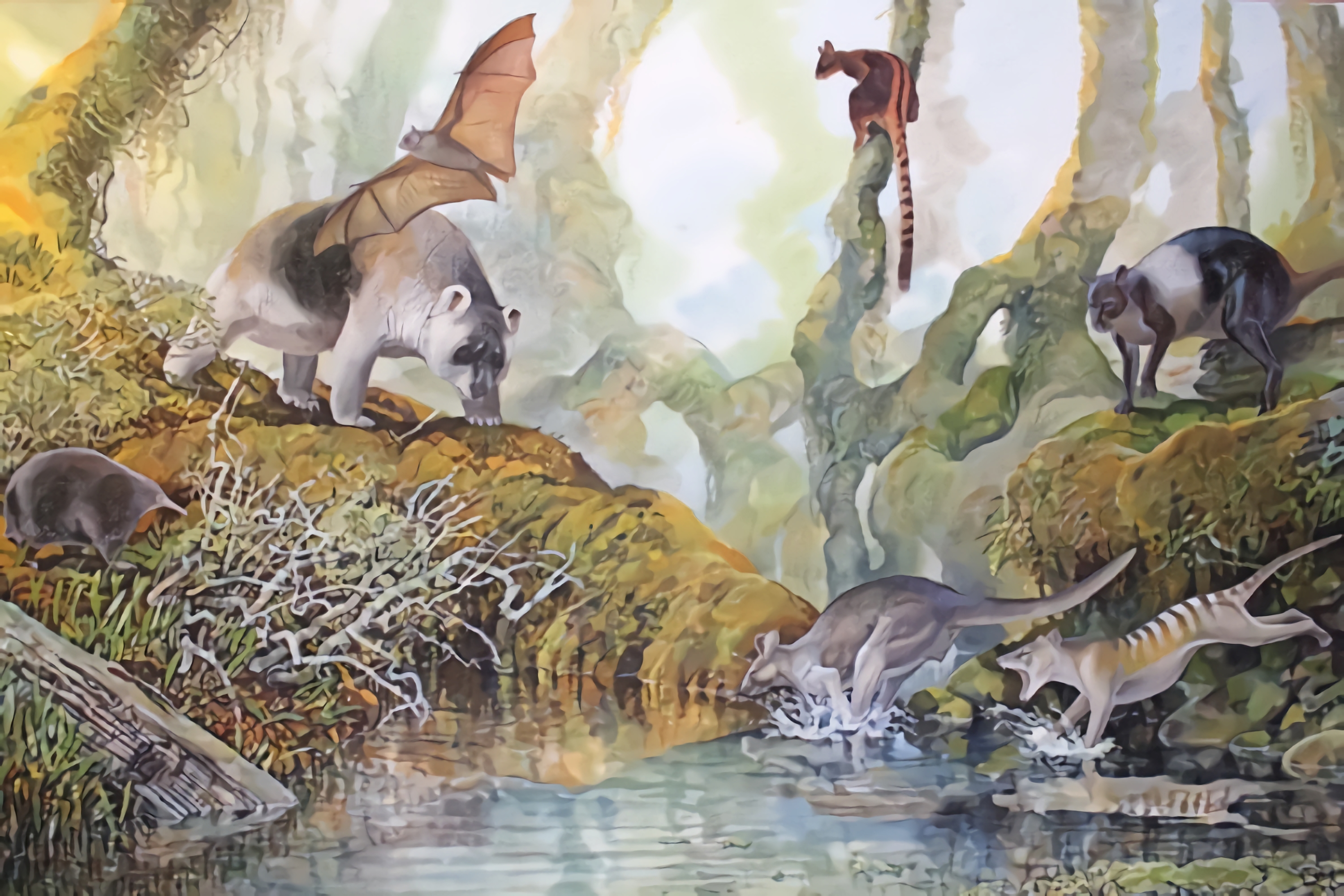
New Kangaroo Described from Papua New Guinea

Artist's impression of Nombe Rockshelter Megafauna, showing the Nombe kangaroo on the Right.
Image resized using AI by SFLORG
 Credit: Artwork Courtesy Peter Schouten

Australian paleontologists from Flinders University have described a new genus of giant fossil kangaroo from the mountains of central Papua New Guinea.

The new description of the fossil kangaroo has found that, rather than being closely related to Australian kangaroos, it most likely belongs to a unique genus of more primitive kangaroo found only in PNG.

The kangaroo, first described in 1983 by Professor Tim Flannery, is known from fossils around 20,000-50,000 years old. They come from the Nombe Rockshelter, an archaeological and paleontological site in Chimbu Province, Papua New Guinea.

Nombe is already known for multiple extinct species of kangaroo and giant four-legged marsupials called diprotodontids.

Flinders University researchers have renamed the animal Nombe nombe, after the location of its discovery – and plan to return to PNG for further excavations and research next year.

The squat, muscular Nombe lived in a diverse montane rainforest with thick undergrowth and a closed canopy. Here, it evolved to eat the tough leaves from trees and shrubs, with a thick jaw bone and strong chewing muscles.

Cancer drug shows potential as treatment for muscular dystrophy

Dr. Farshad Babaeijandaghi
Source UBC
Researchers at UBC’s School of Biomedical Engineering have discovered that an existing cancer drug could have potential as a treatment for muscular dystrophy.

The researchers found that the drug — known as a colony-stimulating factor 1 receptor (CSF1R) inhibitor — helped slow the progress of Duchenne muscular dystrophy in mice by increasing the resiliency of muscle fibers.

The findings were published today in Science Translational Medicine.

“This is a class of drug that is already being used in clinical trials to treat rare forms of cancer,” says Dr. Farshad Babaeijandaghi, a postdoctoral fellow at UBC and first author on the study. “To find that it could potentially serve a double purpose as a treatment for muscular dystrophy is incredibly exciting. It shows a lot of promise, and with further testing, could help extend and improve quality of life for patients.”

Duchenne muscular dystrophy (DMD) is a severe genetic disorder that leads to progressive muscle weakness and degeneration due to disruptions to the protein dystrophin, which helps keep muscle cells intact. It is the most common congenital disease in Canada, affecting about one out of every 3,500 males, and in rarer cases, females.

DMD symptoms typically appear in early childhood, with patients facing increased loss of muscle function as they age. As the disease progresses, many patients are forced to rely on mobility aids, such as a wheelchair, with the disease eventually impacting heart and lung function. While improvements in cardiac and respiratory care have increased life expectancy in recent decades, there is currently no cure.

Featured Article

What Is: Abyssopelagic Zone

A master of abyssopelagic survival, the anglerfish overcomes absolute darkness and sparse food supplies with a specialized, light-producing ...

Top Viewed Articles